Hot and cold things (Heat)
Watch this topic in 60 seconds
Free preview · Lesson 1
Understanding Hot and cold things (Heat)
Exploring Hot and Cold Things (Heat!)
Hello, young scientists! Today, we're going on an exciting adventure to understand something we feel every single day: hot and cold! Think about it – what feels warm and what feels chilly? Let's dive in!
What is 'Hot'?
Imagine you're holding a mug of delicious hot cocoa on a cold winter day. Mmm, that warmth feels so good, right? Or think about the sun shining brightly in the sky – its rays feel warm on your skin. That's 'hot'!
When something is hot, it means it has a lot of something called heat energy. Don't worry, it's not a scary word! Think of heat energy like tiny, invisible dancers inside everything. When these dancers move very, very fast, they make things feel hot! The faster they dance, the hotter something gets.
Here are some things that are hot:
- A freshly baked cookie straight from the oven.
- A warm bath.
- The flame from a candle or a campfire.
- The sand on a beach on a sunny day.
- A toaster making your bread crunchy.
Safety Tip: Remember, some things can be VERY hot, like a stove or a steaming kettle. Always ask a grown-up for help and be careful not to touch things that are too hot, as they can hurt you!
What is 'Cold'?
Now, let's think about the opposite! What about a yummy ice cream cone on a hot summer day? Or stepping outside when it's snowing? That chilly feeling is 'cold'!
When something is cold, it means those tiny, invisible dancers inside it are moving much slower. They don't have as much heat energy. The slower they dance, the colder something feels.
Here are some things that are cold:
- Ice cubes in your drink.
- Snowflakes falling from the sky.
- Water straight from the cold tap.
- Food from the refrigerator.
- A refreshing glass of lemonade.
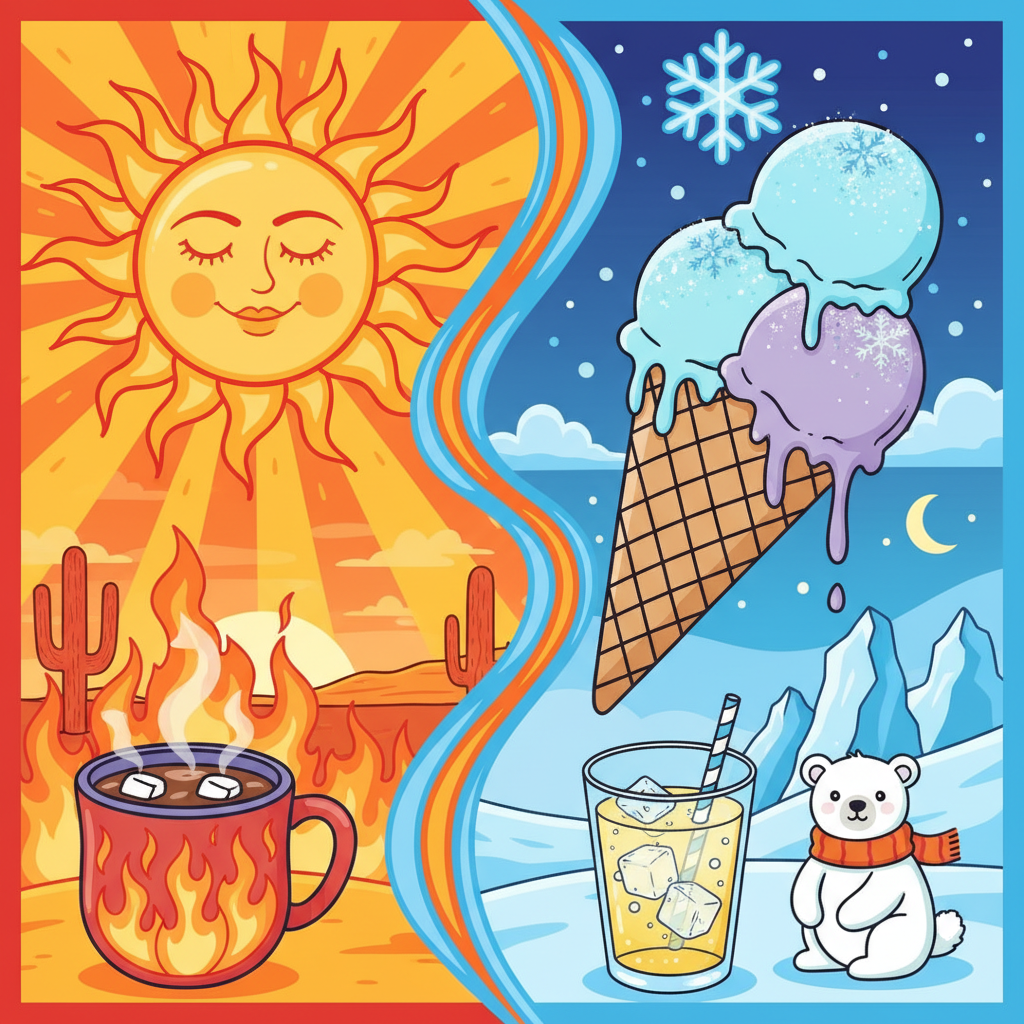 ⚠️ This picture may have spelling mistakes. Trust the words in the lesson.
What is Heat? (The Superstar!)
We've talked about hot and cold, but what makes something hot in the first place? It's that invisible dancer we talked about – Heat!
Heat is a special kind of energy. It's what makes hot things hot and helps to make cold things warmer. Think of heat as a tiny invisible push or pull that can move from one place to another. It always wants to move from hotter places to colder places, like how water always flows downhill.
How Do Things Get Hot? Where Does Heat Come From?
Heat comes from many different places! Let's explore some of them:
-
The Sun: Our Giant Heater!
The biggest and most important source of heat on Earth is the sun! It's like a giant, super-powerful light bulb and heater in the sky. Its light and warmth travel all the way to us, making our planet warm enough for plants, animals, and us to live!
-
Fire: A Fiery Friend (and Foe!)
When wood burns in a campfire, or a candle burns, it releases a lot of heat. Fire is made when things like wood, paper, or gas burn. It's a great way to stay warm, cook food, or light up the dark. But remember, fire can also be dangerous, so always have a grown-up nearby when you see a fire!
-
Rubbing Things Together (Friction):
Try this: rub your hands together very fast for a few seconds. What do you feel? They get warm, right? That's because when two things rub against each other, they create heat. This is called friction. It's like your hands are doing a super-fast dance, and that dance creates heat!
-
Electricity: Making Things Work!
Many appliances in our homes use electricity to make heat. For example, a toaster uses electricity to make heat that toasts your bread. An electric heater uses electricity to warm up a room. It's like electricity is an invisible chef cooking up heat!
How Do Things Get Cold? (Taking Heat Away!)
Instead of adding heat, making things cold often means taking heat away! It's like giving those fast-dancing heat particles a little time-out.
-
Refrigerators and Freezers: Heat Vacuums!
Your refrigerator doesn't *add* cold; it works like a special machine that takes the heat OUT of your food and drinks and pushes it outside. It's like a vacuum cleaner for heat!
-
Melting Ice: A Heat Sponge!
When you put ice in a warm drink, the ice starts to melt. But why? Because the ice is 'drinking up' the heat from your warm drink! The ice needs heat to change from a solid (ice) to a liquid (water). As it drinks the heat, your drink gets colder!
-
Evaporation: The Cooling Trick!
When water turns into an invisible gas called water vapor, it's called evaporation. When water evaporates from your skin (like sweat on a hot day), it takes heat with it, making you feel cooler. It's like the water is a tiny superhero flying away with your extra heat!
Measuring Hot and Cold: The Thermometer!
How do we know exactly how hot or cold something is? We use a special tool called a thermometer!
A thermometer is like a ruler for heat. It has numbers on it, and usually a red or silver line inside. When it gets hotter, the line goes up! When it gets colder, the line goes down! The numbers tell us the temperature.
We measure temperature in something called 'degrees'. You might hear 'degrees Celsius' or 'degrees Fahrenheit'. Don't worry too much about the big words for now, just know that a thermometer helps us measure exactly how hot or cold something is.
Review Time!
So, we've learned that hot things have a lot of heat energy (fast dancers!), and cold things have less heat energy (slow dancers!). Heat is energy that can move from one place to another, making things warm. We find heat from the sun, fire, rubbing things, and electricity. We can also make things cold by taking heat away, like with a refrigerator or melting ice. And we use a thermometer to measure how hot or cold something is!
Keep exploring the world around you, and notice all the amazing hot and cold things you find every day!
Keep learning, free
Create a free Syllabax account to unlock practice questions and games for this topic.
Visual Learning Enhanced! 🚀
To help you master this topic, we use Advanced Syllabax AI to generate detailed diagrams and visual models.
Note on Visuals: The AI sometimes makes spelling errors in image labels. Please refer to the lesson text for the correct terminology.