Tally marks (Data Handling)
Watch this topic in 60 seconds
Free preview · Lesson 1
Understanding Tally marks (Data Handling)
Tally Marks: Keeping Track of Things!
Imagine you're at a fun fair, and you're selling delicious popcorn! Lots of people want to buy it. How can you keep track of how many bags of popcorn you've sold without getting confused? That's where our special tool, **tally marks**, comes in handy! Tally marks are like a secret code or a quick way to count things, especially when lots of things are happening at once.
What are Tally Marks?
Tally marks are simple lines that we use to count. Think of them like little soldiers standing in a row. Each soldier represents one item we've counted.
- One item? We make one line: |
- Two items? We make two lines: ||
- Three items? We make three lines: |||
- Four items? We make four lines: ||||
But what happens when we have five items? This is where the magic happens! Instead of making five lines, we group them. We draw a line diagonally across the four lines. This makes a little **gate** or a **bundle**.
- Five items? We make a gate: |||| (or just ////, which is easier to see!)
This gate makes it super easy to count. Instead of counting one by one, we can just look at the gate and instantly know it's 5!
Why Use Tally Marks?
Tally marks are like a superhero for counting! They help us:
- Count quickly: When things are happening fast, like at the popcorn stand, tally marks let us mark each sale quickly without stopping to add numbers.
- Stay organized: Instead of a jumbled mess of numbers, tally marks group things neatly.
- Avoid mistakes: The gate system helps us group by fives, making it harder to miscount.
Counting Tally Marks: The Bundle Method
Remember our popcorn selling? Let's say you sold 7 bags. How would you use tally marks?
First, you make your gate for the first 5 bags:
||||
Then, you have 2 more bags to count. You start a new set of lines for these:
|||| ||
To count this, you look at the gate and know it's 5. Then you count the extra lines: 1, 2. So, 5 + 2 = 7 bags!
Let's try another one. What if you sold 12 bags of popcorn?
You make your first gate for 5:
||||
You make your second gate for the next 5 (that's 10 bags total):
|||| ||||
You've sold 2 more bags (10 + 2 = 12). So you add two more lines:
|||| |||| ||
To count, you see two gates (5 + 5 = 10) and two extra lines (10 + 2 = 12). Easy peasy!
Tally Marks in Action: Examples
Tally marks are used everywhere! Imagine a teacher wants to know how many students have a pet dog, a pet cat, a pet fish, or no pet.
Dogs: |||| |||| || (This means 5 + 5 + 2 = 12 students have dogs.)
Cats: |||| |||| (This means 5 + 5 = 10 students have cats.)
Fish: | (This means 1 student has a fish.)
No Pet: |||| (This means 5 students have no pets.)
See how neat that looks? It's much faster to count this way than having a long list of names!
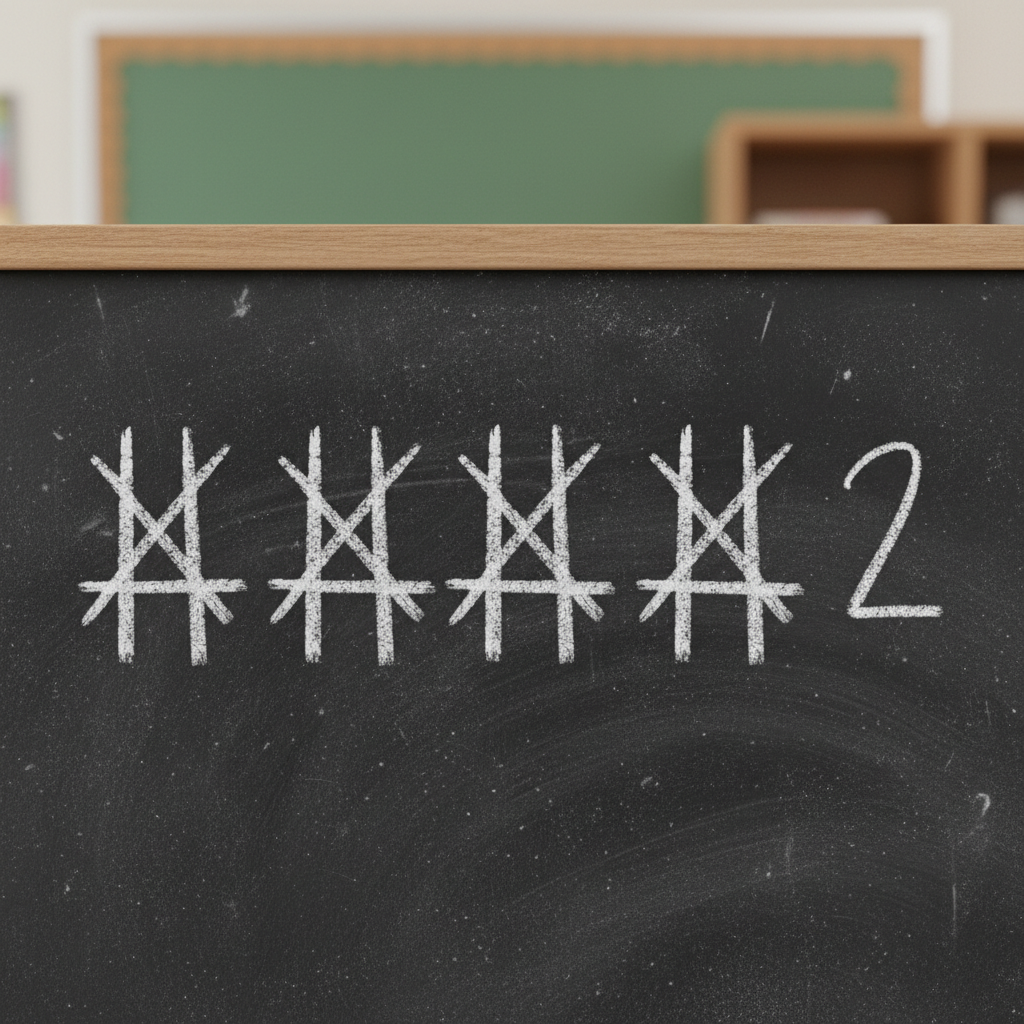
Let's Practice Counting
Look at these tally marks. How many do they represent?
Example 1: |||| |||| |||| (Count the gates: 3 gates = 15. Count the extra lines: 3 lines. Total: 15 + 3 = 18)
Example 2: |||| |||| || (Count the gates: 2 gates = 10. Count the extra lines: 2 lines. Total: 10 + 2 = 12)
Example 3: |||| (This is just one gate, which means 5!)
When are Tally Marks Most Useful?
Tally marks are perfect for situations where you need to count things as they happen. Think about:
- Counting how many times a certain letter appears in a book.
- Keeping score in a game.
- Counting the different types of cars that pass your house.
- Recording how many students choose pizza or sandwiches for lunch.
They are a simple, effective way to collect data – that's just a fancy word for information!
Keep learning, free
Create a free Syllabax account to unlock practice questions and games for this topic.
Visual Learning Enhanced! 🚀
To help you master this topic, we use Advanced Syllabax AI to generate detailed diagrams and visual models.
Note on Visuals: The AI sometimes makes spelling errors in image labels. Please refer to the lesson text for the correct terminology.