Learning Journey
Free preview · Lesson 1
Understanding Composite shapes (Area & Perimeter)
Welcome to the World of Composite Shapes!
Imagine you're building with LEGOs. You don't just build with single bricks; you connect them to make bigger, more interesting structures like houses, cars, or spaceships. In math, we have something similar called composite shapes. Just like your LEGO creations are made from many basic bricks, composite shapes are figures made up of two or more simple geometric shapes joined together.
This lesson is all about understanding these 'LEGO creations' in geometry. We'll learn how to find their area (the space they cover, like how much paint you'd need for your LEGO house walls) and their perimeter (the total distance around their outside edge, like the length of a fence you'd put around your LEGO yard).
Refresher: Basic Shapes - Your Geometric Building Blocks
Before we jump into composite shapes, let's quickly review the heroes of basic geometry. You've met these before!
-
Rectangle: A four-sided shape with four right angles. Opposite sides are equal.
- Area: Length × Width (
A = L × W). Think of covering a rectangular floor with tiles. - Perimeter: 2 × (Length + Width) (
P = 2(L + W)). Think of the trim around that floor.
- Area: Length × Width (
-
Square: A special type of rectangle where all four sides are equal.
- Area: Side × Side (
A = s²). - Perimeter: 4 × Side (
P = 4s).
- Area: Side × Side (
-
Triangle: A three-sided shape.
- Area: ½ × Base × Height (
A = ½bh). This is like cutting a rectangle in half diagonally!
- Area: ½ × Base × Height (
-
Circle: A perfectly round shape.
- Area: π × Radius × Radius (
A = πr²). Imagine the space covered by a round pizza. - Circumference (Perimeter): 2 × π × Radius (
C = 2πr) or π × Diameter (C = πd). This is the 'crust' of the pizza.
- Area: π × Radius × Radius (
What Exactly Are Composite Shapes?
As we said, composite shapes are like geometric Frankenstein monsters – but in a good way! They are created by combining (or sometimes, removing) simpler shapes. Think of a house: it often has a rectangular base and a triangular roof. That's a composite shape!
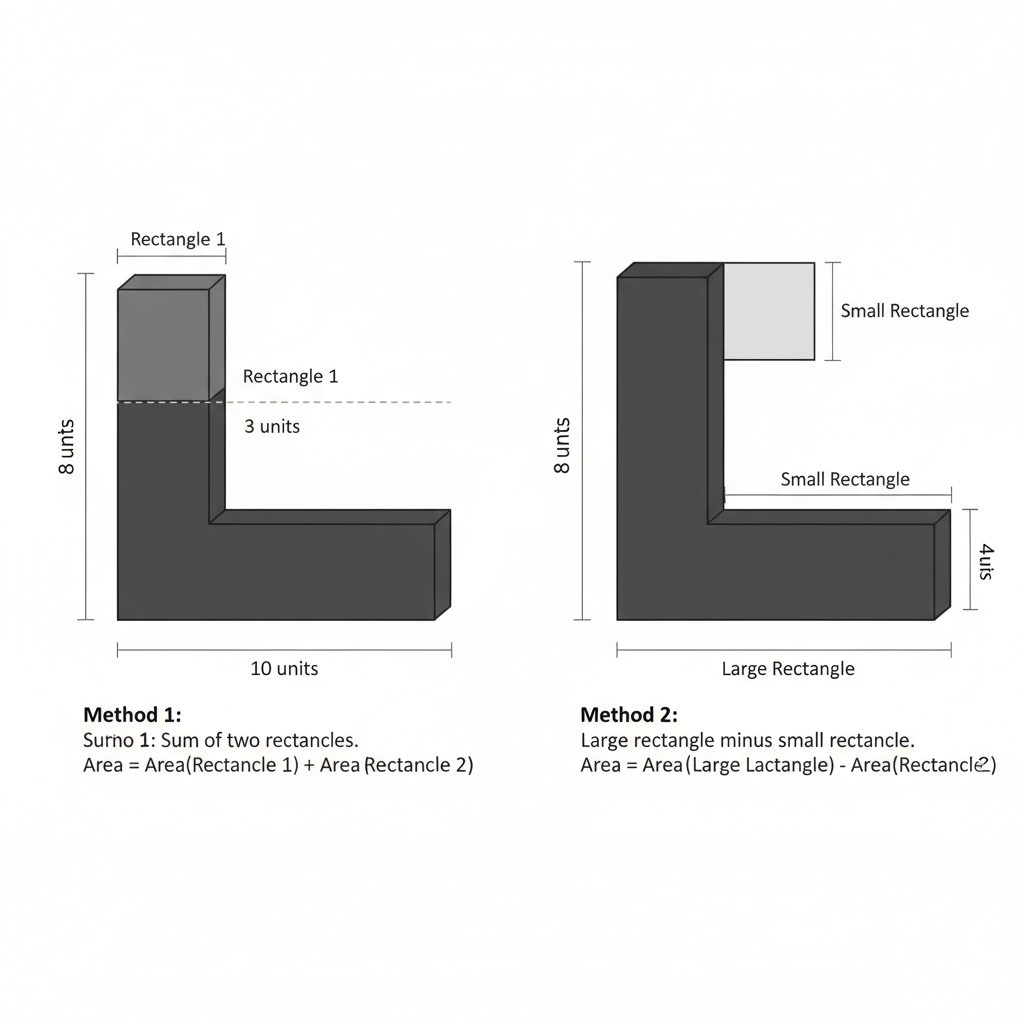
Here's an example to visualize this:
 ⚠️ This picture may have spelling mistakes. Trust the words in the lesson.
In this image, you see an 'L-shaped' figure. Can you spot the simpler shapes hiding within it?
Calculating the Area of Composite Shapes
Finding the area of a composite shape is like solving a puzzle. You have two main strategies:
Strategy 1: Decomposition (Breaking Down)
This is like cutting a complicated cake into simpler slices that you know how to measure. You break the composite shape into the basic shapes you recognize (rectangles, squares, triangles, etc.). Then, you find the area of each individual piece and add them all together.
Example: Imagine an L-shaped room. You can't just multiply length by width for the whole thing. But you *can* draw a line to split it into two rectangles. Find the area of the first rectangle, then the area of the second, and finally, add those two areas together to get the total area of the room.
Steps:
- Divide: Draw imaginary (or real!) lines to break the composite shape into basic shapes.
- Calculate: Find the area of each smaller, simpler shape using the formulas you know.
- Add: Sum up all the individual areas to get the total area of the composite shape.
Strategy 2: Subtraction (Cutting Out)
Sometimes, it's easier to think of a composite shape as a larger, simpler shape with a piece 'cut out' of it. Think of a donut: it's a big circle with a smaller circle removed from the middle. Or imagine a backyard that's a perfect rectangle, but you've built a rectangular swimming pool in the middle – the grass area is the total backyard minus the pool area.
Example: For our L-shaped room again, you could also imagine it as a large rectangle with a smaller, rectangular 'bite' taken out of one corner. Find the area of the imagined large rectangle, then find the area of the 'bite' (the missing part), and subtract the 'bite's' area from the large rectangle's area.
Steps:
- Envision: Imagine the composite shape as a larger, complete basic shape.
- Identify the 'Hole': Figure out the shape of the part that's 'missing' or 'cut out'.
- Calculate: Find the area of the large imagined shape. Then, find the area of the 'hole' or missing part.
- Subtract: Subtract the area of the 'hole' from the area of the larger shape.
Both strategies will give you the same correct area, so choose the one that seems easier for the specific shape you're working with!
Calculating the Perimeter of Composite Shapes
Finding the perimeter of a composite shape is like walking around the edge of a property and measuring the total distance. The key here is to only measure the outside edges. You absolutely do NOT include any interior lines that you might have used to break the shape apart for area calculations.
Analogy: If you're building a fence around your L-shaped yard, you only put the fence around the very outside. You don't put a fence inside the yard where you drew an imaginary line to divide it into two rectangles. That would be silly and a waste of fence!
Steps:
- Identify Outer Edges: Look at the composite shape and carefully identify every single side that forms its outermost boundary.
- Measure/Determine Lengths: You'll usually be given the lengths of most sides. For any missing side lengths, you might need to use a bit of logic. For example, if a long side is made up of two smaller segments, you add those segments together. Or, if a side is parallel to another side, and you know the lengths involved, you can deduce its length.
- Add: Sum up the lengths of ALL the outer edges. That's your perimeter!
Common Mistake Alert! Don't accidentally include interior lines in your perimeter calculation. Perimeter is only the 'fence' around the outside!
Area vs. Perimeter: A Quick Comparison
It's super important not to confuse area and perimeter. They measure very different things, even for the same shape!
- Area: Measures the space *inside* a 2D shape. Think of painting a wall, tiling a floor, or how much land a building covers. It's measured in square units (e.g., cm², m², ft²).
- Perimeter: Measures the distance *around* the outside of a 2D shape. Think of building a fence, putting trim around a room, or running a lap around a track. It's measured in linear units (e.g., cm, m, ft).
Analogy: Imagine you have a garden. The area tells you how much soil you need to fill it or how many plants you can put in. The perimeter tells you how much fencing you need to buy to protect your plants from rabbits.
Putting it all Together: A Final Thought
Composite shapes might look intimidating at first, but remember they are just a collection of familiar friends (rectangles, triangles, etc.). The trick is to be a detective: look for those hidden simple shapes, decide whether to break them down or subtract, and always remember to only measure the *outside* for perimeter. With practice, you'll be a master builder of geometric understanding!
Keep learning, free
Create a free Syllabax account to unlock practice questions and games for this topic.
Visual Learning Enhanced! 🚀
To help you master this topic, we use Advanced Syllabax AI to generate detailed diagrams and visual models.
Note on Visuals: The AI sometimes makes spelling errors in image labels. Please refer to the lesson text for the correct terminology.