Daily routine timing (Time)
Watch this topic in 60 seconds
Free preview · Lesson 1
Understanding Daily routine timing (Time)
Understanding Daily Routine Timing: A Journey Through Time
Welcome, young learners, to a super exciting adventure where we'll discover the magic of time and how it helps us organize our amazing days! Have you ever wondered why we eat breakfast in the morning, play in the afternoon, and sleep at night? It's all thanks to something called 'time'!
What is Time?
Imagine time is like a long, invisible river that flows continuously. We can't see it, touch it, or hold it, but it's always moving forward. This river of time helps us know when to do different things. We divide this river into smaller parts, like seconds, minutes, and hours, to make it easier to understand.
Parts of a Day
A whole day is like a big circle. This circle is divided into three main parts:
- Morning: This is when the sun first wakes up and starts to shine. It's time for breakfast, getting ready for school, and maybe even a little playtime before class. Think of it as the 'getting started' part of our day.
- Afternoon: The sun is high up in the sky during the afternoon. This is usually when we have lunch, finish our schoolwork, and have lots of fun playing with friends or doing our favorite activities. It's the 'busy and fun' part of our day.
- Evening/Night: The sun starts to go to sleep, and the sky gets dark. This is when we eat dinner, get ready for bed, and dream sweet dreams. It's the 'winding down' part of our day.
Clocks: Our Time Travelers!
How do we know what time it is? We use a special tool called a clock! A clock is like a helper that tells us where we are in the river of time.
A clock has a face with numbers from 1 to 12. It also has hands that move around the face. The short hand is called the 'hour hand', and it tells us which hour it is. The long hand is called the 'minute hand', and it tells us how many minutes have passed in that hour.
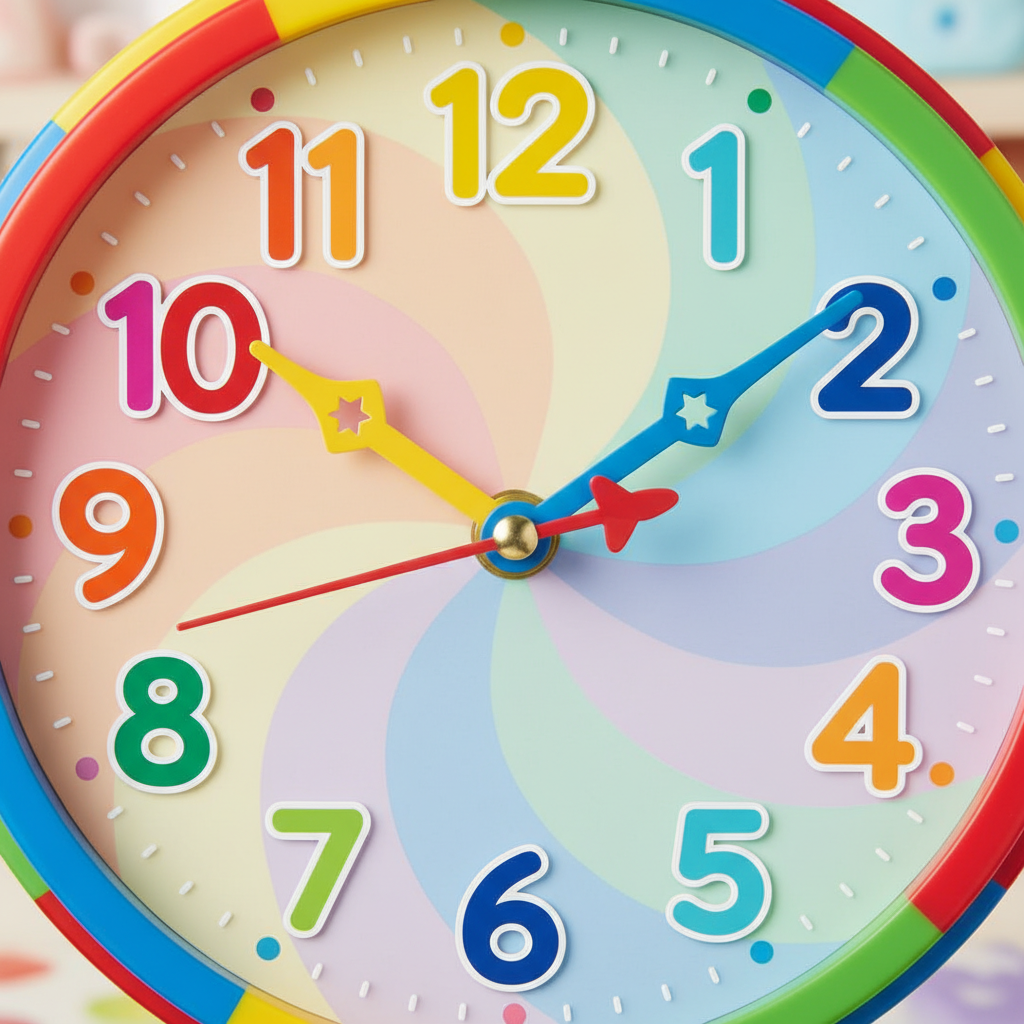
Think of the hour hand like a slow turtle, moving one number at a time. The minute hand is like a speedy rabbit, zooming around the clock face. When the minute hand makes a full trip around the clock, one whole hour has passed!
O'clock: A Special Time
When the minute hand points straight up to the 12, it means a new hour has just begun. We call this 'o'clock'. So, if the short hour hand points to the 3 and the long minute hand points to the 12, it's 3 o'clock! This is a special moment when we know exactly that a new hour has started.
Connecting Time to Our Day
Let's see how we use time in our daily routine:
- Morning: We wake up around 7 o'clock in the morning. This is when the hour hand is on the 7 and the minute hand is on the 12. Then, we might eat breakfast around 7:30. This means the hour hand is a little past the 7, and the minute hand is on the 6.
- School Time: School often starts around 8 o'clock or 9 o'clock in the morning. This is when we are busy learning and playing with our friends.
- Lunch: Lunchtime is usually around 12 o'clock (noon) or 1 o'clock in the afternoon. The sun is very high in the sky!
- Playtime: We might have playtime in the afternoon, perhaps around 3 o'clock.
- Dinner: Dinner is usually in the evening, maybe around 6 o'clock or 7 o'clock.
- Bedtime: We get ready for bed when it's around 8 o'clock or 9 o'clock at night. This is when the moon is out, and it's time to rest.
Why is Timing Important?
Timing is like the glue that holds our day together!
- Helps Us Plan: Knowing the time helps us know when to do things. We know when to wake up, when to go to school, when to eat, and when to sleep. It's like having a schedule for our day!
- Helps Us Be On Time: If we want to catch the school bus or meet a friend, we need to know the right time to be there. Being on time means showing up when we are supposed to.
- Helps Us Balance: Time helps us make sure we have enough time for everything – learning, playing, eating, and resting. It helps us have a balanced day.
So, remember, time is our friend! It helps us make every day a wonderful and organized adventure. Keep practicing telling time and understanding your daily routine – you'll be a time master in no time!
Keep learning, free
Create a free Syllabax account to unlock practice questions and games for this topic.
Visual Learning Enhanced! 🚀
To help you master this topic, we use Advanced Syllabax AI to generate detailed diagrams and visual models.
Note on Visuals: The AI sometimes makes spelling errors in image labels. Please refer to the lesson text for the correct terminology.