Matching objects (Logical Thinking)
Watch this topic in 60 seconds
Free preview · Lesson 1
Understanding Matching objects (Logical Thinking)
Matching Objects: A Fun Way to Think Logically!
Hello, young learners! Today, we're going on an exciting adventure to discover how to match objects. Matching is like being a super detective! You look closely at things, find what's the same, and put them together. It's a very important skill that helps us understand the world around us. Think of it like finding your favorite socks in the drawer – you look for the one that looks just like the other!
What is Matching?
Matching means finding two or more things that are alike in some way. They might look the same, be the same color, be the same shape, or have the same job. When we match things, we use our eyes and our brains to notice details. It's like a puzzle where you have to find the pieces that fit together perfectly.
Why is Matching Important?
Matching helps us in many ways:
- It helps us organize: Imagine your toy box! If you match all the cars together and all the blocks together, it's much easier to find what you want to play with. It's like putting your clothes away neatly after laundry.
- It helps us learn new things: When you learn the alphabet, you match the letter 'A' with the sound 'ah'. When you learn numbers, you match the number '3' with three apples.
- It helps us solve problems: If you have a missing button for your shirt, you need to find one that matches the others.
- It makes us smarter thinkers! Matching helps our brains get stronger, just like eating healthy food helps our bodies grow strong. It teaches us to look carefully and think about how things are similar.
Types of Matching
There are many fun ways to match objects. Let's explore a few:
1. Matching by Color
This is one of the easiest ways to match! You look for objects that are the same color.
Analogy: Think about a box of crayons. You have red crayons, blue crayons, and yellow crayons. You can match all the red crayons together. Or, when you're helping set the table, you match the red napkin with the red plate.
Example: A red apple matches with another red apple. A blue car matches with a blue block.
2. Matching by Shape
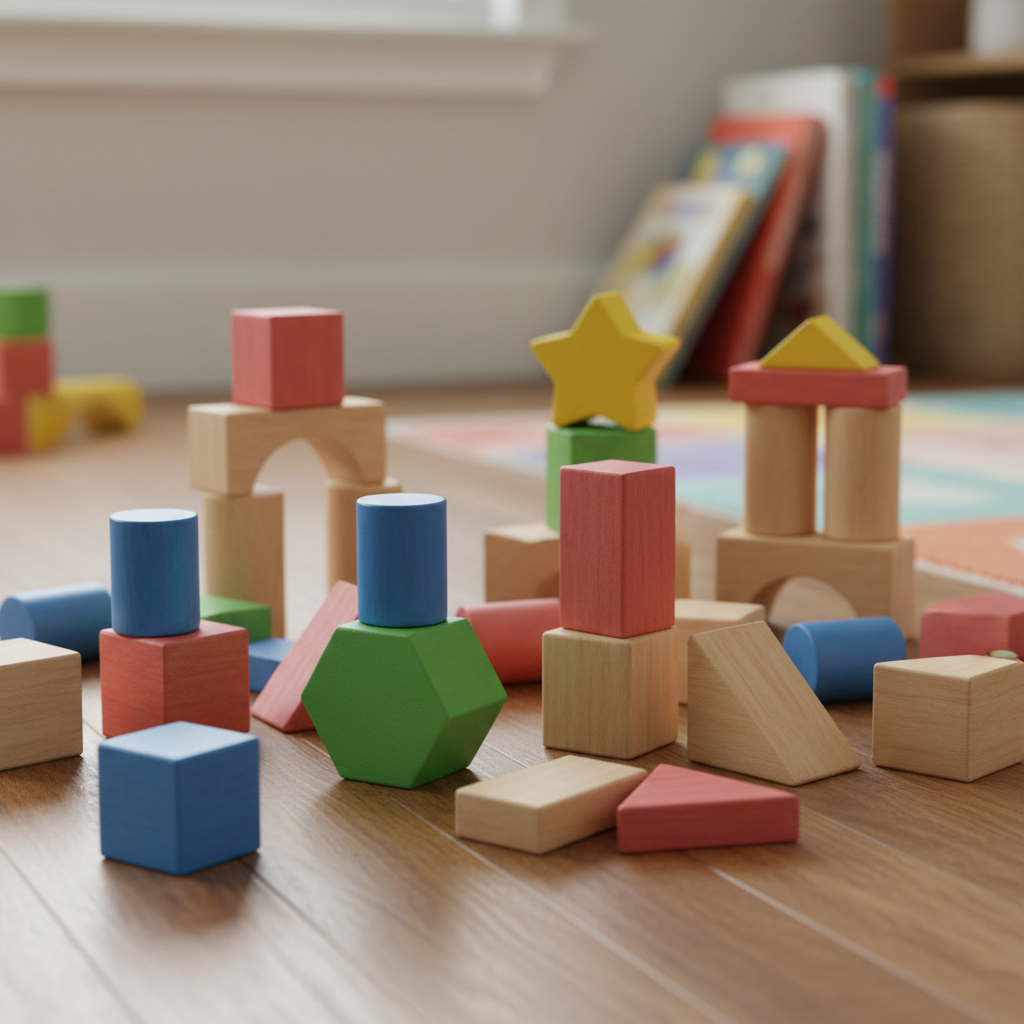
Here, we look for objects that have the same shape. They might be different colors, but if their shape is the same, they match!
Analogy: Think about shape sorter toys for babies. There's a hole shaped like a circle, and a block shaped like a circle. They are a perfect match! Or, think about cookies. You might have star-shaped cookies and round cookies. You can match all the star cookies together.
Example: A round ball matches with a round button. A square block matches with a square cracker.
 ⚠️ This picture may have spelling mistakes. Trust the words in the lesson.
3. Matching by Size
Sometimes, objects match because they are the same size. One might be big, and one might be small, but if they are both medium-sized, they match!
Analogy: Imagine you have pairs of shoes. You have big shoes for a grown-up and small shoes for a child. But you also have shoes that are the same size for you and your friend. Those are a size match! Or think about stacking rings – you want to find rings that are the same size to make a neat tower.
Example: A small toy car matches with another small toy car. A large plate matches with another large plate.
4. Matching by Type or Function (What they do!)
This is a bit trickier and super cool! We match things based on what they are or what they are used for. They might look different, but they do the same job or belong to the same group.
Analogy: Think about eating. A spoon and a fork are different shapes, but they are both used for eating food! So, they match as 'eating utensils'. Or, think about your school supplies. A pencil and a crayon are different, but they are both used for drawing or writing. They match as 'writing tools'.
Example: A toothbrush matches with toothpaste because they are both used for cleaning teeth. A hammer matches with a nail because they are both used for building.
Let's Practice Being Matching Detectives!
Now that we know all about matching, let's put on our detective hats and find some matches!
Look at the pictures. Can you find the objects that match? What makes them a match? Is it their color, shape, size, or what they do?
Remember, matching is all about observing carefully and finding those similarities. It’s a skill that will help you learn and grow every single day!
Keep learning, free
Create a free Syllabax account to unlock practice questions and games for this topic.
Visual Learning Enhanced! 🚀
To help you master this topic, we use Advanced Syllabax AI to generate detailed diagrams and visual models.
Note on Visuals: The AI sometimes makes spelling errors in image labels. Please refer to the lesson text for the correct terminology.