Tables up to 20 (focus area) (Multiplication)
Watch this topic in 60 seconds
Free preview · Lesson 1
Understanding Tables up to 20 (focus area) (Multiplication)
Mastering Multiplication Tables: Your Fun Journey Up to 20!
Welcome, amazing 4th graders, to an exciting adventure where we'll conquer the world of multiplication! Today, we're focusing on learning our multiplication tables up to 20. Don't worry, it's going to be super fun, like playing a game where you become a multiplication master!
What is Multiplication, Anyway?
Multiplication is like a super-fast way of adding the same number over and over again. Imagine you have a basket, and in that basket, you have 3 apples. Now, imagine you have 4 of these baskets, each with 3 apples. Instead of counting all the apples one by one (3 + 3 + 3 + 3), we can use multiplication!
We say: "4 groups of 3 apples." In math, this is written as 4 x 3. The 'x' symbol means 'times' or 'groups of'.
So, 4 x 3 is the same as 3 + 3 + 3 + 3, which equals 12 apples. See? Multiplication saved us a lot of counting!
Why Learn Tables Up to 20?
Learning our multiplication tables up to 20 (like 1x1, 1x2, ... up to 20x20) is like learning the secret code to solving bigger math problems much faster. Think of it like learning all the letters of the alphabet. Once you know them, you can read amazing stories! Knowing your times tables helps you with:
- Bigger Math Problems: When you get to harder math, multiplication is your best friend.
- Quick Thinking: You'll be able to answer questions in a snap!
- Real-World Fun: Imagine planning a party! If you need 5 party favors for each of your 15 friends, multiplication (5 x 15) tells you exactly how many favors you need without counting one by one.
Meet the Multiplication Family!
Every number has a multiplication family, called a 'times table'. Let's meet a few!
The '3' Family (The 3 Times Table):
This family is like having 3 cookies for every friend.
- 1 x 3 = 3 (1 group of 3 cookies)
- 2 x 3 = 6 (2 groups of 3 cookies, or 3 + 3)
- 3 x 3 = 9 (3 groups of 3 cookies, or 3 + 3 + 3)
- 4 x 3 = 12 (4 groups of 3 cookies, or 3 + 3 + 3 + 3)
- ... and so on, up to 10 x 3 = 30, and even higher!
The '7' Family (The 7 Times Table):
Imagine you have 7 shiny stickers for every page in your sticker book.
- 1 x 7 = 7 (1 page with 7 stickers)
- 2 x 7 = 14 (2 pages with 7 stickers each, or 7 + 7)
- 3 x 7 = 21 (3 pages with 7 stickers each, or 7 + 7 + 7)
- 4 x 7 = 28 (4 pages with 7 stickers each, or 7 + 7 + 7 + 7)
Tips and Tricks for Memorizing!
Learning these tables might seem like a lot, but we have super cool tricks!
- Use Your Fingers: For some tables (like 9s!), your fingers can be amazing helpers!
- Look for Patterns: Notice how the numbers in the 5s table always end in a 0 or a 5? That's a cool pattern!
- Sing it Out Loud: Many times tables have catchy songs that make learning fun. Ask your teacher or parent to find some!
- Practice Makes Perfect: The more you practice, the easier it gets. Like riding a bike, the first few times might be wobbly, but soon you'll be zooming!
- Flashcards are Your Friends: Make cards with a problem on one side (like 6 x 7) and the answer on the other (42).
Let's Visualize!
Imagine you're building with LEGOs. If you have 5 boxes, and each box has 8 LEGO bricks, how many bricks do you have in total?
This is a multiplication problem: 5 x 8.
Think of 5 rows, with 8 bricks in each row. It looks like a little grid!
Counting all those bricks would take a while, but multiplication tells us the answer is 40!
Understanding the 'Commutative Property' (A Fancy Name for a Simple Idea!)
This property is like saying that the order doesn't matter. For multiplication, it means that 3 x 4 is the exact same answer as 4 x 3.
Think about our apple baskets again: 4 baskets with 3 apples each (4 x 3 = 12) is the same total number of apples as 3 baskets with 4 apples each (3 x 4 = 12).
It's like saying "a chocolate chip cookie" is the same as "a cookie that is chocolate chip." The meaning stays the same!
Going Beyond 10: Tables Up to 20!
Now, let's take our super-skills to numbers beyond 10. Don't be scared! It's the same idea. Let's look at the '12' family:
- 1 x 12 = 12
- 2 x 12 = 24 (12 + 12)
- 3 x 12 = 36 (12 + 12 + 12)
- 4 x 12 = 48 (12 + 12 + 12 + 12)
- ... and so on.
You can use the same tricks: finger counting (for some higher numbers), looking for patterns (like how the 10s table numbers always end in 0), or breaking down bigger numbers. For example, to figure out 7 x 15, you could think:
"I know 7 x 10 is 70. And I know 7 x 5 is 35. So, 70 + 35 = 105!"
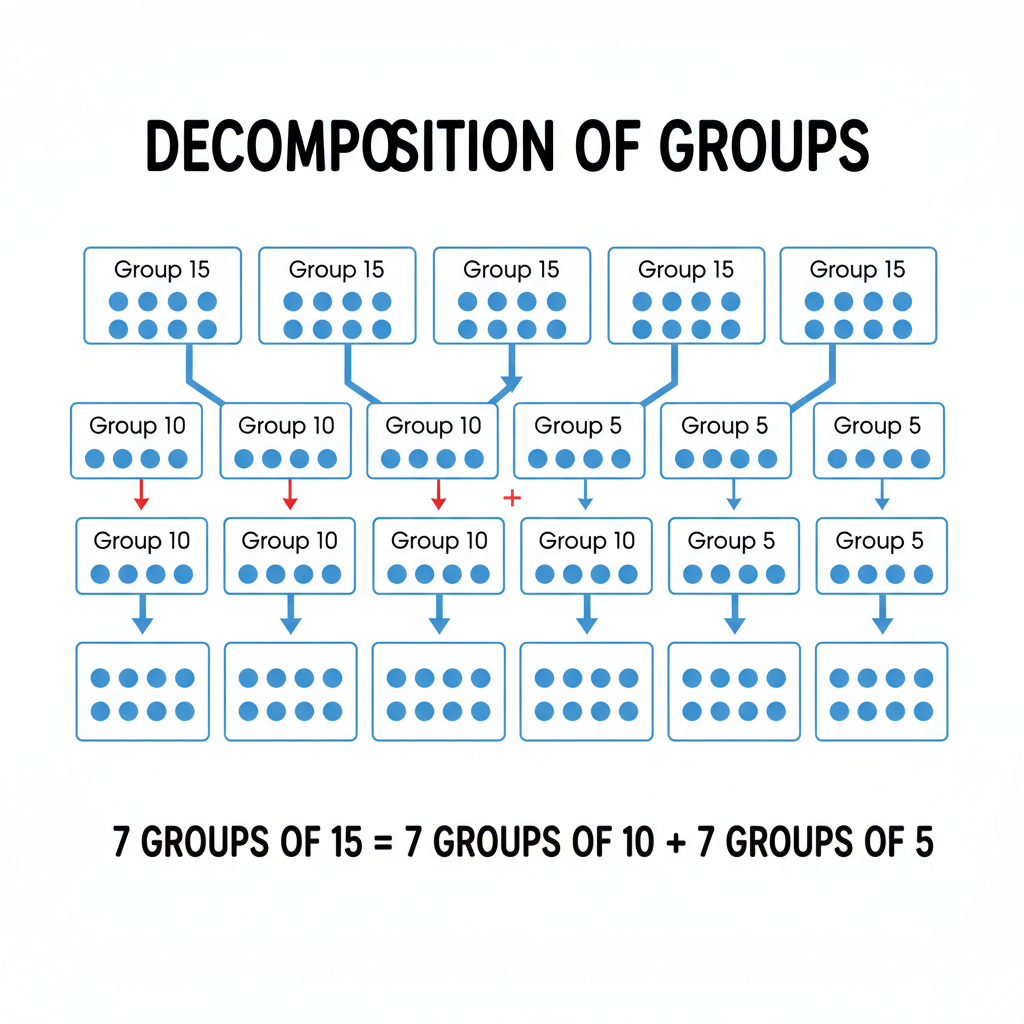
This is called 'breaking apart' or 'distributing' – it makes big problems feel smaller!
Why is This Important for You?
Knowing your multiplication tables up to 20 is like having a superpower in math. It helps you solve problems faster, understand more complex ideas later on, and even helps in everyday situations, like sharing snacks equally or figuring out how much of something you need. Keep practicing, keep playing, and you'll become a multiplication superstar!
Keep learning, free
Create a free Syllabax account to unlock practice questions and games for this topic.
Visual Learning Enhanced! 🚀
To help you master this topic, we use Advanced Syllabax AI to generate detailed diagrams and visual models.
Note on Visuals: The AI sometimes makes spelling errors in image labels. Please refer to the lesson text for the correct terminology.