Universal law of gravitation[PHYSICS]
Watch this topic in 60 seconds
Free preview · Lesson 1
Understanding Universal law of gravitation[PHYSICS]
Imagine you drop a ball, and it falls to the ground. Why doesn't it just float away? The answer lies in one of the most fundamental forces in our universe: Gravity. Gravity is the invisible force that pulls everything towards everything else. It's why we stay on Earth, why the Moon orbits Earth, and why Earth orbits the Sun.
The Story of the Apple and a Grand Idea
The legend goes that Sir Isaac Newton was sitting under an apple tree when an apple fell on his head. Instead of just eating it, Newton started to ponder: Why did the apple fall downwards, straight to the Earth, instead of floating sideways or upwards? This simple observation sparked a brilliant idea in his mind. He realized that the same force that pulled the apple to the ground might also be the force that kept the Moon in its orbit around the Earth. He imagined this force reaching out far into space, connecting celestial bodies.
What is Gravity, in Simple Terms?
Think of gravity like a giant, invisible magnet. But instead of attracting only metal, gravity attracts anything that has mass. The more "stuff" (mass) an object has, the stronger its gravitational pull. So, you (who have mass) are pulling on your pencil, and your pencil is pulling on you! The reason you don't notice this is because your masses are tiny compared to the enormous mass of the Earth. Earth is like a super-sized magnet, and it pulls everything on its surface (including you, your pencil, and apples) towards its center.
The Two Big Rules of Gravity: Mass and Distance
Newton's genius was to figure out exactly how this invisible force works. He came up with two main rules:
Rule 1: More Mass = More Gravity
This is the first and most important rule. Imagine you have a tiny fridge magnet and a giant industrial electromagnet used to lift cars. Which one has a stronger pull? The electromagnet, of course! Why? Because it has much more "magnetic stuff" (and mass). Similarly, in gravity, a small rock has a very weak gravitational pull, while a massive planet like Jupiter has an incredibly strong pull. The Earth pulls on you much more strongly than your small pet does, because Earth has vastly more mass. So, the gravitational force between two objects gets stronger if either or both of their masses increase.
Rule 2: More Distance = Less Gravity
Now, think about the brightness of a light bulb. If you're standing right next to it, it's very bright. But as you walk further and further away, the light gets dimmer. The light itself isn't changing, but its effect on you weakens with distance. Gravity works in a similar way. The further two objects are from each other, the weaker the gravitational force between them becomes. It's like trying to talk to a friend across a very long football field – the further you are, the harder it is to hear each other. So, the gravitational force between two objects gets weaker as the distance between them increases.
And here's a crucial detail: it doesn't just get weaker; it gets weaker very quickly. If you double the distance between two objects, the gravitational force doesn't just halve; it becomes a quarter of what it was! If you triple the distance, it becomes a ninth! This is called an "inverse square law" relationship with distance. It means gravity's influence drops off sharply as you move away.
Putting It All Together: The Universal Law of Gravitation
Newton combined these two rules into one elegant statement, often called the Universal Law of Gravitation:
"Every particle of matter in the universe attracts every other particle with a force that is directly proportional to the product of their masses and inversely proportional to the square of the distance between their centers."
Let's break that down:
- "Every particle of matter in the universe attracts every other particle": This means everything pulls on everything else, no matter how big or small, or where they are. That's why it's called "universal"!
- "directly proportional to the product of their masses": If you multiply the masses of the two objects, the force of gravity is directly related to that number. Bigger masses multiplied together mean bigger gravitational force.
- "inversely proportional to the square of the distance between their centers": This is the "gets weaker very quickly with distance" part we just discussed. The force depends on the distance squared (r²), but in an inverse way (1/r²).
We can write this law as a mathematical formula:
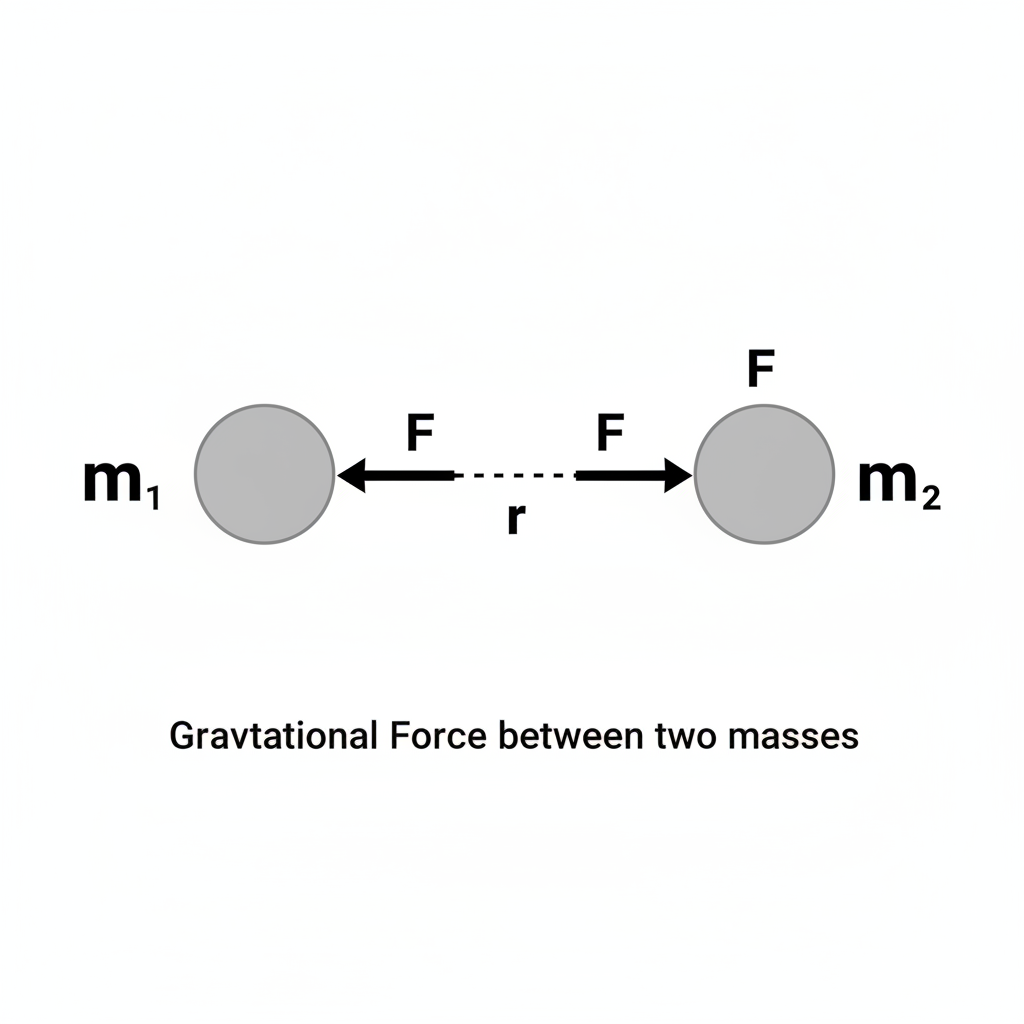
F = G * (m₁ * m₂) / r²
Let's look at what each symbol means:
- F: This is the Force of gravity (how strong the pull is).
- G: This is the Universal Gravitational Constant. Think of G as a special "scaling factor" or a magic number that makes the equation work out correctly. It's a very tiny number, which tells us that gravity is a relatively weak force unless at least one of the masses involved is absolutely enormous (like a planet or star). It's always the same value everywhere in the universe.
- m₁: This is the mass of the first object.
- m₂: This is the mass of the second object.
- r: This is the distance between the centers of the two objects. Remember, it's the distance between their centers, not just their surfaces!
Here's a visual to help understand the relationship between masses, distance, and the gravitational force:
 ⚠️ This picture may have spelling mistakes. Trust the words in the lesson.
Why is it "Universal"?
The most incredible part of this law is its "universality." It doesn't just apply to apples falling on Earth. It applies to:
- The Earth pulling on you, keeping your feet firmly on the ground.
- The Moon pulling on Earth, causing the ocean tides.
- The Sun pulling on Earth, keeping our planet in its orbit and defining our years.
- Distant galaxies pulling on each other across vast cosmic distances.
From the smallest dust particle to the largest star, every object in the universe exerts a gravitational pull on every other object. It's truly a universal force.
The Importance of Gravity in Our Lives and the Universe
Without gravity, our world would be completely different, and life as we know it wouldn't exist. It's gravity that:
- Keeps the atmosphere around Earth, allowing us to breathe.
- Holds planets, stars, and galaxies together.
- Allows us to have a sense of "up" and "down."
- Makes water flow downhill and rain fall.
- Is essential for launching rockets into space and for keeping satellites in orbit.
Understanding the Universal Law of Gravitation has been crucial for countless scientific advancements, from predicting eclipses to designing space missions. It's a foundational concept for understanding how the cosmos works.
So, the next time you see something fall, remember Newton's apple and the invisible, universal force that shapes our world and the entire universe!
Keep learning, free
Create a free Syllabax account to unlock practice questions and games for this topic.
Visual Learning Enhanced! 🚀
To help you master this topic, we use Advanced Syllabax AI to generate detailed diagrams and visual models.
Note on Visuals: The AI sometimes makes spelling errors in image labels. Please refer to the lesson text for the correct terminology.