Amplitude, frequency, pitch[PHYSICS]
Watch this topic in 60 seconds
Free preview · Lesson 1
Understanding Amplitude, frequency, pitch[PHYSICS]
Understanding Sound: Amplitude, Frequency, and Pitch
Welcome, young scientists! Today, we're going to dive into the fascinating world of sound and explore some of its most important characteristics: amplitude, frequency, and pitch. These are the building blocks that help us understand why some sounds are loud and others are soft, why some sounds are high and others are low. We'll use lots of everyday examples and analogies to make these concepts as clear as possible.
What is Sound?
Before we talk about amplitude and frequency, let's quickly remember what sound is. Sound is created when something vibrates. A vibration is a rapid back-and-forth movement. When an object vibrates, it pushes and pulls on the air particles around it, creating waves of pressure that travel outwards. Think of it like dropping a pebble into a still pond. The pebble creates ripples that spread across the water. Sound waves are similar, but they travel through the air (or other materials) instead of water.
Amplitude: How Loud is the Sound?
Imagine you're playing with a slinky. If you push and pull it gently, the waves you create will be small. If you push and pull it with a lot of force, the waves will be big and stretched out. Amplitude is like the 'size' or 'height' of a sound wave. It tells us how much energy the sound wave carries.
Analogy Time!
- Water Waves: Think about waves in the ocean. A small ripple made by a gentle breeze has a low amplitude. A huge tsunami wave has a very high amplitude.
- Shouting vs. Whispering: When you shout, you push more air out forcefully, creating bigger sound waves with high amplitude. When you whisper, you use less force, creating smaller sound waves with low amplitude.
- Drumming: If you tap a drum very lightly, you get a soft sound (low amplitude). If you hit the drum hard with a drumstick, you get a loud sound (high amplitude).
So, a sound with a high amplitude is a loud sound, and a sound with a low amplitude is a soft sound. The louder a sound is, the more energy it has.
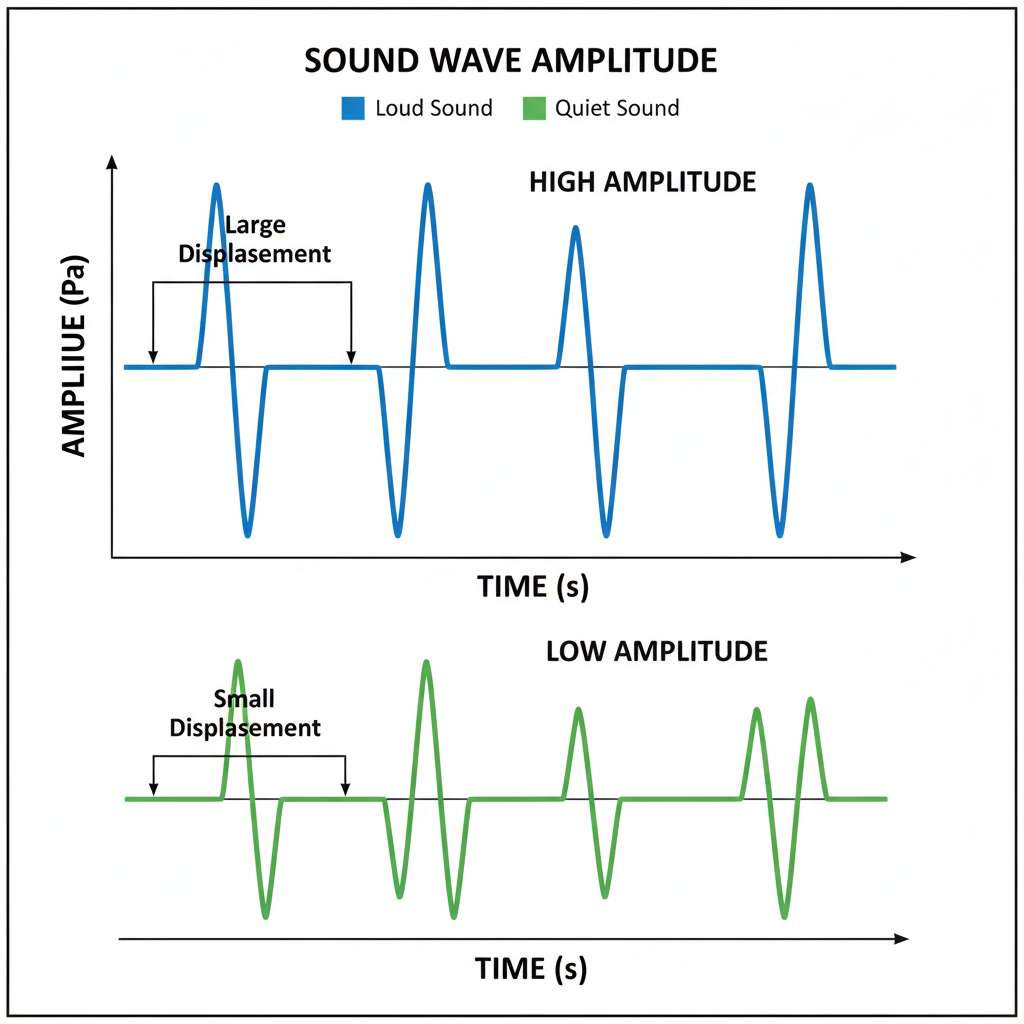 ⚠️ This picture may have spelling mistakes. Trust the words in the lesson.
Frequency: How Fast is the Vibration?
Now, let's talk about frequency. Frequency is about how *fast* the vibrations are happening. Think back to our slinky. If you wiggle it back and forth very quickly, you create lots of waves close together. If you wiggle it slowly, the waves are spread out.
Frequency measures the number of waves (or vibrations) that pass a certain point in one second. We measure frequency in Hertz (Hz). So, 1 Hertz means one wave passes every second.
Analogy Time!
- Strumming a Guitar: If you strum a guitar string quickly, it vibrates fast, producing a high frequency. If you strum it slowly, it vibrates slower, producing a low frequency.
- Flapping Wings: A hummingbird flaps its wings much faster than a pigeon. The hummingbird's wings have a higher frequency of flapping.
- Heartbeat: Imagine your heart beating. If it beats very quickly (like when you're running), it has a high frequency. If it beats slowly (like when you're sleeping), it has a low frequency.
A sound with a high frequency means the sound source is vibrating very quickly. A sound with a low frequency means the sound source is vibrating slowly.
Pitch: The Highness or Lowness of a Sound
Here's where frequency and pitch come together! Pitch is how high or low a sound sounds to our ears. And guess what? Pitch is directly related to frequency.
It's simple:
- High Frequency = High Pitch
- Low Frequency = Low Pitch
Analogy Time!
- Different Instruments: Think about a tiny piccolo flute and a big tuba. The piccolo makes a very high-pitched sound because its air vibrations are fast (high frequency). The tuba makes a very low-pitched sound because its air vibrations are slow (low frequency).
- Voices: Generally, younger children and adult women have higher voices (higher pitch) than adult men. This is because their vocal cords vibrate faster.
- Squeaks and Growls: A mouse's squeak is a high-pitched sound (high frequency), while a lion's roar is a low-pitched sound (low frequency).
So, when you hear a squeaky door hinge, it's a high-pitched sound. When you hear a booming bass drum, it's a low-pitched sound. This difference in pitch comes from the frequency of the sound waves.
Putting it All Together
Let's recap the main ideas:
- Amplitude is about the 'size' of the sound wave and determines how loud or soft a sound is.
- Frequency is about how 'fast' the vibrations are and is measured in Hertz (Hz).
- Pitch is how 'high' or 'low' a sound seems to us, and it depends directly on the frequency. High frequency means high pitch, and low frequency means low pitch.
Understanding these three concepts helps us describe and appreciate the amazing variety of sounds we hear every day, from the gentle rustling of leaves to the powerful roar of a jet engine!
Keep learning, free
Create a free Syllabax account to unlock practice questions and games for this topic.
Visual Learning Enhanced! 🚀
To help you master this topic, we use Advanced Syllabax AI to generate detailed diagrams and visual models.
Note on Visuals: The AI sometimes makes spelling errors in image labels. Please refer to the lesson text for the correct terminology.