Learning Journey
Watch this topic in 60 seconds
Free preview · Lesson 1
Understanding Water cycle[CHEMISTRY]
The Amazing Journey of Water: A Chemistry Adventure!
Welcome, young scientists, to an exciting exploration of the Earth's most precious resource: water! We're going to learn about how water moves around our planet in a never-ending journey called the water cycle. Think of it like a giant, natural recycling program for water, driven by energy from the sun and gravity.
What is Water? A Tiny, Mighty Molecule!
Before we dive into the cycle, let's remember what water is made of. Water is a molecule, which is like a tiny building block. A water molecule has two hydrogen atoms (think of them as little speedy messengers) and one oxygen atom (the bigger, more central character). They are bonded together, like friends holding hands, to form H2O. This simple structure is responsible for all of water's amazing properties!
The Sun's Big Role: Evaporation!
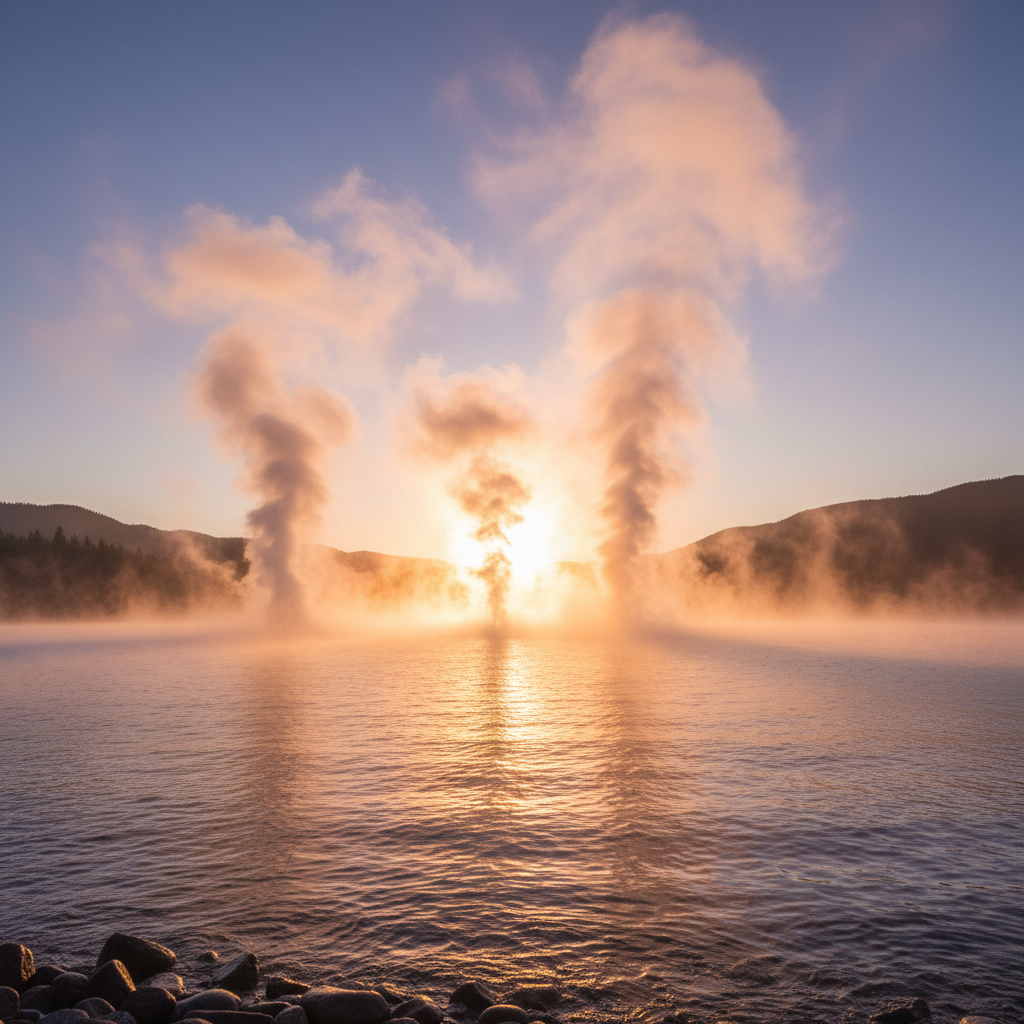
Our journey begins with the sun. Imagine the sun is like a giant hairdryer. When the sun shines on water – whether it's in oceans, lakes, rivers, or even puddles – it warms it up. This warmth gives the water molecules energy, making them wiggle and jiggle faster and faster.
Eventually, these fast-moving water molecules get so energetic that they break free from their friends (the other water molecules) and float up into the air as an invisible gas called water vapor. This process is called evaporation. It's like when you see steam rising from a hot cup of soup – that's water evaporating!
Analogy: Think of a busy playground. When the sun (the energy source) comes out, the kids (water molecules) get excited and start running around. Some kids get so excited they jump over the fence and run off to explore (become water vapor). The fence is like the surface of the water.
 ⚠️ This picture may have spelling mistakes. Trust the words in the lesson.
Cooling Down: Condensation!
Now, that invisible water vapor is floating way up high in the atmosphere. What happens up there? It's much colder! As the water vapor cools down, the speedy water molecules start to slow down and get closer together again. They start holding hands with each other again, but this time, they form tiny little droplets of liquid water or even tiny ice crystals. This process is called condensation.
These tiny droplets and ice crystals cling to tiny dust particles in the air. When enough of them gather together, they form clouds! So, clouds are basically just huge collections of tiny water droplets or ice crystals floating in the sky.
Analogy: Imagine you're breathing out on a cold day. You see your breath, right? That's because the warm, moist air from your lungs (like water vapor) meets the cold outside air. The water vapor in your breath cools down and turns back into tiny water droplets you can see, forming a little cloud. That's condensation!
The Big Drop: Precipitation!
Inside the clouds, those tiny water droplets or ice crystals bump into each other and join together, growing bigger and heavier. Eventually, they become too heavy to stay floating in the air. What happens then? They fall back to Earth! This is called precipitation. Precipitation can come in many forms:
- Rain: Liquid water droplets falling from the sky.
- Snow: Ice crystals falling when the air is very cold.
- Sleet: Raindrops that freeze as they fall.
- Hail: Lumps of ice formed in stormy clouds.
Gravity, the force that pulls everything down towards the Earth, is what makes precipitation fall.
Analogy: Think of a crowded elevator. As more people (water droplets) get on, the elevator gets heavier. Eventually, it might get so full and heavy that it has to stop and let people off (precipitation).
Flowing Back Home: Collection and Runoff!
When precipitation reaches the Earth, it doesn't just disappear! It collects in different places.
- Some water soaks into the ground, becoming groundwater. Plants love to drink this!
- Some water flows over the land's surface, heading towards rivers, lakes, and eventually, the oceans. This is called runoff.
- Some precipitation falls directly into oceans, lakes, and rivers.
This collected water is ready to start the journey all over again when the sun warms it up.
Analogy: Imagine a messy room after a party. The spilled drinks (precipitation) end up on the floor, under the furniture, or maybe even get soaked up by a rug. Eventually, someone needs to clean it up and put things back in their place (collection and runoff), and the room is ready for the next party (the cycle starts again).
The Continuous Cycle: Putting It All Together!
The water cycle is a continuous loop. Water evaporates, condenses into clouds, falls back to Earth as precipitation, and then collects to begin the cycle anew. It's a perfect example of how matter (like water) is conserved and recycled on our planet, powered by the sun's energy and driven by gravity.
This cycle is vital for all life on Earth. It provides the fresh water that plants, animals, and humans need to survive. So, next time you see rain falling or clouds in the sky, remember the incredible journey that water is taking!
Keep learning, free
Create a free Syllabax account to unlock practice questions and games for this topic.
Visual Learning Enhanced! 🚀
To help you master this topic, we use Advanced Syllabax AI to generate detailed diagrams and visual models.
Note on Visuals: The AI sometimes makes spelling errors in image labels. Please refer to the lesson text for the correct terminology.