Future Trends in Computing
Watch this topic in 60 seconds
Free preview · Lesson 1
Understanding Future Trends in Computing
Future Trends in Computing: What's Next for Our Digital World?
Welcome to the exciting world of future computing! In this foundational lesson, we're going to explore some of the most groundbreaking and mind-bending trends that are shaping how we interact with technology, process information, and live our daily lives. Think of it like looking into a crystal ball, but instead of magic, we're seeing the logical next steps for the powerful machines all around us. Understanding these trends isn't just for computer scientists; it's for everyone, because they will impact everything from how we learn and work to how we play and communicate.
Before we dive into the 'future,' let's briefly remember the 'now.' Today's computers, like your phone or laptop, are incredibly powerful. They work by performing calculations incredibly fast, using tiny switches that are either 'on' or 'off' (representing 0s and 1s). This is called classical computing. Now, imagine a world where these rules are changing, and new possibilities are emerging!
1. Artificial Intelligence (AI): Computers That Learn and Think
Have you ever asked a smart speaker to play a song or seen a movie recommendation pop up on a streaming service? That's AI at work! Artificial Intelligence (AI) is essentially about teaching computers to perform tasks that typically require human intelligence. It's not about giving a computer step-by-step instructions for every single scenario, but rather giving it the ability to learn from data, recognize patterns, make decisions, and even solve problems.
Think of AI like a really good student. Instead of giving the student a perfect answer key for every test, you give them tons of textbooks, examples, and practice problems. Over time, they learn the underlying rules and can then ace new tests, even if they haven't seen those exact questions before. That's the core idea behind Machine Learning, a huge part of AI. If you show a computer a million pictures of cats and dogs and label them correctly, it will eventually learn to tell the difference between a new cat and a new dog picture on its own!
A more advanced form of Machine Learning is Deep Learning. Imagine our student now has not just one brain, but many interconnected layers of 'neurons' (like a simplified version of the human brain). This allows it to process incredibly complex patterns, like understanding human speech, recognizing faces with high accuracy, or even generating new creative content like art or music. AI is already driving self-driving cars, powering medical diagnostics, and making our online experiences more personalized. In the future, AI will become even more integrated, helping us discover new medicines, manage smart cities, and much more.
2. Quantum Computing: A Leap Beyond Traditional Computers
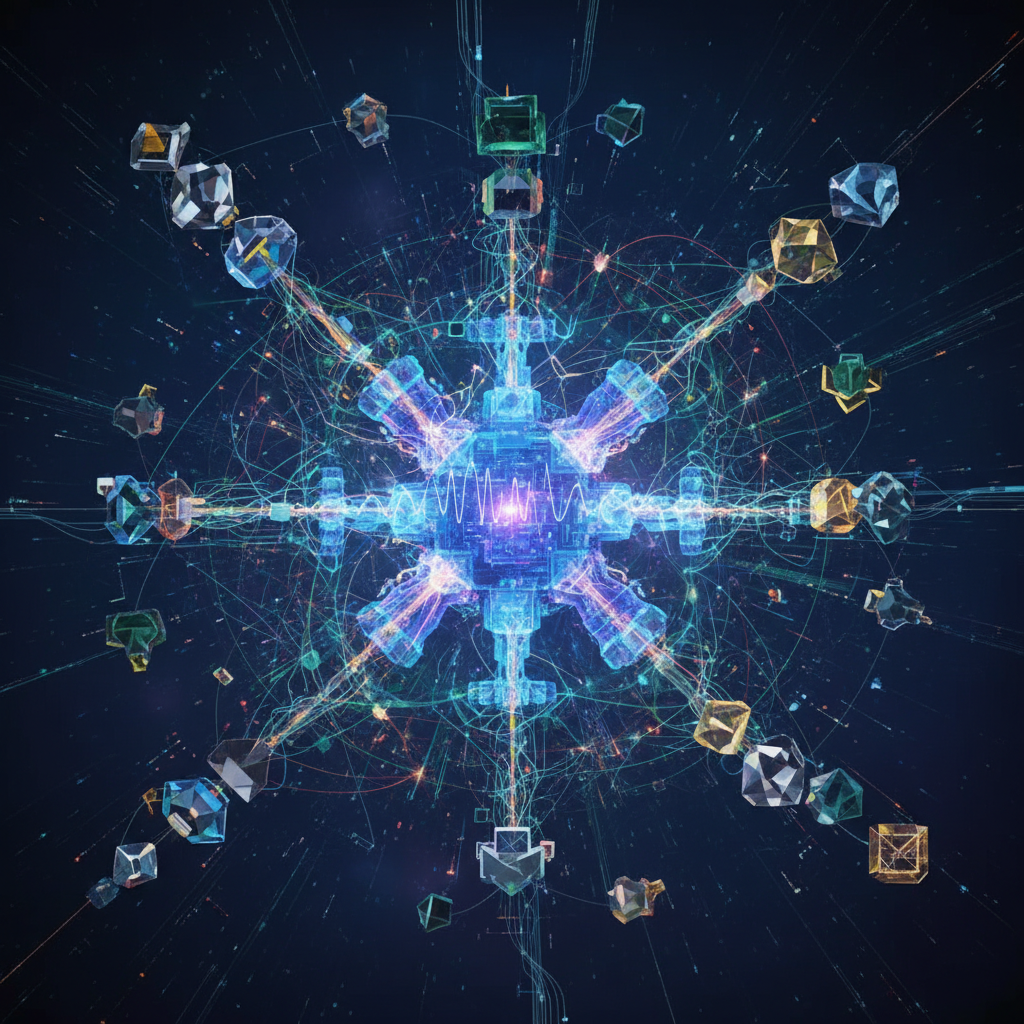
This is where things get truly futuristic! Remember how classical computers use 0s and 1s (on/off switches)? Quantum Computing works in a fundamentally different way, using principles from quantum mechanics (the physics of the super small particles that make up everything).
Instead of just 0 or 1, quantum computers use qubits (quantum bits). A qubit isn't just 0 or 1; it can be 0, 1, or both at the same time! This mind-bending concept is called superposition. Imagine a coin spinning in the air: it's neither heads nor tails until it lands. A qubit is like that spinning coin, holding both possibilities simultaneously. This allows quantum computers to process vast amounts of information in parallel, exploring many possibilities at once.
Another wild concept is entanglement, where two qubits become linked, and the state of one instantaneously affects the state of the other, no matter how far apart they are. Think of it like having two magic dice that, no matter where they are rolled, always show the same number when rolled together. These unique properties mean quantum computers can solve certain types of problems that are practically impossible for even the fastest classical supercomputers. These problems include discovering new materials, developing unbreakable encryption, and simulating complex biological processes. While still in early stages, quantum computing promises to revolutionize fields like medicine, finance, and cryptography.
3. Cloud Computing: Your Digital Locker in the Sky
You're probably already using Cloud Computing without even realizing it! Every time you save a document to Google Drive, watch a movie on Netflix, or check your email through a web browser, you're interacting with the cloud. Cloud computing means storing and accessing data and programs over the internet instead of directly on your computer's hard drive.
Think of it like this: instead of owning a giant, powerful computer yourself, you're renting space and processing power from a massive data center (a huge building full of computers) owned by a company like Amazon, Google, or Microsoft. This 'rental' service means you don't have to worry about maintaining the hardware, keeping software updated, or buying incredibly expensive machines. You just pay for what you use, when you need it.
The benefits are huge: you can access your files and applications from any device, anywhere in the world, as long as you have an internet connection. Companies use cloud computing to host their websites, run complex software, store customer data, and even power AI applications. It offers flexibility, scalability (you can easily get more power if you need it), and cost savings. The future will see even more services move to the cloud, making powerful computing resources accessible to everyone.
4. Edge Computing: Bringing the Brains Closer to the Action
While cloud computing is great for centralizing data, sometimes you need to process information really, really fast, right where it's collected. That's where Edge Computing comes in. Instead of sending all data to a distant cloud server for processing, edge computing processes data closer to its source – at the 'edge' of the network.
Imagine a self-driving car. It needs to react instantly to obstacles or changing traffic lights. If it had to send all its sensor data to a cloud server, wait for the server to process it, and then receive instructions back, it would be too slow and dangerous. Instead, the car itself has powerful mini-computers (the 'edge' devices) that can process most of the critical data right on the spot, making immediate decisions. It only sends important summaries or less time-sensitive data to the cloud.
Think of it like having a small, smart assistant right by your side, ready to make quick decisions, rather than having to call a central office every time you need an answer. Edge computing is crucial for applications where speed (low latency) is critical, like autonomous vehicles, smart factories, real-time medical monitoring, and even augmented reality headsets. It complements cloud computing, creating a more efficient and responsive digital world.
5. The Internet of Things (IoT): Our Connected World
Have you ever heard of a 'smart home' where your lights, thermostat, and security cameras can all be controlled from your phone? That's the Internet of Things (IoT). IoT refers to the vast network of physical objects – things – embedded with sensors, software, and other technologies for the purpose of connecting and exchanging data with other devices and systems over the internet.
Essentially, it's about everyday objects 'talking' to each other and to us. This could be anything from a smart refrigerator that tells you when you're low on milk, to fitness trackers monitoring your health, to industrial sensors tracking machine performance in a factory. These devices collect data about their environment and their usage, which can then be analyzed to provide insights, automate tasks, and make our lives easier or more efficient.
Imagine smart city sensors that monitor traffic flow and adjust traffic lights in real-time, or smart farming sensors that tell farmers exactly when to water their crops. The future of IoT involves even more pervasive connectivity, creating a truly 'smart' environment around us, often leveraging edge computing for immediate data processing.
6. Cybersecurity: Protecting Our Digital Future
As more and more of our lives move online and as these future computing trends connect more devices and process more sensitive data, the importance of Cybersecurity grows exponentially. Cybersecurity is the practice of protecting systems, networks, and programs from digital attacks. These attacks are usually aimed at accessing, changing, or destroying sensitive information; extorting money from users; or interrupting normal business processes.
Think of it like building a super-secure castle (your digital systems) and hiring the best digital bodyguards (cybersecurity professionals and tools) to protect it from attackers (hackers). With AI helping to identify threats, quantum computing potentially creating unbreakable encryption (and also potentially breaking current encryption!), cloud computing centralizing vast amounts of data, and billions of IoT devices creating new entry points for attacks, the challenge of cybersecurity is immense.
In the future, cybersecurity will be fundamental to trust and safety. It will involve advanced AI defenses, sophisticated data encryption, and continuous monitoring to protect personal privacy, national infrastructure, and global commerce from increasingly intelligent threats. Learning about strong passwords, identifying phishing scams, and understanding data privacy are basic but crucial skills for everyone in this connected world.
Conclusion: An Interconnected Future
These future trends in computing – Artificial Intelligence, Quantum Computing, Cloud Computing, Edge Computing, the Internet of Things, and Cybersecurity – are not isolated islands. They are deeply interconnected and influence one another. AI will power smarter IoT devices; cloud computing will provide the infrastructure for AI and quantum research; edge computing will make IoT more responsive; and cybersecurity will be the invisible guardian protecting it all. Understanding these foundational concepts is your first step towards navigating and contributing to the incredible digital future that is rapidly unfolding around us.
Keep learning, free
Create a free Syllabax account to unlock practice questions and games for this topic.
Visual Learning Enhanced! 🚀
To help you master this topic, we use Advanced Syllabax AI to generate detailed diagrams and visual models.
Note on Visuals: The AI sometimes makes spelling errors in image labels. Please refer to the lesson text for the correct terminology.