Transportation[BIOLOGY]
Watch this topic in 60 seconds
Free preview · Lesson 1
Understanding Transportation[BIOLOGY]
Understanding Transportation: How Life Moves What It Needs (Grade 10 Biology)
Imagine your house. How do groceries get into your fridge? How does electricity power your lights? How does trash leave your house? The answer is a system of transportation – roads, vehicles, wires, and waste collection services. Just like your house, every living organism, from a tiny plant to a large animal, needs an efficient transportation system to survive.
In biology, transportation refers to the movement of essential substances (like water, nutrients, oxygen, and food) to different parts of an organism, and the removal of waste products away from where they are produced. It's like the ultimate delivery service running inside every living thing!
Part 1: Transportation in Plants – The Silent Delivery Network
Plants might look still, but inside, they are bustling with activity. They need to move water and minerals from the soil all the way up to their leaves, sometimes dozens of meters high! They also need to move the food they make in their leaves (through photosynthesis) to every other part, like the roots, flowers, and fruits, for energy and growth.
1. The Water Highway: Xylem
Think of the xylem as the plant's dedicated water pipeline system. It's a network of tiny tubes that run throughout the plant, from the tips of the roots, through the stem, and into every leaf. These tubes are made of special cells that are dead and hollow, forming continuous channels, much like the plumbing pipes in your house.
- What it transports: Water and dissolved minerals from the soil.
- Direction: Mostly one-way (unidirectional) – always upwards, from roots to leaves.
- How it works:
- Root Pressure (The Gentle Push): Water is absorbed by root cells and gently pushed up into the xylem. Imagine water slowly filling a hose from the bottom up.
- Transpiration Pull (The Powerful Pull): This is the main driving force. Leaves have tiny pores called stomata (like mini-mouths) through which water vapor escapes into the air. When water evaporates from the leaves, it creates a 'pull' or 'suction' force, much like sipping a drink through a straw. This pull draws the entire column of water up through the xylem tubes, all the way from the roots. It's a continuous, unbroken chain of water molecules!
So, the xylem is like the main water supply line, constantly delivering fresh water and minerals to all the plant's cells, especially those in the leaves where photosynthesis happens.
2. The Food Delivery Service: Phloem
While the xylem brings water, the phloem is responsible for distributing the food that the plant manufactures. Photosynthesis, the process of making sugar (food), primarily occurs in the leaves. This sugar needs to be transported to other parts of the plant, such as the growing tips, fruits, flowers, and even the roots, where it can be stored or used for energy.
- What it transports: Sugars (food) produced during photosynthesis.
- Direction: Two-way (bidirectional) – it can go up to growing shoots or down to the roots and storage organs, depending on where the food is needed. Think of it as a multi-directional food delivery truck service.
- How it works: The phloem consists of living cells called sieve tubes and companion cells. Sugars are actively loaded into the sieve tubes, which creates a higher concentration of sugar. Water then follows by osmosis, creating pressure that pushes the sugar solution to areas where it's needed (called 'sinks').
To summarize, the phloem is the internal food highway, making sure every part of the plant gets the energy it needs to grow, flower, and produce fruits.
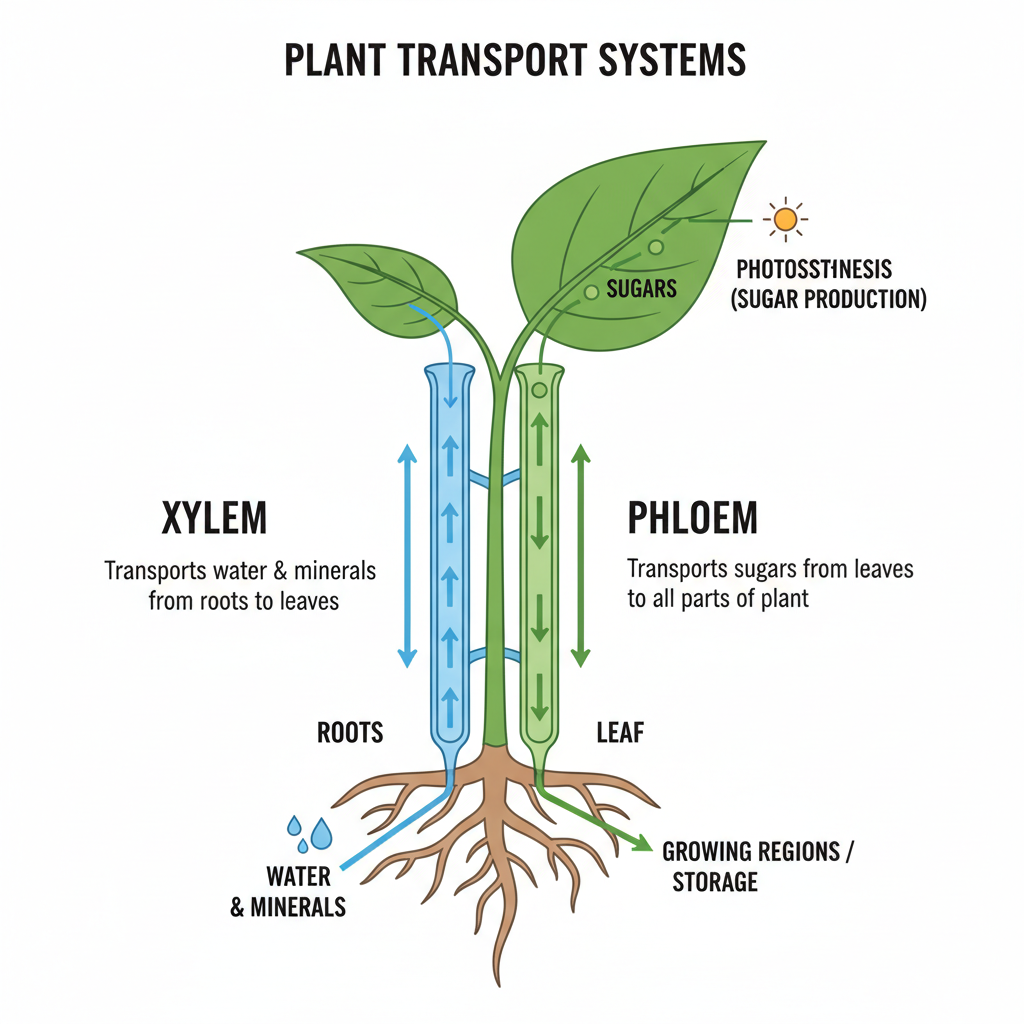 ⚠️ This picture may have spelling mistakes. Trust the words in the lesson.
Part 2: Transportation in Animals – The Dynamic Circulatory System
Animals, especially complex ones like humans, have a more advanced and dynamic transportation system. This system, known as the circulatory system, ensures that every single cell in the body receives what it needs and that waste products are efficiently removed.
The Main Components of the Circulatory System:
1. The Pump: The Heart
The heart is the muscular organ that acts as the central pump of the circulatory system. Imagine it as a powerful engine or a robust water pump that keeps the entire system flowing. It tirelessly contracts and relaxes, pushing blood throughout the body.
- Function: To pump blood continuously, providing the force needed for circulation.
- Analogy: A relentless, high-powered engine that never stops working to move fluids.
2. The Roads: Blood Vessels
Blood vessels are the network of tubes that carry blood to and from all parts of the body. They are like the vast network of roads and highways that crisscross a country, allowing traffic (blood) to move efficiently.
- Arteries: These are thick, muscular vessels that carry oxygen-rich blood away from the heart to the rest of the body. Think of them as the major highways taking fresh supplies from the central warehouse (heart) to various cities (organs and tissues). The only exception is the pulmonary artery, which carries deoxygenated blood from the heart to the lungs.
- Veins: These vessels carry oxygen-poor blood back to the heart from the body. They are like the return roads, bringing back used goods and waste to a central processing plant (heart, and then to lungs/kidneys for removal). The pulmonary vein is an exception, carrying oxygenated blood from the lungs to the heart.
- Capillaries: These are the smallest and most numerous blood vessels, forming a microscopic network between arteries and veins. They are like the tiny side streets and alleys where actual deliveries and pickups happen. It is here that oxygen, nutrients, and hormones are exchanged with the body's cells, and carbon dioxide and other waste products are collected. Their walls are incredibly thin, allowing substances to easily pass through.
3. The Cargo: Blood
Blood is the actual transport medium, the fluid that carries all the essential substances. It's like the fleet of diverse delivery vehicles and the river they all float in.
- Plasma: This is the liquid part of blood, mostly water. It's like the river itself, carrying dissolved nutrients, hormones, proteins, and waste products.
- Red Blood Cells (RBCs): These are like tiny, specialized delivery vans packed with hemoglobin, a protein that binds to oxygen. Their main job is to pick up oxygen from the lungs and deliver it to every cell in the body. They also carry some carbon dioxide back to the lungs.
- White Blood Cells (WBCs): These are the body's defense team. They are like patrolling police officers or soldiers, constantly searching for and destroying harmful invaders like bacteria and viruses.
- Platelets: These are small cell fragments crucial for blood clotting. If there's a 'leak' or 'damage' to a blood vessel (like a cut), platelets rush to the scene to form a plug, preventing excessive blood loss. They're like a rapid repair crew.
How Animal Circulation Works (Double Circulation):
Most complex animals, including humans, have a double circulation system. This means blood goes through the heart twice for each complete circuit around the body. Think of it as having two separate, but connected, delivery loops:
- Pulmonary Circulation (Heart & Lungs Loop): Deoxygenated blood (blood low in oxygen, high in carbon dioxide) is pumped from the heart to the lungs. In the lungs, it picks up oxygen and releases carbon dioxide. This oxygenated blood then returns to the heart. This loop is like a specialized trip to the gas station to refuel with oxygen.
- Systemic Circulation (Heart & Body Loop): Oxygenated blood is pumped from the heart to all other parts of the body (organs, muscles, brain, etc.). Here, oxygen and nutrients are delivered to the cells, and carbon dioxide and other wastes are collected. This deoxygenated blood then returns to the heart. This loop is like the main delivery route to all the 'customers' (cells) in the body.
This double system is very efficient because it ensures that oxygen-rich blood is kept separate from oxygen-poor blood, allowing for maximum oxygen delivery to the body's demanding cells.
Comparing Transportation: Plants vs. Animals
While both plants and animals need transportation, their systems have evolved differently to suit their lifestyles:
- Speed: Animal circulatory systems are much faster due to the pumping action of the heart, essential for active, mobile organisms. Plant transport is slower, relying on osmotic pressure and transpiration pull.
- Medium: Animals use blood; plants use water and sap (water + sugars).
- Components: Animals have a heart, blood vessels, and blood. Plants have xylem and phloem.
- Direction: Xylem is mostly unidirectional (up); phloem is bidirectional. Animal circulation is a continuous, closed loop.
In conclusion, transportation is a fundamental biological process that ensures the survival and proper functioning of all living organisms. Whether it's water flowing up a tall tree or oxygen circulating through your body, these intricate delivery systems are truly marvels of nature!
Keep learning, free
Create a free Syllabax account to unlock practice questions and games for this topic.
Visual Learning Enhanced! 🚀
To help you master this topic, we use Advanced Syllabax AI to generate detailed diagrams and visual models.
Note on Visuals: The AI sometimes makes spelling errors in image labels. Please refer to the lesson text for the correct terminology.