Right, acute & obtuse angles (Lines & Angles)
Watch this topic in 60 seconds
Free preview · Lesson 1
Understanding Right, acute & obtuse angles (Lines & Angles)
Understanding Angles: Right, Acute, and Obtuse!
Welcome, young mathematicians, to the exciting world of shapes and lines! Today, we're going to become angle detectives. Angles are everywhere around us, from the corners of our classrooms to the hands on a clock. Let's learn how to identify three special types of angles: right angles, acute angles, and obtuse angles.
What is an Angle?
Imagine two roads meeting at an intersection. The 'V' shape where they meet is an angle. An angle is formed when two lines or rays (which are like lines that go on forever in one direction) start at the same point, called the vertex. Think of the vertex as the tip of an arrow. The two lines or rays are the sides of the angle.
Measuring Angles: A Special Tool
We measure angles in degrees, using a tool called a protractor. It looks like a half-circle with numbers all around the edge. For now, we don't need to use a protractor, but it's good to know it exists! We'll be using our eyes and some clever comparisons to figure out what kind of angle we're looking at.
1. Right Angles: The Perfect Square Corner!
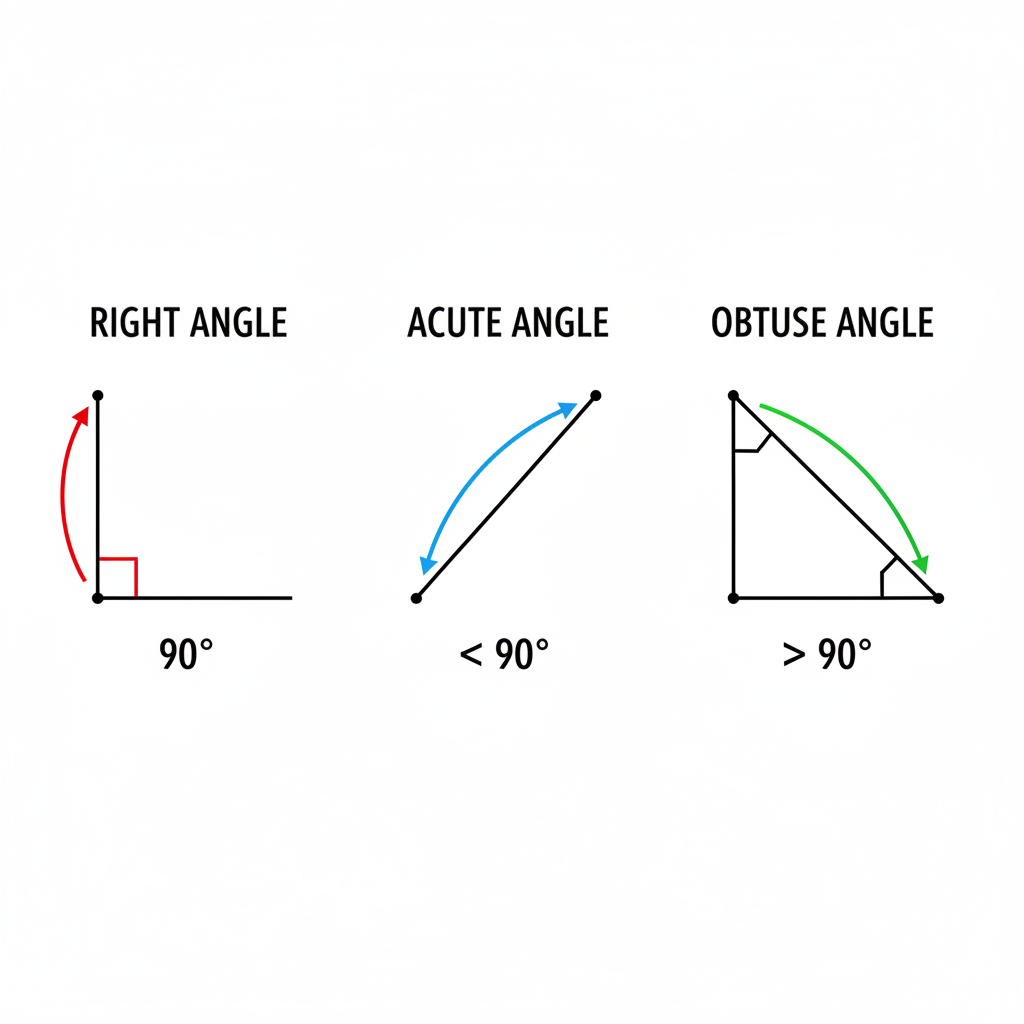
A right angle is like the corner of a perfect square or a rectangle. Think about the corner of a book, the corner of a window, or the corner where a wall meets the floor. These are all examples of right angles! They are exactly 90 degrees. We often see a little square drawn in the corner of a right angle to show that it's exactly a right angle. It's like a special stamp of approval!
Analogy: Imagine you're building with LEGOs. When you snap two bricks together so they form a perfect 'L' shape, that corner is a right angle. Or think about a stop sign – the corners are perfect right angles.
Key Feature: A right angle looks like the letter 'L'.
2. Acute Angles: The Shy Angles!
An acute angle is smaller than a right angle. Think of it as a 'cute' little angle, because it's less than 90 degrees. The word 'acute' means 'sharp' or 'pointed', and these angles look sharp and pointed!
Analogy: Imagine you're opening a door just a little bit, not wide open, but just a crack. That small opening makes an acute angle. Or think about the pointy beak of a bird – the angle at the tip is acute. Another example is the angle formed by the hands of a clock when it's showing a time like 1:00 or 2:00.
Key Feature: An acute angle is always smaller than a right angle.
3. Obtuse Angles: The Wide Angles!
An obtuse angle is larger than a right angle. These angles are 'open' wider than a right angle. They are greater than 90 degrees but less than 180 degrees (which is a straight line).
Analogy: Imagine you're opening a door almost all the way. That wide opening makes an obtuse angle. Think about a reclining chair – the angle between the seat and the backrest when it's almost flat is obtuse. Or consider the angle formed by the hands of a clock when it's showing a time like 4:00 or 5:00.
Key Feature: An obtuse angle is always wider than a right angle.
Let's Review!
- Right Angle: Exactly like the corner of a square (90 degrees). Think 'L' shape.
- Acute Angle: Smaller than a right angle (less than 90 degrees). Think 'cute' and 'sharp'.
- Obtuse Angle: Larger than a right angle (more than 90 degrees, but less than a straight line). Think 'wide' and 'open'.
Keep your eyes peeled for angles everywhere you go!
Keep learning, free
Create a free Syllabax account to unlock practice questions and games for this topic.
Visual Learning Enhanced! 🚀
To help you master this topic, we use Advanced Syllabax AI to generate detailed diagrams and visual models.
Note on Visuals: The AI sometimes makes spelling errors in image labels. Please refer to the lesson text for the correct terminology.