Environmental impact[PHYSICS]
Watch this topic in 60 seconds
Free preview · Lesson 1
Understanding Environmental impact[PHYSICS]
Environmental Impact: A Physics Perspective (Grade 10 - Foundational)
Welcome, future scientists! Today, we're going to explore how the fundamental laws of physics shape our environment and how human actions leave an 'environmental footprint.' Think of the Earth as a giant, intricate machine, and physics is the instruction manual that helps us understand how it works and what happens when we tinker with it. We'll break down complex ideas into simple terms, using lots of analogies to make sense of it all.
Chapter 1: The Energy Engine of Our World
1.1 Energy: The Ultimate Changer
At its core, physics is about energy. Energy is the ability to do work or cause change. It comes in many forms: the energy stored in food (chemical energy), the energy of a moving car (kinetic energy), the energy of a ball held high (potential energy), or the energy that makes things warm (thermal energy or heat). Imagine energy like a universal currency. You can't create it or destroy it, but you can change it from one form to another, like exchanging dollars for euros.
1.2 Powering Our Lives - And Its Footprint
Our modern world runs on energy. We use it to light our homes, power our phones, drive our cars, and manufacture everything we use. Where does all this energy come from? Historically, and still predominantly today, much of it comes from 'fossil fuels' like coal, oil, and natural gas. These are like ancient batteries, storing energy from sunlight that plants captured millions of years ago. When we burn them, we release that stored energy.
Think of fossil fuels as a limited savings account. The money (energy) in it is finite. Once you spend it, it's gone. In contrast, 'renewable energy' sources like solar, wind, and hydro power are like a regular paycheck that keeps coming in. The sun shines every day, the wind blows, and rivers flow. Understanding this distinction is crucial to understanding our environmental impact.
1.3 Energy Transformations and 'Waste'
The First Law of Thermodynamics, also known as the Law of Conservation of Energy, states that energy cannot be created or destroyed, only transformed from one form to another. For example, when you turn on a light bulb, electrical energy transforms into light energy and also heat energy. When a car burns gasoline, chemical energy transforms into kinetic energy (to move the car) and a lot of heat energy (which is why the engine gets hot).
But here's the catch: while energy isn't lost, useful energy often is. The Second Law of Thermodynamics, in simple terms, tells us that every time energy changes form, some of it becomes less 'useful' and often disperses as heat. Imagine trying to tidy a messy room: no matter how hard you try, some dust always seems to get around, making the room slightly less orderly. In energy terms, this 'dust' is often heat that dissipates into the environment, contributing to what we call 'thermal pollution' or simply wasted energy. This is why we talk about 'energy efficiency' – how much of the initial energy we put in actually does the work we want it to do, versus how much turns into unusable heat.
Chapter 2: The Earth's Blanket and Our Role
2.1 Heat Transfer Basics
Heat, or thermal energy, moves in three main ways:
- Conduction: Heat transfer through direct contact. Like touching a hot stove.
- Convection: Heat transfer through the movement of fluids (liquids or gases). Like boiling water, where hot water rises and cool water sinks.
- Radiation: Heat transfer through electromagnetic waves, even through empty space. Like feeling the warmth of the sun on your skin.
2.2 The Greenhouse Effect: Earth's Natural Blanket
Our planet has a natural process called the greenhouse effect, which is vital for life. It works a bit like a blanket. The sun's energy (mostly visible light and ultraviolet radiation) shines down on Earth. Some of this energy is absorbed by the Earth's surface, warming it up. The Earth then radiates some of this energy back into space as infrared radiation (heat).
Certain gases in our atmosphere, like carbon dioxide (CO2), methane (CH4), and water vapor, are very good at absorbing this outgoing infrared radiation. They act like the glass roof of a greenhouse or a car parked in the sun – they let the sun's energy in but trap some of the heat trying to escape, keeping the Earth warm enough to support life. Without this natural greenhouse effect, Earth would be a frozen wasteland.
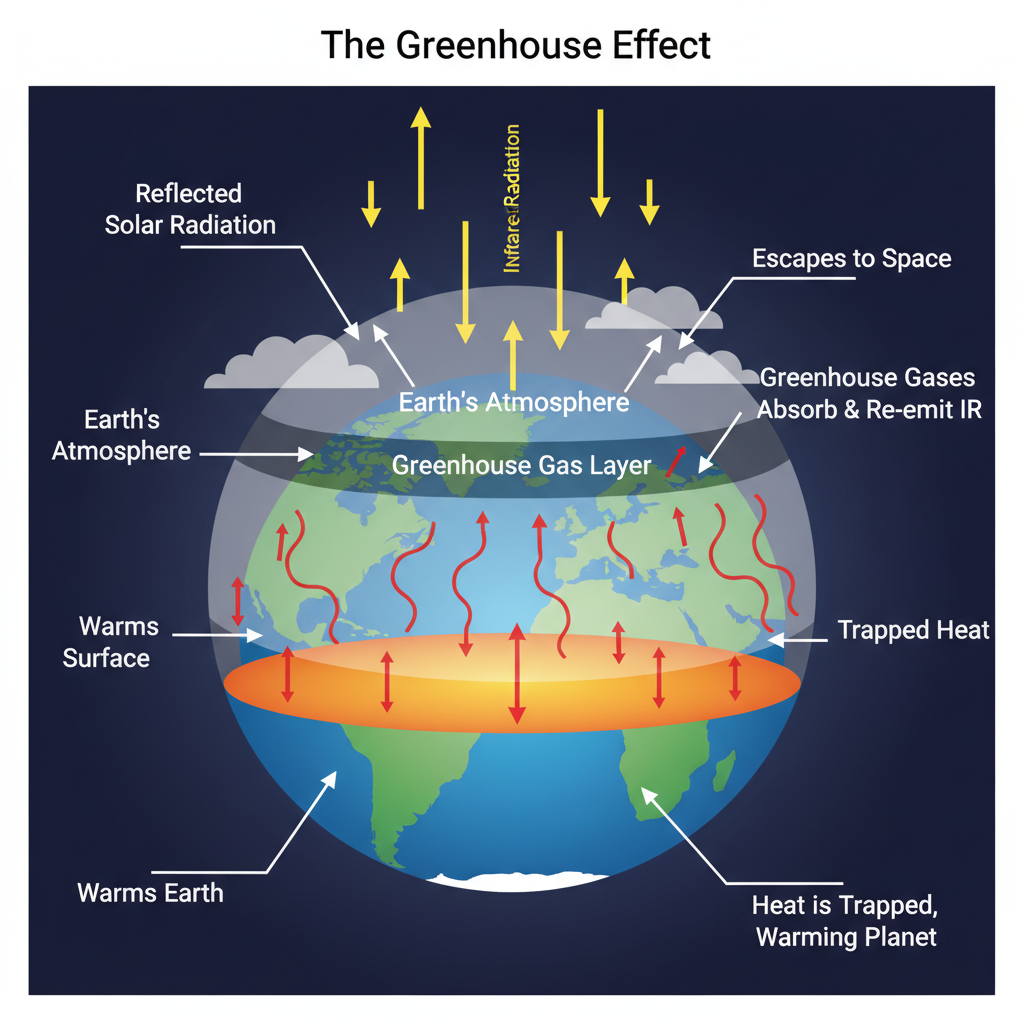 ⚠️ This picture may have spelling mistakes. Trust the words in the lesson.
2.3 Human Activities and the Blanket
Here's where physics connects directly to our impact. When we burn fossil fuels for energy, we release large amounts of greenhouse gases, especially CO2, into the atmosphere. This is like adding extra, thicker blankets to the Earth. While a natural blanket is good, too many blankets can make you uncomfortably hot. By increasing the concentration of these heat-tratrapping gases, we are intensifying the natural greenhouse effect, leading to a rise in global average temperatures – a phenomenon known as global warming or climate change. The physics of how these gases absorb specific wavelengths of infrared radiation is a key piece of this puzzle.
Chapter 3: Pollution: Unwanted Byproducts
Pollution isn't just about chemicals; it has significant physical components that physics helps us understand.
3.1 Air Pollution (Physics Perspective)
When we burn fuels, not only do we release greenhouse gases, but also tiny solid particles and liquid droplets called 'particulates' (like smoke, soot, and dust) into the air. These particulates can scatter and absorb sunlight, affecting visibility (think smog) and even influencing local temperatures. They can also travel long distances due to wind and atmospheric circulation (convection), impacting air quality far from their source. The physics of how these particles interact with light and air currents is complex but vital.
3.2 Water Pollution (Physical Impact)
- Thermal Pollution: Many power plants use water from rivers or lakes to cool their systems. This warmed water is then often released back into the source, raising its temperature. This change in water temperature (thermal energy) can drastically impact aquatic ecosystems, as many species are sensitive to even small temperature fluctuations.
- Plastic Pollution: Plastics are a physical pollutant. These materials, often derived from fossil fuels, don't biodegrade easily. They break down into smaller and smaller pieces called 'microplastics,' which can be ingested by marine life and spread throughout the food chain, physically disrupting organisms and ecosystems. The physics of material strength and degradation over time is relevant here.
3.3 Noise Pollution
Noise pollution is simply unwanted or excessive sound. Sound is a form of mechanical energy that travels as waves. Sources like traffic, airplanes, and industrial machinery create sound waves that can be disruptive and harmful to human and animal health. Physics helps us understand sound intensity (decibels), frequency, and how sound waves propagate through different mediums, allowing us to measure and mitigate noise pollution.
Chapter 4: Resource Depletion: Running on Empty?
4.1 Non-renewable vs. Renewable Resources
We've touched on this, but let's reinforce it. Non-renewable resources are those that exist in finite quantities and are consumed much faster than nature can replenish them. Fossil fuels are the prime example. Once they're burned, they're gone. Imagine a single jar of your favorite candy – once you eat it all, there's no more.
Renewable resources, like solar energy, wind energy, and hydropower, are continually replenished by natural processes. Think of an apple tree that produces fruit every year – you can keep harvesting from it sustainably. The physics of harnessing these natural flows of energy is what makes them so promising.
4.2 The Physics of Consumption
Our increasing demand for energy means we are rapidly depleting non-renewable resources. The rate at which we extract and consume these resources has profound environmental consequences, from the physical disruption of mining and drilling sites to the pollution generated during their extraction and use. Physics helps us quantify these demands (e.g., how many joules of energy a city consumes daily) and understand the energy conversion efficiencies at each step, highlighting where resources are wasted.
Chapter 5: Towards a Sustainable Future (Physics Solutions)
The good news is that physics also offers solutions!
5.1 Renewable Energy Technologies
- Solar Power: Photovoltaic cells (solar panels) use the 'photoelectric effect' – a physics phenomenon where light energy (photons) strikes a material and knocks electrons loose, creating an electric current.
- Wind Power: Wind turbines convert the kinetic energy of moving air into rotational mechanical energy, which then drives a generator to produce electrical energy. This is a direct application of energy transformation.
- Hydropower: The potential energy of water stored behind a dam is converted into kinetic energy as it flows downhill, turning turbines that generate electricity.
5.2 Energy Efficiency and Conservation
Improving energy efficiency means getting more useful work out of the energy we consume. This involves applying physics principles to design better insulation for buildings (reducing heat transfer), more efficient engines (reducing heat loss), and smarter electronics. Conservation, on the other hand, is about reducing our overall energy consumption through behavioral changes and mindful use.
Conclusion
Understanding the environmental impact through the lens of physics reveals that our planet is a complex system governed by fundamental laws of energy and matter. From the burning of fossil fuels and the resulting greenhouse effect to the various forms of pollution and the depletion of finite resources, physics provides the tools to comprehend these challenges. More importantly, it empowers us to develop innovative solutions, from harnessing renewable energy to improving energy efficiency, paving the way for a more sustainable future.
Keep learning, free
Create a free Syllabax account to unlock practice questions and games for this topic.
Visual Learning Enhanced! 🚀
To help you master this topic, we use Advanced Syllabax AI to generate detailed diagrams and visual models.
Note on Visuals: The AI sometimes makes spelling errors in image labels. Please refer to the lesson text for the correct terminology.