Dependent Events
Watch this topic in 60 seconds
Free preview · Lesson 1
Understanding Dependent Events
Understanding Dependent Events: When One Thing Changes Everything Else!
Welcome, future probability whizzes! Today, we're going to embark on an exciting journey into the world of "Dependent Events." Don't let the fancy name scare you; it's a super important idea in math and life, and we'll break it down into tiny, easy-to-understand pieces. By the end of this, you'll be able to spot dependent events like a detective spots clues!
What is Probability, Anyway? A Quick Refresh
Before we dive into dependency, let's quickly remember what probability is. Imagine you have a coin. If you flip it, what's the chance it lands on heads? It's 1 out of 2, or 50%, right? Probability is just a way of measuring how likely something is to happen. It's usually a number between 0 (impossible) and 1 (certain).
Events: The "Things" That Happen
In probability, we talk a lot about "events." An event is simply an outcome or a set of outcomes in an experiment. For example:
- Flipping a coin and getting "heads" is an event.
- Rolling a die and getting a "4" is an event.
- Drawing a red card from a deck is an event.
Now, let's think about what happens when two or more events occur. This is where "dependent" and "independent" come into play.
The Big Idea: Dependent Events Explained
Alright, grab your thinking caps! **Dependent events** are like a chain reaction. They are two or more events where the outcome of the first event *changes* the probability of the second event happening. Think of it this way: what happens first has a direct impact on what can happen next.
Analogy 1: The Cookie Jar Caper!
Imagine you have a cookie jar with 5 chocolate chip cookies and 5 oatmeal cookies. You love chocolate chip!
- Event 1: You reach in and grab a chocolate chip cookie and EAT IT! (Mmm, delicious!)
- Event 2: Your little brother then reaches into the same jar to grab a cookie.
Before you ate your cookie, there were 10 cookies in total (5 chocolate chip, 5 oatmeal). The probability of your brother getting a chocolate chip cookie was 5/10. But because you ate one chocolate chip cookie, now there are only 9 cookies left, and only 4 of them are chocolate chip!
So, the probability of your brother getting a chocolate chip cookie has changed from 5/10 to 4/9. Your action (eating a cookie) *depended* on what was available, and it *changed* what was available for the next person. That's a dependent event!
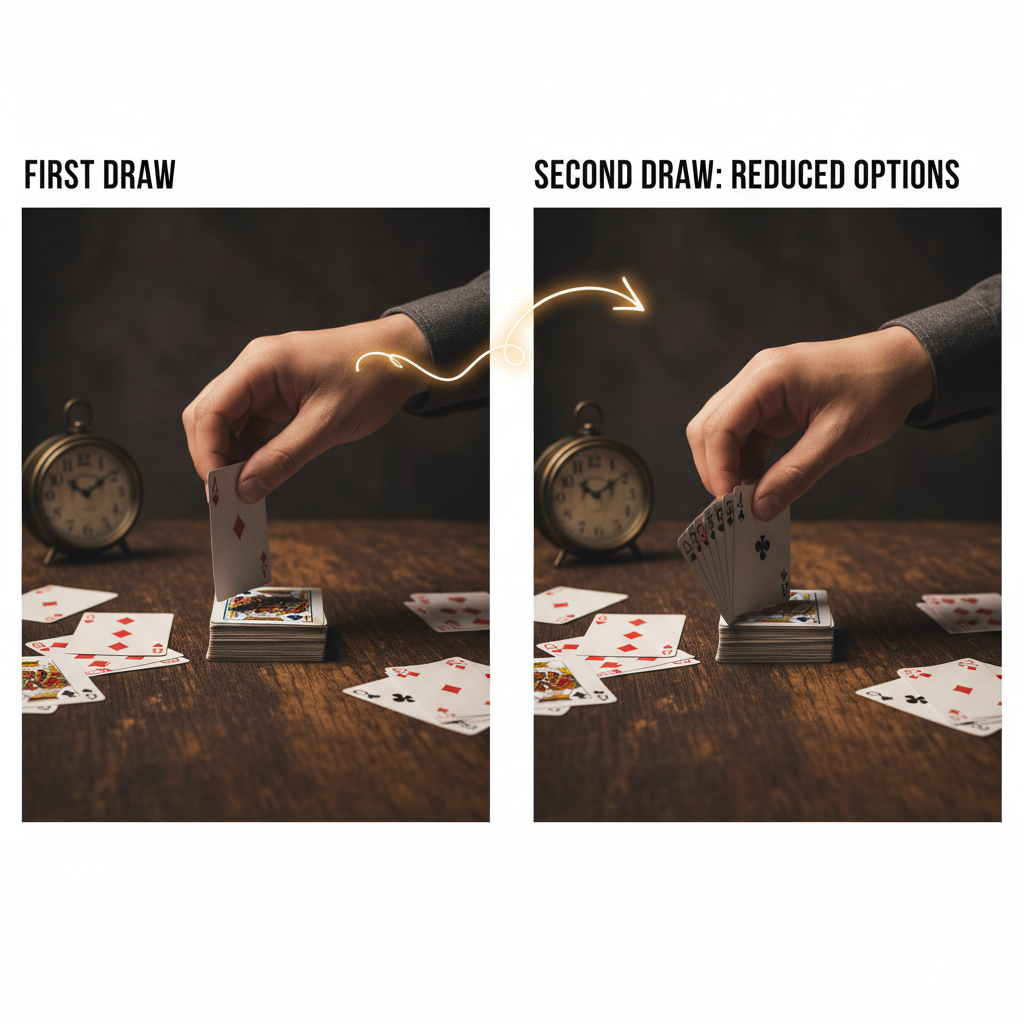
Analogy 2: The Magic Deck of Cards
Let's use a standard deck of 52 playing cards. There are 4 suits (hearts, diamonds, clubs, spades) and 13 cards in each suit.
Scenario A (Dependent): Drawing cards *without replacement*
- Event 1: You draw a Queen of Hearts from the deck. You keep it.
- Event 2: Now, your friend draws a card from the *remaining* cards.
What happened?
- Initially, there were 52 cards. The probability of drawing *any* specific card was 1/52. The probability of drawing a Queen was 4/52.
- After you drew the Queen of Hearts and *didn't put it back*, there are now only 51 cards left in the deck.
- Also, there are now only 3 Queens left instead of 4.
The probability of your friend drawing another Queen (or any other specific card) has changed because the deck itself has changed. The second draw is "dependent" on the first draw.
Analogy 3: The Jigsaw Puzzle
Imagine you're putting together a 1000-piece jigsaw puzzle.
- Event 1: You find a corner piece. (Awesome!)
- Event 2: You then look for another corner piece.
Before you found the first corner piece, there were 4 corner pieces in total. After you find one, there are only 3 corner pieces left to find. Your chance of finding another specific corner piece changes after the first one is removed from the 'available to be found' pile. This is also a form of dependency.
How are Dependent Events Different from Independent Events? (A Quick Contrast)
It's helpful to understand dependent events by briefly looking at their opposite: independent events.
Independent events are when the outcome of one event *does not* affect the outcome of another event. They're like two separate stories happening at the same time, with no influence on each other.
Example of Independent Events:
- You flip a coin and get heads.
- Then, you flip the coin *again*.
Does the first flip change the probability of the second flip? No! Each coin flip is a fresh start, always a 50/50 chance for heads or tails, regardless of what happened before. The coin doesn't remember!
Key Difference: With dependent events, something is *removed* or *changed* from the available options, or the circumstances themselves are altered. With independent events, the circumstances reset or remain the same for each trial.
Calculating Probabilities for Dependent Events (The Simple Way)
When you want to find the probability of two dependent events both happening, you multiply their probabilities. But there's a special twist:
P(A and B) = P(A) * P(B after A has occurred)
Let's go back to our cookie jar example:
You have a jar with 5 chocolate chip (CC) and 5 oatmeal (O) cookies (total 10 cookies).
What is the probability that you pick a chocolate chip cookie, and then (without replacement) your brother also picks a chocolate chip cookie?
- Probability of Event A (You pick a CC cookie):
- There are 5 CC cookies out of 10 total.
- P(You pick CC) = 5/10 = 1/2
- Probability of Event B (Brother picks a CC cookie) *after* Event A has occurred:
- Now there are only 9 cookies left in the jar.
- And since you ate a CC cookie, there are only 4 CC cookies left.
- P(Brother picks CC | You picked CC) = 4/9
- Now, multiply these probabilities:
- P(Both pick CC) = P(You pick CC) * P(Brother picks CC after you did)
- P(Both pick CC) = (5/10) * (4/9)
- P(Both pick CC) = (1/2) * (4/9)
- P(Both pick CC) = 4/18 = 2/9
So, there's a 2/9 chance (or about 22%) that both you and your brother will pick a chocolate chip cookie.
Why is this important?
Understanding dependent events is super useful!
- In games: Think about card games like Poker or Blackjack. The cards dealt change the probabilities of what's left in the deck.
- In science: If you're studying a population of animals and removing some for observation, the characteristics of the remaining population change.
- In daily life: If you have a list of tasks to do, completing one task often changes the conditions for the next (e.g., finishing your homework means you can now play games).
Recap and Reinforcement
Let's quickly review the core idea:
- An "event" is something that happens.
- "Dependent events" are when the outcome of one event directly impacts the probability of a subsequent event.
- The key phrase to look for is "without replacement" or any scenario where the total number of items or the number of specific items changes after the first event.
- To find the probability of two dependent events both happening, you multiply the probability of the first event by the probability of the second event *given that the first event already occurred*.
You've done a fantastic job exploring this foundational concept! Keep an eye out for dependent events in your everyday life – you'll be surprised how often they pop up!
Keep learning, free
Create a free Syllabax account to unlock practice questions and games for this topic.
Visual Learning Enhanced! 🚀
To help you master this topic, we use Advanced Syllabax AI to generate detailed diagrams and visual models.
Note on Visuals: The AI sometimes makes spelling errors in image labels. Please refer to the lesson text for the correct terminology.