Learning Journey
Watch this topic in 60 seconds
Free preview · Lesson 1
Understanding Respiratory system[BIOLOGY]
The Amazing Respiratory System: Your Body's Air Machine!
Welcome, young scientists, to the incredible world of your respiratory system! Have you ever wondered how you get the energy to run, jump, play, and even think? A big part of that energy comes from the air you breathe. Your respiratory system is like a sophisticated air machine inside your body, working constantly to keep you alive and energized!
What is the Respiratory System?
The respiratory system is a network of organs and tissues that helps you breathe. It's responsible for taking in oxygen from the air and getting rid of a waste product called carbon dioxide. Think of it like a delivery service for your body. Oxygen is like a package that your cells need to work, and carbon dioxide is like the trash that needs to be hauled away.
The Journey of Air: Following the Path
Let's follow a breath of air as it travels through your respiratory system. It's quite a journey!
1. The Nose and Mouth: The Entry Points
Your breath usually starts its journey through your nose or mouth. Your nose is the best entry point because it has a few superpowers:
- Filtering: Tiny hairs inside your nose act like little brooms, catching dust and other particles so they don't go deeper into your lungs.
- Warming: The air you breathe might be cold, but your nose warms it up to body temperature, making it more comfortable for your lungs.
- Moistening: The air also gets a bit of moisture in your nose, which helps protect your airways.
Your mouth can also be used to breathe, especially when you need a lot of air quickly, like when you're exercising.
2. The Pharynx and Larynx: The Passageways
After passing through your nose or mouth, the air travels down a short tube called the pharynx (which is also part of your throat). From there, it moves into the larynx, also known as the voice box. The larynx is cool because it has vocal cords that vibrate to help you talk and sing!
3. The Trachea: The Windpipe
Next, the air enters the trachea, or windpipe. This is a sturdy tube that carries air down towards your lungs. It's kept open by rings of cartilage, which are like little C-shaped support beams, preventing it from collapsing.
4. The Bronchi and Bronchioles: Branching Out
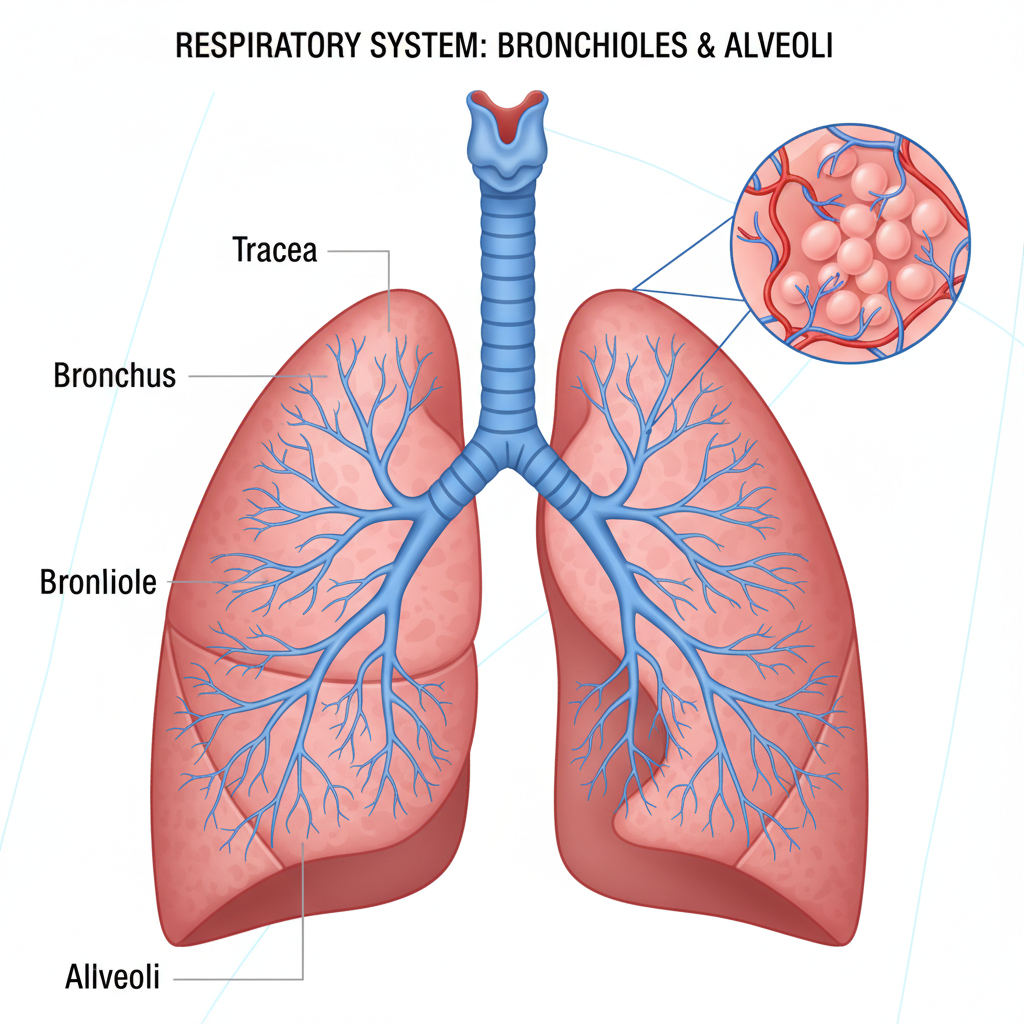
The trachea doesn't go all the way into the lungs. Instead, it splits into two smaller tubes called bronchi (one for each lung). These bronchi then branch off into even smaller tubes, like the branches of a tree, called bronchioles. This branching system is essential for spreading the air throughout the lungs.
5. The Lungs: The Main Air Bags
The lungs are the stars of the show! They are two large, spongy organs located in your chest, protected by your rib cage. Inside the lungs, the bronchioles end in tiny, balloon-like sacs called alveoli. There are millions of these alveoli, and they are where the real magic happens.
 ⚠️ This picture may have spelling mistakes. Trust the words in the lesson.
6. The Alveoli: Tiny Exchange Centers
The alveoli are incredibly small, like tiny bubbles. Their walls are extremely thin, and they are surrounded by a network of tiny blood vessels called capillaries. This is where the exchange of gases takes place:
- Oxygen In: When you inhale, oxygen from the air fills the alveoli. It then passes through the thin walls of the alveoli and into your blood.
- Carbon Dioxide Out: At the same time, carbon dioxide, a waste product from your body's activities, is in your blood. It passes from the blood into the alveoli to be breathed out.
Breathing In and Breathing Out: Inhalation and Exhalation
Breathing is an automatic process, meaning your body does it without you having to think about it. It involves two main actions:
Inhalation (Breathing In)
When you inhale, your diaphragm (a large, dome-shaped muscle below your lungs) contracts and flattens. At the same time, the muscles between your ribs pull your rib cage up and out. This makes the chest cavity larger, creating lower pressure inside your lungs than outside. Air rushes into your lungs to fill this space.
Exhalation (Breathing Out)
When you exhale, your diaphragm relaxes and moves back up into a dome shape. The muscles between your ribs relax, and your rib cage moves down and inward. This makes the chest cavity smaller, increasing the pressure inside your lungs. The extra air, including the carbon dioxide, is pushed out of your lungs.
Why is Breathing Important?
Every single cell in your body needs oxygen to perform its job. Oxygen is used in a process called respiration (which is different from breathing, but they work together!) to create energy. Without oxygen, your cells can't make energy, and your body can't function. Carbon dioxide is a waste product that needs to be removed because too much of it can be harmful.
So, the next time you take a deep breath, remember the incredible journey of air and the vital work your respiratory system is doing for you!
Keep learning, free
Create a free Syllabax account to unlock practice questions and games for this topic.
Visual Learning Enhanced! 🚀
To help you master this topic, we use Advanced Syllabax AI to generate detailed diagrams and visual models.
Note on Visuals: The AI sometimes makes spelling errors in image labels. Please refer to the lesson text for the correct terminology.