Physical separation techniques[CHEMISTRY]
Watch this topic in 60 seconds
Free preview · Lesson 1
Understanding Physical separation techniques[CHEMISTRY]
Understanding Physical Separation Techniques: Unmixing the World!
Have you ever had a bowl of mixed nuts and only wanted to eat the peanuts? Or perhaps you've seen a chef use a colander to drain pasta from water? These everyday actions are perfect examples of what we call physical separation techniques! In chemistry, we often encounter mixtures – combinations of different substances that are physically mixed but not chemically joined. Sometimes, for various reasons, we need to separate these substances from each other. That's where physical separation techniques come in!
What are Mixtures? The Unsung Heroes of Our Daily Lives
Before we dive into how to separate things, let's quickly remember what a mixture is. Imagine a fruit salad: you have apples, grapes, and bananas all in one bowl. They are together, but they are still apples, grapes, and bananas. You can see each individual fruit, and you can pick them out if you want. This is a mixture – two or more substances that are combined physically, but each substance keeps its own unique properties. There's no new substance formed.
Mixtures are everywhere! Air is a mixture of nitrogen, oxygen, argon, and other gases. Saltwater is a mixture of salt and water. Even the soil in your garden is a mixture of dirt, pebbles, water, and decaying leaves.
Why Do We Need to Separate Mixtures?
Think about these scenarios:
- We need pure water for drinking or for experiments.
- We want to extract valuable metals from ore.
- We need to remove impurities from a desired product.
- We might want to recover a solvent after a reaction.
In all these cases, separating components from a mixture is crucial. The great thing about physical separation is that we use the physical properties of the substances (like size, boiling point, magnetism, density) to get them apart, without changing what they actually are.
Key Physical Separation Techniques: Your Chemistry Toolkit!
Let's explore some of the most common and useful physical separation techniques you'll encounter in chemistry, explained in simple terms with lots of analogies!
1. Hand-Picking (or Sorting): The Simplest Method
What it is: This is exactly what it sounds like! You use your hands (or tweezers) to physically pick out the different components of a mixture. It's usually used when the components are large enough to see and handle, and are distinct from each other.
How it works: It relies on differences in appearance, size, or shape.
Analogy: Imagine you have a box of LEGO bricks, and you only want the red ones. You simply pick out all the red bricks with your hands! Or, if you spill a mix of lentils and pebbles on the floor, you can pick out the pebbles.
Examples: Separating different types of vegetables, removing stones from rice, sorting recyclable materials like plastic bottles from glass bottles.
2. Sieving: The Sifter's Secret
What it is: Sieving involves using a sieve (or a mesh screen) with tiny holes to separate components of a mixture based on their size. One component passes through the holes, while the other is retained.
How it works: It relies on a significant difference in particle size.
Analogy: Think about baking a cake. You often sift flour to remove any lumps and make it finer. The fine flour goes through the sieve, while the lumps stay behind. Another example is a sand sifter at the beach – the fine sand falls through, and bigger shells or pebbles are left behind.
Examples: Separating sand from gravel, removing husks from grains, sifting flour, separating finely ground spices from larger chunks.
3. Magnetic Separation: The Power of Attraction
What it is: This technique is used to separate magnetic substances from non-magnetic substances in a mixture.
How it works: It exploits the property of magnetism. Magnets attract materials like iron, nickel, and cobalt.
Analogy: Imagine you've accidentally dropped a box of paperclips into a pile of sand. Instead of painstakingly picking out each paperclip, you can simply run a magnet over the sand. The magnet will attract and lift the paperclips, leaving the sand behind! It's like a superhero magnet picking up all the metal villains.
Examples: Separating iron filings from sulfur powder, separating magnetic ores from non-magnetic rock, recycling plants using large electromagnets to separate ferrous metals from other waste.
4. Decantation: The Gentle Pour
What it is: Decantation is a simple method used to separate an insoluble solid from a liquid, or to separate two immiscible (non-mixing) liquids that have different densities, by carefully pouring off the top layer without disturbing the bottom layer.
How it works: It relies on differences in density. Heavier solids settle at the bottom, or denser liquids settle below less dense liquids.
Analogy: Think about pouring water out of a pot after cooking pasta – you try to leave the pasta in the pot and just pour the water out. Or, if you let a glass of muddy water sit for a while, the mud will settle at the bottom. You can then carefully pour the cleaner water off the top. Another great example is oil and vinegar salad dressing – the oil floats on top of the vinegar because it's less dense, and you can carefully pour the oil off if you wished.
Examples: Separating sand from water (after the sand settles), separating oil from water, separating cream from milk (cream rises to the top).
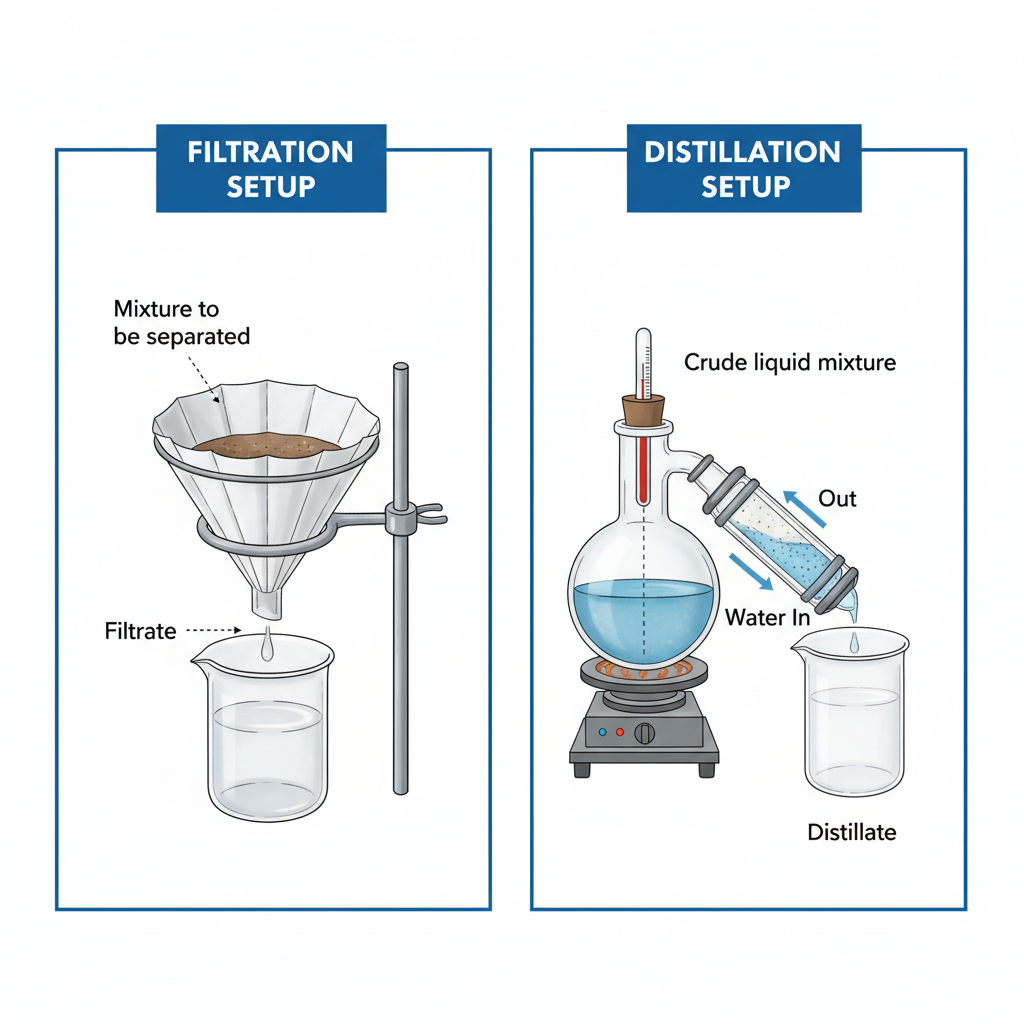
5. Filtration: The Cleaner's Choice
What it is: Filtration is a widely used technique to separate an insoluble solid from a liquid (or a gas) by passing the mixture through a filter medium that allows the liquid (or gas) to pass through but retains the solid particles.
How it works: It relies on particle size difference, similar to sieving, but usually for much smaller particles. The filter paper has pores too small for the solid particles to pass through.
Analogy: The most common analogy is making coffee. When you pour hot water over coffee grounds in a coffee maker, the water (now coffee!) passes through the filter paper, leaving the coffee grounds behind. The filter paper acts as a barrier, trapping the solid coffee grounds while letting the liquid coffee through. Your lungs also filter the air you breathe!
Terms: The liquid that passes through the filter is called the filtrate. The solid that remains on the filter paper is called the residue.
Examples: Separating chalk powder from water, removing impurities from water in a water purification plant, air filters in cars or homes.
6. Evaporation: Disappearing Act for Liquids
What it is: Evaporation is used to separate a soluble solid (a solid that has dissolved) from its solvent (usually a liquid). The liquid is heated and turns into a gas (evaporates), leaving the solid behind.
How it works: It relies on the difference in boiling points. The solvent has a much lower boiling point than the dissolved solid.
Analogy: Imagine you spill some salty water on the kitchen counter. After a while, the water disappears (evaporates), but you're left with a white salty residue on the counter. The sun does this naturally to puddles after it rains, leaving behind any dust or minerals that were dissolved in the rainwater. Similarly, how salt is harvested from seawater in large salt pans – the sun evaporates the water, leaving pure salt crystals behind.
Important Note: This method is ideal when you want to recover the solid, but you don't care about recovering the liquid, as the liquid is lost to the atmosphere as vapor.
Examples: Obtaining salt from saltwater, separating sugar from water (if the sugar isn't heat-sensitive), drying clothes in the sun.
7. Distillation: The Purifier
What it is: Distillation is a more sophisticated technique used to separate components of a liquid mixture based on differences in their boiling points. It involves heating the mixture to vaporize one component, then cooling the vapor to condense it back into a liquid, which is collected separately.
How it works: It leverages significant differences in boiling points. The substance with the lower boiling point evaporates first, then condenses, leaving the other component(s) behind.
Analogy: Think about purifying water. If you boil salty water, the water turns into steam (vapor), leaving the salt behind. If you then collect and cool this steam, it turns back into pure liquid water, free from salt. It's like the water is taking a 'steam vacation' away from the salt, then coming back as a purified version of itself. Another analogy is how moonshine used to be made (illegally!) – alcohol boils at a lower temperature than water, so you can separate it by boiling and re-condensing.
Types of Distillation:
- Simple Distillation: Used to separate a liquid from a dissolved non-volatile solid (like salt from water) or to separate two liquids with significantly different boiling points (at least 25°C difference).
- Fractional Distillation: Used to separate liquids with boiling points that are closer together (e.g., separating components of crude oil into petrol, diesel, etc.). This involves a special column to improve separation, but you'll learn more about this later!
Terms: The vaporized and then condensed liquid is called the distillate. The substance left in the original flask is the residue.
Examples: Purifying water, separating alcohol from water, separating crude oil into different fractions (fuels, lubricants), producing distilled spirits.
Putting It All Together: Choosing the Right Technique
The key to effective separation is choosing the right technique. You need to consider the physical properties of the substances in your mixture:
- Are they solids, liquids, or gases?
- What are their sizes?
- Are they magnetic?
- Are they soluble or insoluble in a solvent?
- What are their densities?
- What are their boiling points?
By understanding these properties, you can become a master of unmixing and purification!
Keep learning, free
Create a free Syllabax account to unlock practice questions and games for this topic.
Visual Learning Enhanced! 🚀
To help you master this topic, we use Advanced Syllabax AI to generate detailed diagrams and visual models.
Note on Visuals: The AI sometimes makes spelling errors in image labels. Please refer to the lesson text for the correct terminology.