Soap & micelles[CHEMISTRY]
Watch this topic in 60 seconds
Free preview · Lesson 1
Understanding Soap & micelles[CHEMISTRY]
Soap & Micelles: The Science Behind Getting Clean!
Have you ever wondered why soap is so good at cleaning? It's not just magic! There's fascinating chemistry happening right in your hands every time you wash. In this lesson, we're going to dive into the world of soap and tiny structures called micelles to understand how they work together to make things spotless.
The Great Divide: Water vs. Oil
Before we talk about soap, let's understand a fundamental problem: water and oil (or grease) don't mix. You've probably heard the saying, "They go together like oil and water!" This is because water molecules are 'polar' – they have a slightly positive end and a slightly negative end, like tiny magnets. This allows them to stick together very strongly. Oil and grease molecules, however, are 'non-polar' – they don't have these charged ends and prefer to stay away from the strongly-attracting water molecules. Imagine water molecules holding hands tightly in a circle, and oil molecules are like someone trying to join but can't because they don't know the secret handshake. So, when you try to wash greasy hands with just water, the water just rolls off the grease, doing very little cleaning.
Enter Soap: A Chemical Mediator!
This is where soap comes to the rescue! Soap is a special kind of molecule that acts like a mediator or a bridge between water and oil. It's unique because it has a split personality, allowing it to interact with both oil and water. Think of a diplomat who can speak two different languages, allowing them to communicate with two groups who otherwise couldn't understand each other.
The Two Sides of a Soap Molecule: Head and Tail
Every soap molecule has two main parts:
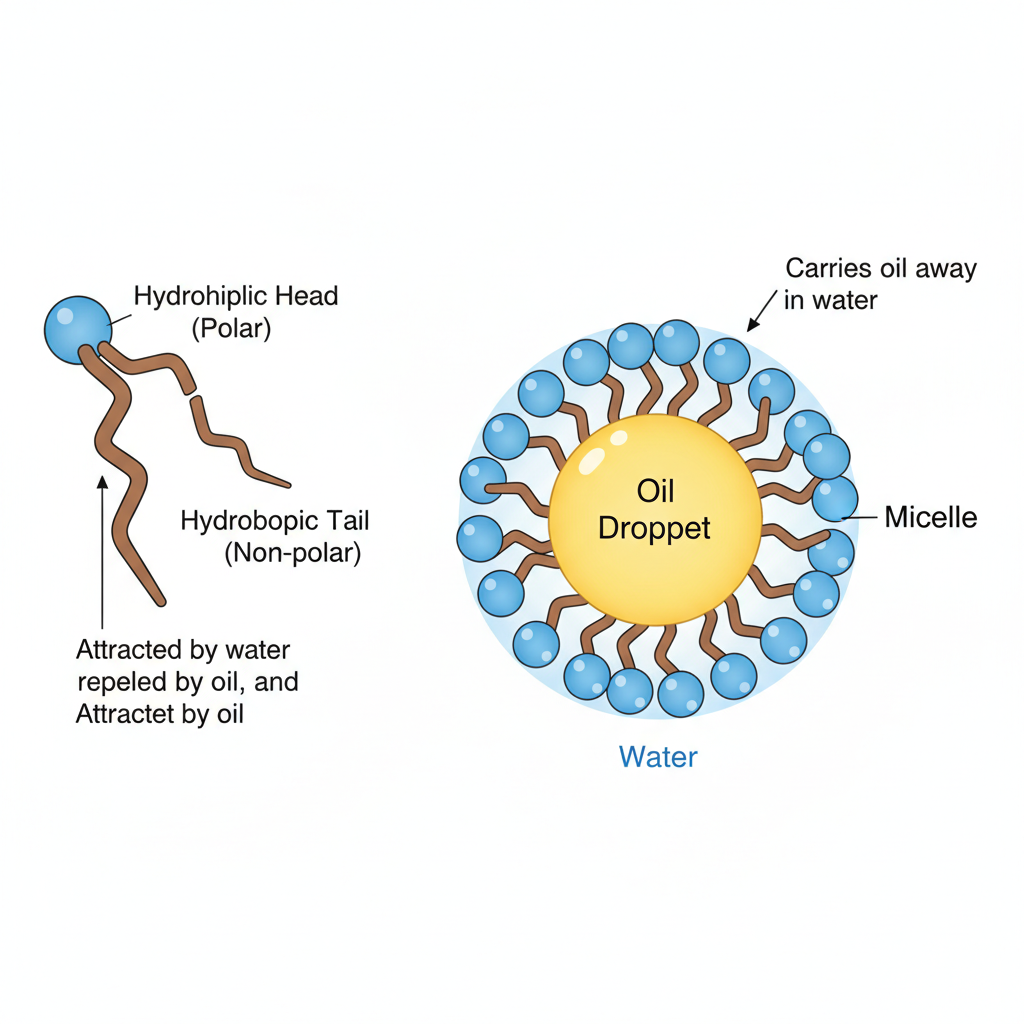
- The Hydrophilic Head (Water-Loving): This part of the soap molecule absolutely loves water. "Hydro" means water, and "philic" means loving. The head is usually an ion (a charged atom or group of atoms), which makes it polar, just like water. It’s like a friendly puppy that loves to jump into a puddle! This head happily dissolves and mixes with water.
- The Hydrophobic Tail (Water-Fearing): This part of the soap molecule, on the other hand, dislikes water intensely. "Hydro" means water, and "phobic" means fearing. This tail is a long chain of carbon and hydrogen atoms, making it non-polar, much like oil or grease. It's like a grumpy cat that avoids water at all costs! Instead of water, it prefers to mingle with other non-polar substances, like oil and grease.
So, picture a soap molecule like a tiny tadpole: a round head that loves water and a long tail that tries to get away from it. Or, think of it as a person who loves swimming but hates getting their hair wet – they'll happily dive in, but try to keep their head above water!
 ⚠️ This picture may have spelling mistakes. Trust the words in the lesson.
The Micelle Mission: Trapping Dirt!
Now, let's see how these unique soap molecules actually clean. When you mix soap with water and greasy dirt, the soap molecules go on a mission:
- Surrounding the Greasy Dirt: The hydrophobic (water-fearing) tails of the soap molecules quickly seek out the greasy dirt or oil. They burrow into the grease, trying to get as far away from the surrounding water as possible. It's like a group of friends who dislike the rain, all huddling together under a tiny umbrella (the grease) to stay dry.
- Facing the Water: At the same time, the hydrophilic (water-loving) heads of the soap molecules point outwards, happily interacting with the water all around. They're like the umbrella's handle, exposed to the rain but perfectly fine with it.
- Forming a Micelle: As more and more soap molecules surround the grease, they form a tiny, spherical structure called a micelle. Inside this micelle, the greasy dirt is completely encapsulated by the hydrophobic tails. On the outside, the hydrophilic heads form a protective, water-friendly shell. Imagine a tiny ball made of soap, with the grease trapped right in its center. It's like a tiny, invisible cleaning submarine that has captured the oil!
Once the grease is trapped inside these micelles, something amazing happens. Because the outside of the micelle is entirely made of water-loving soap heads, the whole micelle (with the trapped dirt inside) can now easily mix and float in the water. It’s like the "diplomat" soap molecule has made the oil "speak water's language."
Rinsing Away the Grime
When you rinse your hands or clothes with water, these micelles, carrying their captured cargo of dirt and grease, are easily washed away. The water flows over them, carrying the water-soluble micelles and their dirty contents down the drain. Without soap, the water would simply slide over the grease, leaving it behind. With soap, the grease is picked up, packaged into micelles, and then rinsed away! This process is called emulsification – where two immiscible (non-mixing) liquids are made to mix, or one is dispersed throughout the other.
Why Is This Important?
Understanding soap and micelles isn't just a fun chemistry fact; it's fundamental to hygiene and many industries! From washing dishes and laundry to personal care products like shampoo and body wash, the micelle mechanism is at play. It allows us to remove dirt, oil, and bacteria effectively, contributing to our health and cleanliness every day.
So, the next time you use soap, remember the clever little molecules with their split personalities, diligently working to trap grime in tiny spheres and wash it all away. It's a true marvel of simple chemistry making a big difference!
Keep learning, free
Create a free Syllabax account to unlock practice questions and games for this topic.
Visual Learning Enhanced! 🚀
To help you master this topic, we use Advanced Syllabax AI to generate detailed diagrams and visual models.
Note on Visuals: The AI sometimes makes spelling errors in image labels. Please refer to the lesson text for the correct terminology.