Estimation & rounding [Mental Arithmetic]
Watch this topic in 60 seconds
Free preview · Lesson 1
Understanding Estimation & rounding [Mental Arithmetic]
Estimation & Rounding: Your Superpower for Numbers!
Welcome, awesome mathematicians! Today, we're going to unlock a secret superpower that will make dealing with numbers so much easier. This superpower is called Estimation and Rounding! Think of it like being a detective for numbers, figuring out what they're *about* or *close to* without needing to be perfectly exact. It's like guessing how many jellybeans are in a jar – you don't count every single one, but you can make a really good guess!
What is Estimation?
Estimation is all about making a smart guess. When we estimate, we try to find an answer that is close to the real answer. It's not the exact answer, but it's close enough for many situations.
Imagine you're going to the store with
Estimation is super useful when:
- You need to find an answer quickly.
- You don't need the *exact* answer.
- The exact answer is too hard to find.
- You want to check if your exact answer makes sense.
What is Rounding?
Rounding is a special tool we use to help us estimate. When we round a number, we change it to a nearby, simpler number, usually one that ends in a 0 or a 5. Think of it like smoothing out the bumps on a road. Instead of a bumpy, uneven path, you get a nice, smooth, easy-to-travel road. Rounding makes numbers smoother!
The most common way to round is to the nearest 10, 100, or 1000. Let's focus on rounding to the nearest 10.
Rounding to the Nearest 10
To round a number to the nearest 10, we look at the ones digit (the very last digit).
- If the ones digit is 5, 6, 7, 8, or 9, we round up. This means we increase the tens digit by 1 and change the ones digit to 0.
- If the ones digit is 0, 1, 2, 3, or 4, we round down. This means we keep the tens digit the same and change the ones digit to 0.
Let's try some examples:
Example 1: Round 37 to the nearest 10.
Look at the ones digit: it's 7. Since 7 is 5 or greater, we round up. The tens digit is 3. We increase it by 1 (to 4) and change the ones digit to 0. So, 37 rounded to the nearest 10 is 40.
Example 2: Round 32 to the nearest 10.
Look at the ones digit: it's 2. Since 2 is 4 or less, we round down. The tens digit is 3. We keep it the same (3) and change the ones digit to 0. So, 32 rounded to the nearest 10 is 30.
What about numbers ending in 5? They are special! Numbers ending in 5 always round up. So, 35 rounded to the nearest 10 is 40.
Think of the numbers 0, 1, 2, 3, 4 as being on the "down" side of the number line, closer to the lower 10. Think of 5, 6, 7, 8, 9 as being on the "up" side, closer to the higher 10.
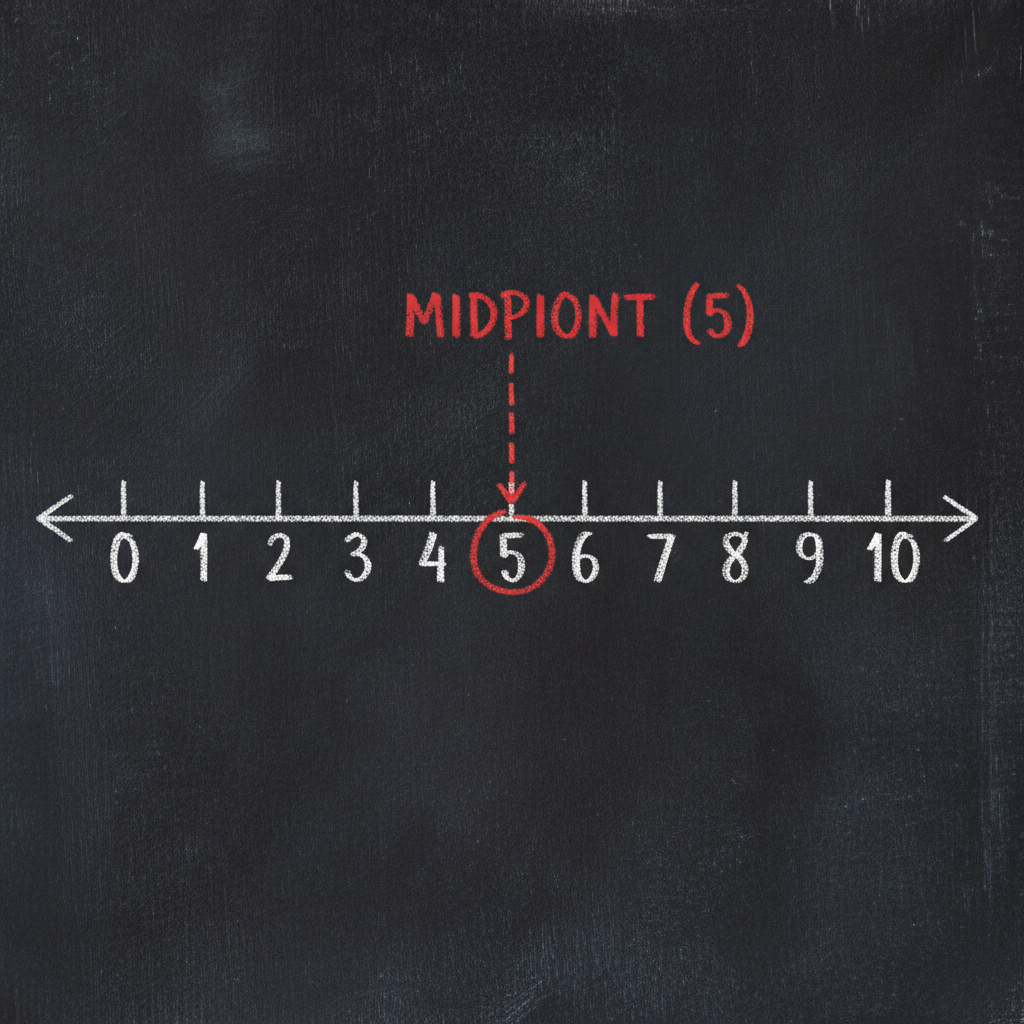 ⚠️ This picture may have spelling mistakes. Trust the words in the lesson.
In the picture above, you can see that numbers from 0 to 4 are closer to 0 (the lower 10), and numbers from 5 to 9 are closer to 10 (the higher 10).
Rounding to the Nearest 100
Rounding to the nearest 100 is very similar! This time, we look at the tens digit (the second digit from the right).
- If the tens digit is 5, 6, 7, 8, or 9, we round up. This means we increase the hundreds digit by 1 and change the tens and ones digits to 0.
- If the tens digit is 0, 1, 2, 3, or 4, we round down. This means we keep the hundreds digit the same and change the tens and ones digits to 0.
Example 3: Round 275 to the nearest 100.
Look at the tens digit: it's 7. Since 7 is 5 or greater, we round up. The hundreds digit is 2. We increase it by 1 (to 3) and change the tens and ones digits to 0. So, 275 rounded to the nearest 100 is 300.
Example 4: Round 230 to the nearest 100.
Look at the tens digit: it's 3. Since 3 is 4 or less, we round down. The hundreds digit is 2. We keep it the same (2) and change the tens and ones digits to 0. So, 230 rounded to the nearest 100 is 200.
See how rounding makes the numbers simpler? This is great for quick calculations!
Using Rounding for Estimation
Now, let's put it all together! We can use rounding to estimate sums (addition) and differences (subtraction).
Example 5: Estimate the sum of 48 + 31.
First, round each number to the nearest 10:
- 48 rounded to the nearest 10 is 50 (because the ones digit is 8, which is 5 or greater).
- 31 rounded to the nearest 10 is 30 (because the ones digit is 1, which is 4 or less).
Now, add the rounded numbers:
50 + 30 = 80
So, the estimated sum of 48 + 31 is 80. The actual sum is 79. Our estimate of 80 is very close!
Example 6: Estimate the difference between 72 and 29.
First, round each number to the nearest 10:
- 72 rounded to the nearest 10 is 70 (because the ones digit is 2, which is 4 or less).
- 29 rounded to the nearest 10 is 30 (because the ones digit is 9, which is 5 or greater).
Now, subtract the rounded numbers:
70 - 30 = 40
So, the estimated difference between 72 and 29 is 40. The actual difference is 43. Our estimate of 40 is very close!
Estimation and rounding are fantastic tools that help us understand numbers better and make quick, smart guesses. Keep practicing, and you'll become an estimation expert in no time!
Keep learning, free
Create a free Syllabax account to unlock practice questions and games for this topic.
Visual Learning Enhanced! 🚀
To help you master this topic, we use Advanced Syllabax AI to generate detailed diagrams and visual models.
Note on Visuals: The AI sometimes makes spelling errors in image labels. Please refer to the lesson text for the correct terminology.