Expanded and short form (Understanding Numbers)
Watch this topic in 60 seconds
Free preview · Lesson 1
Understanding Expanded and short form (Understanding Numbers)
Expanded and Short Form: Understanding Numbers
Welcome, young mathematicians! Today, we're going on an exciting adventure to explore how we write numbers. We'll learn about two ways to write numbers: the short form and the expanded form. Think of it like having a secret code to understand any number, big or small!
What is a Number?
Before we dive into short and expanded forms, let's remember what numbers are. Numbers are symbols that help us count things, measure things, and tell us how many. They are like building blocks for everything around us!
The Short Form: The Quick Way to Write Numbers
Imagine you have a basket with 3 apples, a pile of 5 oranges, and 2 bananas. How would you write that number down quickly? You'd probably write 352. This is the short form of the number. It's like giving your number a nickname – it's short, sweet, and easy to say!
In the short form, we use digits (0, 1, 2, 3, 4, 5, 6, 7, 8, 9) arranged in a specific order to represent a number. Each digit has a special job based on where it sits in the number. This is called its place value.
Understanding Place Value
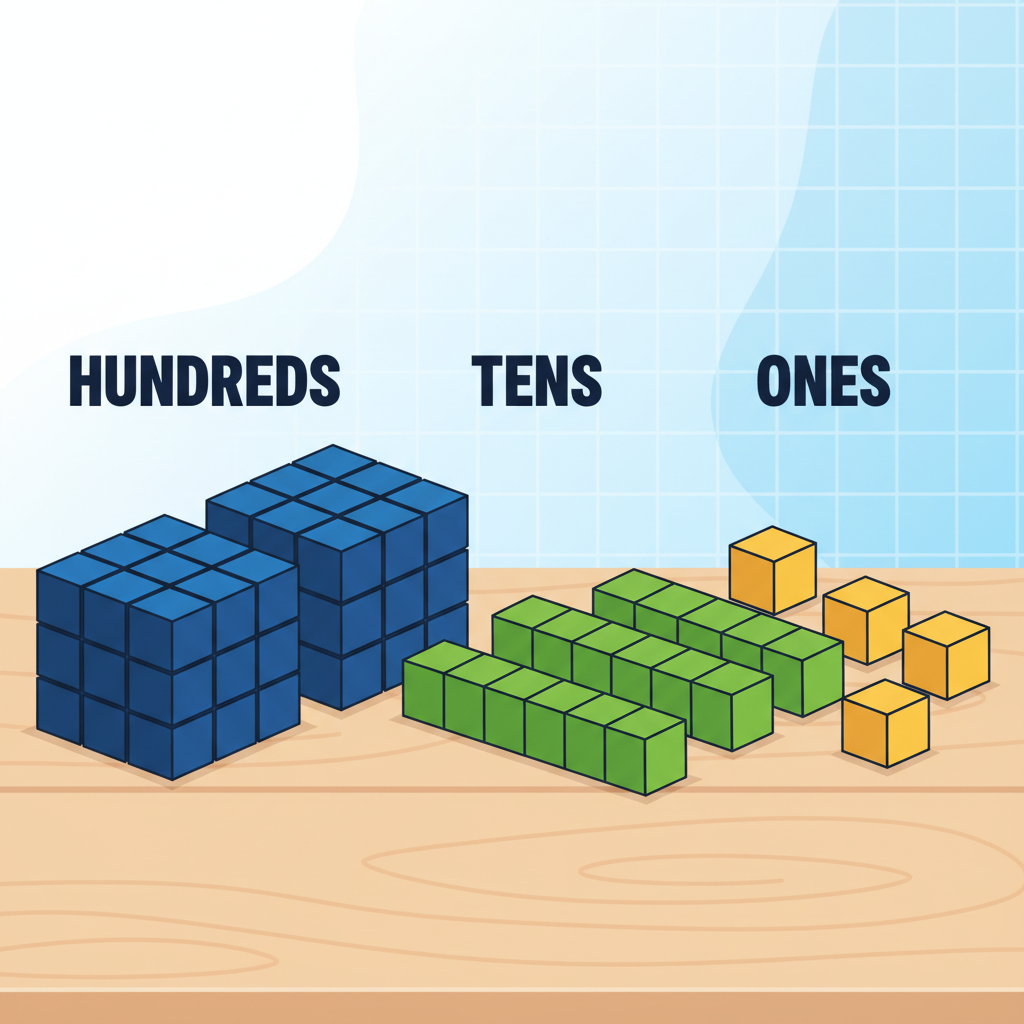
Let's look at our number 352 again. Each digit has a place:
- The digit 2 is in the ones place. It represents 2 individual things. Think of it as 2 single candies.
- The digit 5 is in the tens place. It doesn't just mean 5; it means 5 groups of ten. Think of it as 5 bags, with 10 candies in each bag. That's 50 candies in total!
- The digit 3 is in the hundreds place. It doesn't just mean 3; it means 3 groups of one hundred. Think of it as 3 boxes, with 100 candies in each box. That's 300 candies in total!
So, when we see the number 352 in short form, we know it's made up of 3 hundreds, 5 tens, and 2 ones.
 ⚠️ This picture may have spelling mistakes. Trust the words in the lesson.
The Expanded Form: Telling the Whole Story
Now, what if we wanted to tell the *whole story* of the number 352? We would use the expanded form. This is like unpacking all those candies from their bags and boxes to see exactly how many we have in total.
In expanded form, we write out the value of each digit based on its place. For 352, the expanded form is:
300 + 50 + 2
Let's break this down:
- 300 comes from the digit 3 in the hundreds place (3 x 100).
- 50 comes from the digit 5 in the tens place (5 x 10).
- 2 comes from the digit 2 in the ones place (2 x 1).
The expanded form shows us exactly how much each digit contributes to the total value of the number. It's like saying, "We have 3 hundred things, plus 5 ten things, plus 2 one things."
More Examples!
Let's try another number: 789
- In short form, it's 789.
- What is the place value of each digit?
- 7 is in the hundreds place (700).
- 8 is in the tens place (80).
- 9 is in the ones place (9).
- So, the expanded form of 789 is: 700 + 80 + 9
How about a number with a zero? Let's look at 405.
- In short form, it's 405.
- Place values:
- 4 is in the hundreds place (400).
- 0 is in the tens place (0 x 10 = 0).
- 5 is in the ones place (5).
- The expanded form of 405 is: 400 + 0 + 5. We can also write it as 400 + 5 because adding zero doesn't change the total!
Let's try a bigger number: 1,234
This number has a thousands place!
- In short form, it's 1,234.
- Place values:
- 1 is in the thousands place (1,000).
- 2 is in the hundreds place (200).
- 3 is in the tens place (30).
- 4 is in the ones place (4).
- The expanded form of 1,234 is: 1,000 + 200 + 30 + 4
Why are these forms important?
Understanding both the short form and the expanded form helps you:
- Read and write numbers correctly: You'll know what a number means when you see it.
- Understand the value of each digit: You'll see how the position of a digit changes its value.
- Compare numbers: Knowing the value helps you figure out which number is bigger.
- Do math operations: When you get to addition and subtraction with larger numbers, knowing expanded form is a super helpful trick!
Let's Practice!
Think of it like this:
- Short form is like a summary of a story – short and to the point!
- Expanded form is like telling the whole story, with all the details about each part.
You've got this!
Keep learning, free
Create a free Syllabax account to unlock practice questions and games for this topic.
Visual Learning Enhanced! 🚀
To help you master this topic, we use Advanced Syllabax AI to generate detailed diagrams and visual models.
Note on Visuals: The AI sometimes makes spelling errors in image labels. Please refer to the lesson text for the correct terminology.