Asexual reproduction[BIOLOGY]
Watch this topic in 60 seconds
Free preview · Lesson 1
Understanding Asexual reproduction[BIOLOGY]
Understanding Asexual Reproduction: Making Copies of Life!
Imagine a world where you could make an exact copy of yourself without anyone else's help. Sounds like science fiction, right? Well, in the amazing world of biology, many organisms do exactly that! This process is called asexual reproduction, and it's a fundamental way life continues on our planet, from tiny bacteria to some complex plants.
What is Reproduction and Why is it Important?
Before we dive into asexual reproduction, let's remember what reproduction is all about. Reproduction is the biological process by which new individual organisms – "offspring" – are produced from their "parents". Think of it like a chain: each generation links to the next, ensuring that a species doesn't disappear. Without reproduction, life would simply stop!
There are two main ways organisms reproduce: sexual reproduction and asexual reproduction.
- Sexual Reproduction: This usually involves two parents and the mixing of genetic material to create offspring that are unique, a bit like blending two different colors to get a new shade.
- Asexual Reproduction: This is what we're focusing on! It's like making a perfect photocopy – one parent creates offspring that are genetically identical to itself.
Asexual Reproduction: The Solo Act of Life
At its core, asexual reproduction is a type of reproduction that involves a single parent producing offspring without the involvement of gametes (sex cells like sperm and egg) or fertilization. The offspring are, for all intents and purposes, clones of the parent – genetically identical.
Key Features of Asexual Reproduction (The "How-To" Guide for Solo Parents):
- One Parent Only: This is the golden rule! No need for a partner. Think of it like baking a cake all by yourself.
- No Sex Cells (Gametes): Unlike sexual reproduction, there are no sperm or eggs involved in asexual reproduction. The parent simply "divides" or "buds" or "fragments" to create new individuals.
- Identical Offspring (Clones): The offspring produced are genetically exact copies of the parent. Imagine if every time you pressed 'copy' on a document, it came out exactly the same. That's what happens here!
- Fast and Efficient: Asexual reproduction can happen very quickly and doesn't require a lot of energy to find a mate. It's like having a super-speedy production line.
- Population Growth: Because it's so fast, organisms that reproduce asexually can rapidly increase their numbers, especially in stable environments where conditions are favorable.
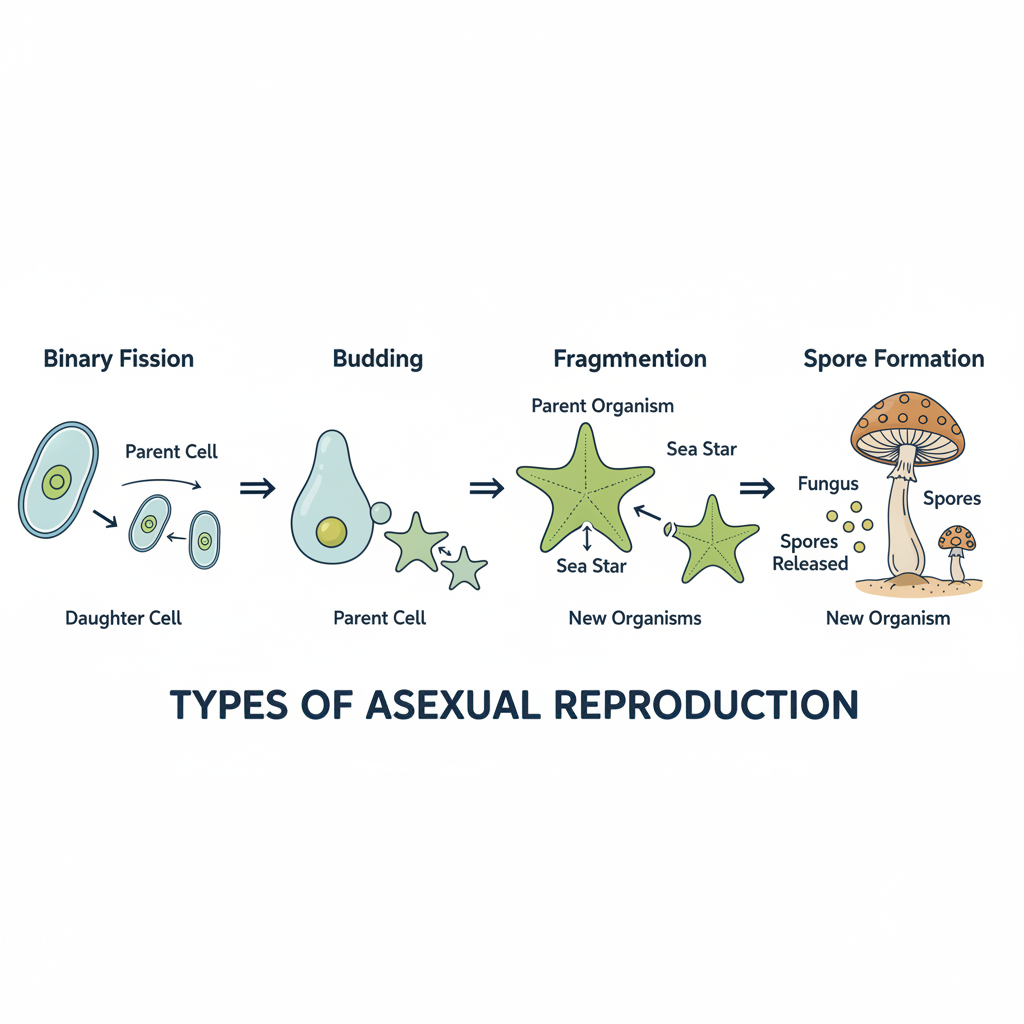 ⚠️ This picture may have spelling mistakes. Trust the words in the lesson.
Meet the Solo Performers: Different Types of Asexual Reproduction
Asexual reproduction isn't a one-trick pony! There are several fascinating ways organisms achieve this "solo act." Let's explore the main types:
1. Binary Fission: The Simple Split
- What it is: This is the simplest form of asexual reproduction, common in single-celled organisms like bacteria and amoebas. The parent cell simply grows, duplicates its genetic material (DNA), and then divides into two roughly equal-sized daughter cells.
- Analogy: Imagine you have a single sheet of paper, and you photocopy it. Now you have two identical sheets. Binary fission is just like that – one cell becomes two identical cells!
- Examples: Bacteria, Amoeba, Paramecium.
2. Budding: The Mini-Me Grows Out
- What it is: In budding, a small outgrowth, or "bud," forms on the parent organism. This bud grows larger, eventually detaching from the parent to become a new, independent organism. Sometimes, the bud might stay attached, forming a colony.
- Analogy: Think of a small bubble forming on the side of a balloon and then pinching off to become a separate, smaller balloon. Or, imagine a tiny sprout growing directly out of the side of a potato – that sprout is a "bud" ready to become a new plant.
- Examples: Yeast (a single-celled fungus), Hydra (a small freshwater animal).
3. Spore Formation: Tiny Travelers
- What it is: Spores are tiny, specialized reproductive cells that can develop into a new organism without fusing with another cell. They are often lightweight and can be dispersed by wind or water, allowing the organism to spread widely.
- Analogy: Picture dandelion seeds. Each seed is tiny, easily carried by the wind, and can grow into a new dandelion plant if it lands in a good spot. Spores are similar, but even simpler and often microscopic.
- Examples: Fungi (like molds and mushrooms), ferns, mosses.
4. Fragmentation: The Break-Up and Rebuild
- What it is: In fragmentation, the parent organism breaks into several pieces, and each piece develops into a new, complete organism. This is often seen in simpler organisms.
- Analogy: Imagine you have a unique magnetic strip. If you break it in half, you don't just have two halves – you now have two *new* complete magnets, each with its own north and south pole. That's how fragmentation works! Each fragment can regenerate lost parts.
- Examples: Starfish (if a piece containing part of the central disc breaks off), Spirogyra (a type of algae), Planaria (flatworms).
5. Vegetative Propagation: Plants' Clever Copies
- What it is: This is a special type of asexual reproduction specifically found in plants. It involves new plants growing from parts of the parent plant, such as stems, roots, or leaves, rather than from seeds or spores.
- Analogy: Ever cut a piece of a plant (like a rose stem) and put it in water, only for roots to grow and a new plant to form? Or seen how strawberries send out "runners" that grow new plants? That's vegetative propagation – using a part of the parent plant to make a clone.
- Examples:
- Runners/Stolons: Strawberries (stems that grow horizontally above ground).
- Rhizomes: Ginger, irises (underground stems).
- Tubers: Potatoes (swollen underground stems).
- Bulbs: Onions, garlic (underground storage leaves).
- Cuttings: Many garden plants (roses, money plants) can be grown from a cut piece of stem or leaf.
The Upsides and Downsides of Going Solo
Just like everything, asexual reproduction has its pros and cons:
Advantages (Why it's Great!):
- Rapid Population Growth: Organisms can quickly populate an area if conditions are good. No waiting to find a mate!
- Energy Efficient: Less energy is expended compared to sexual reproduction, which often involves complex mating rituals or structures.
- No Need for a Mate: Great for organisms that live in isolation or are immobile.
- Stable Environments: If an environment is stable and favorable, offspring that are exact copies of a well-adapted parent will also thrive.
Disadvantages (The Catch):
- Lack of Genetic Variation: This is the biggest drawback. Since all offspring are identical, if the environment changes drastically (e.g., a new disease appears, or the climate shifts), the entire population might be vulnerable because they all have the same genetic weaknesses. It's like having a whole team of players with the same weakness – if that weakness is exploited, the whole team suffers.
- Competition: A rapidly growing population can quickly lead to overcrowding and competition for resources.
Conclusion: The Power of Duplication
Asexual reproduction is a powerful and efficient strategy for many organisms to thrive and spread. From the tiniest bacterium splitting in two to a rose bush growing from a simple cutting, it demonstrates nature's incredible ability to perpetuate life through solo efforts. While it might lack the genetic diversity of sexual reproduction, it's a vital part of the biological tapestry, ensuring the continuation of countless species across our planet.
Keep learning, free
Create a free Syllabax account to unlock practice questions and games for this topic.
Visual Learning Enhanced! 🚀
To help you master this topic, we use Advanced Syllabax AI to generate detailed diagrams and visual models.
Note on Visuals: The AI sometimes makes spelling errors in image labels. Please refer to the lesson text for the correct terminology.