By common factor (Factorization)
Watch this topic in 60 seconds
Free preview · Lesson 1
Understanding By common factor (Factorization)
Unlocking the Power of Factorization: Finding the Common Treasures! (Grade 8)
Welcome, young mathematicians! Today, we're embarking on an exciting journey into the world of factorization, specifically focusing on 'factorization by common factor'. Don't let the big words scare you! Think of it like being a detective, trying to find hidden connections and reorganize things in a smarter way. This skill is incredibly useful, not just in math class, but for understanding how things are built and broken down in many areas of life.
What is Factorization? The 'Un-Doing' Game!
Imagine you have a puzzle. When you put all the pieces together, you get a beautiful picture. Factorization is like taking that picture apart and finding the original pieces, but in a very organized way. In math, when we multiply numbers or expressions, we combine them. Factorization is the reverse – it's finding what numbers or expressions were multiplied together to get the original one.
Analogy: Think about baking a cake. You start with ingredients like flour, sugar, eggs, and milk (these are your 'factors'). You mix them together and bake them to get a delicious cake (this is your 'product'). Factorization is like looking at the cake and figuring out all the main ingredients that went into making it! We're breaking down the 'cake' (our expression) into its 'ingredients' (its factors).
Starting with the Basics: What are Factors?
Before we can find 'common factors', we need to understand what a 'factor' is. A factor of a number is a number that divides it exactly, without leaving a remainder. For example, if you can divide 12 by a number and get a whole number answer, then that number is a factor of 12.
- Factors of 12: 1, 2, 3, 4, 6, 12 (because 1x12=12, 2x6=12, 3x4=12)
- Factors of 18: 1, 2, 3, 6, 9, 18 (because 1x18=18, 2x9=18, 3x6=18)
Analogy: Imagine you have a box of 12 cookies. How many equal groups can you divide them into? You can have 1 group of 12, 2 groups of 6, 3 groups of 4, 4 groups of 3, 6 groups of 2, or 12 groups of 1. Each of those numbers (1, 2, 3, 4, 6, 12) is a factor!
Finding Common Ground: Common Factors
Now, what if you have two numbers, like 12 and 18, and you want to see what factors they share? These shared factors are called 'common factors'.
- Factors of 12: 1, 2, 3, 4, 6, 12
- Factors of 18: 1, 2, 3, 6, 9, 18
The numbers that appear in BOTH lists are the common factors. In this case, the common factors of 12 and 18 are 1, 2, 3, and 6.
Analogy: Imagine two friends, Alex and Ben, both have toy boxes. Alex has a toy car, a toy dog, a toy plane, and a toy boat. Ben has a toy car, a toy dog, a toy train, and a toy robot. The 'common factors' are the toys they both own: the toy car and the toy dog!
The Biggest Shared Treasure: Greatest Common Factor (GCF)
Among all the common factors, there's always one that's the biggest. We call this the Greatest Common Factor (GCF). For 12 and 18, the common factors are 1, 2, 3, and 6. The largest among these is 6. So, the GCF of 12 and 18 is 6.
Analogy: Going back to Alex and Ben's toys, if they decided to trade their *biggest* shared toy, they'd look for the biggest toy that appears in both their boxes. That would be their 'Greatest Common Toy'!
Factorization by Common Factor: Grouping Algebraic Expressions
Now we're ready to apply this to algebraic expressions – those math sentences that have numbers AND letters (variables) in them. Factorization by common factor means we're looking for the GCF not just of numbers, but of entire terms within an expression. Once we find the GCF, we 'pull it out' or 'take it out' of the expression.
Think of it like this: If you have a group of items, and some items are common to all of them, you can put those common items into one separate pile and then list what's left over for each original group.
Steps to Factorize by Common Factor:
- Identify the terms: First, clearly see what different parts (terms) are in your expression. Terms are separated by plus (+) or minus (-) signs.
- Find the GCF of the coefficients: Look at the numbers (coefficients) in front of each variable. Find their GCF.
- Find the GCF of the variables: Look at the variables (letters) in each term. If a variable appears in ALL terms, then it's a common variable. The GCF of variables will be that variable raised to the lowest power it appears with. (Example: 'x' and 'x²' have 'x' as common, because x is x¹).
- Combine to get the overall GCF: Multiply the GCF of the coefficients and the GCF of the variables. This is the 'common treasure' you're looking for!
- Divide and Conquer: Write the overall GCF outside a set of parentheses. Inside the parentheses, write what you get when you divide EACH original term by the overall GCF.
- Check Your Work! Multiply the GCF back into the parentheses (using the distributive property). You should get back your original expression. If you do, you've factored correctly!
Let's See Some Examples!
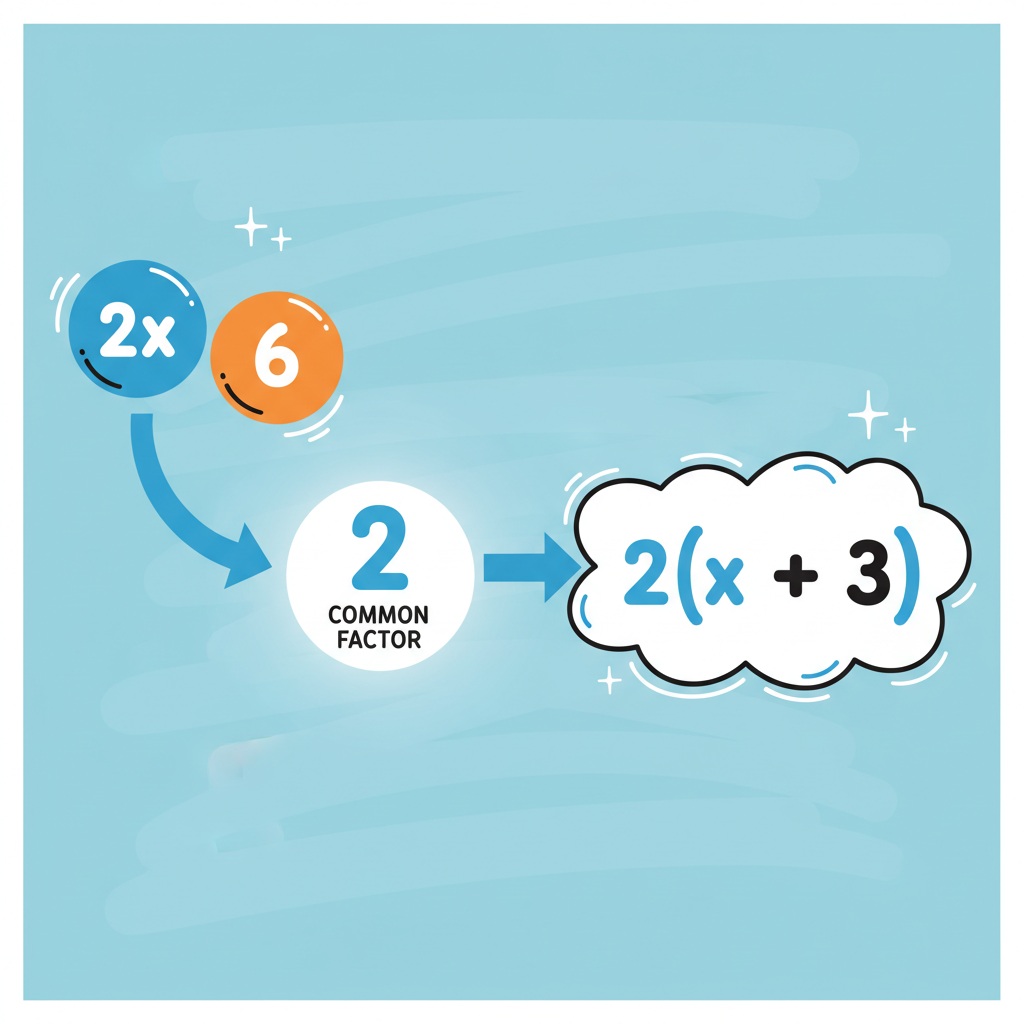
Example 1: Factorize 2x + 6
- Terms: The terms are
2xand6. - GCF of Coefficients: The numbers are 2 and 6. Factors of 2 are {1, 2}. Factors of 6 are {1, 2, 3, 6}. The GCF is 2.
- GCF of Variables: The first term has 'x', but the second term (6) does not have 'x'. So, there is no common variable.
- Overall GCF: The overall GCF is just 2.
- Divide and Conquer:
- Divide
2xby2:x - Divide
6by2:3
2x + 6becomes2(x + 3). - Divide
- Check:
2 * (x + 3) = (2 * x) + (2 * 3) = 2x + 6. It matches!
Example 2: Factorize 5y - 10z
- Terms:
5yand-10z. - GCF of Coefficients: Numbers are 5 and 10. Factors of 5 are {1, 5}. Factors of 10 are {1, 2, 5, 10}. The GCF is 5.
- GCF of Variables: The first term has 'y', the second has 'z'. No common variable.
- Overall GCF: 5.
- Divide and Conquer:
- Divide
5yby5:y - Divide
-10zby5:-2z
5y - 10zbecomes5(y - 2z). - Divide
- Check:
5 * (y - 2z) = (5 * y) - (5 * 2z) = 5y - 10z. It matches!
Example 3: Factorize 3x² + 6x
- Terms:
3x²and6x. - GCF of Coefficients: Numbers are 3 and 6. Factors of 3 are {1, 3}. Factors of 6 are {1, 2, 3, 6}. The GCF is 3.
- GCF of Variables: Both terms have 'x'. The first has
x²(which isx * x), the second hasx(which isx¹). The lowest power of 'x' isx¹, or justx. So, the GCF of variables isx. - Overall GCF: Multiply the numerical GCF (3) by the variable GCF (x). So, the GCF is
3x. - Divide and Conquer:
- Divide
3x²by3x:(3/3) * (x²/x) = 1 * x = x - Divide
6xby3x:(6/3) * (x/x) = 2 * 1 = 2
3x² + 6xbecomes3x(x + 2). - Divide
- Check:
3x * (x + 2) = (3x * x) + (3x * 2) = 3x² + 6x. It matches!
Example 4: Factorize 8ab - 4ac
- Terms:
8aband-4ac. - GCF of Coefficients: Numbers are 8 and 4. Factors of 8 are {1, 2, 4, 8}. Factors of 4 are {1, 2, 4}. The GCF is 4.
- GCF of Variables:
- 'a' is in both terms. The lowest power is
a¹. So, common 'a'. - 'b' is only in the first term. Not common.
- 'c' is only in the second term. Not common.
a. - 'a' is in both terms. The lowest power is
- Overall GCF:
4a. - Divide and Conquer:
- Divide
8abby4a:(8/4) * (a/a) * b = 2 * 1 * b = 2b - Divide
-4acby4a:(-4/4) * (a/a) * c = -1 * 1 * c = -c
8ab - 4acbecomes4a(2b - c). - Divide
- Check:
4a * (2b - c) = (4a * 2b) - (4a * c) = 8ab - 4ac. It matches!
Why is this important?
Factorization by common factor is like learning to spot patterns and simplify complex situations. It's a foundational skill that will help you solve more complicated equations, simplify expressions, and understand more advanced algebra concepts in the future. It helps make complicated expressions look much cleaner and easier to work with. Keep practicing, and you'll become a factorization master in no time!
Keep learning, free
Create a free Syllabax account to unlock practice questions and games for this topic.
Visual Learning Enhanced! 🚀
To help you master this topic, we use Advanced Syllabax AI to generate detailed diagrams and visual models.
Note on Visuals: The AI sometimes makes spelling errors in image labels. Please refer to the lesson text for the correct terminology.