Emerging Technologies: AI & ML Overview
Watch this topic in 60 seconds
Free preview · Lesson 1
Understanding Emerging Technologies: AI & ML Overview
Welcome to the Future: Understanding AI & Machine Learning!
Have you ever wondered how your phone suggests the next word you type, or how Netflix knows exactly what show you might like? These amazing feats are thanks to emerging technologies like Artificial Intelligence (AI) and Machine Learning (ML)! These aren't just concepts from science fiction; they are rapidly changing our world, making our devices smarter, our lives easier, and even helping us solve complex global challenges.
In this lesson, we'll embark on an exciting journey to explore the foundational concepts of AI and ML. We'll break down what they are, how they work, and discover the incredible ways they are already shaping our daily lives. Don't worry, we'll use simple terms and lots of everyday analogies to make these powerful ideas easy to understand!
What is Artificial Intelligence (AI)?
Imagine you have a super-smart robot that can think, learn, and solve problems just like a human. That's essentially the big dream behind Artificial Intelligence! At its core, Artificial Intelligence (AI) is about creating machines that can perform tasks that typically require human intelligence. This includes things like:
- Reasoning: Making logical deductions, like figuring out the best route to school.
- Learning: Gaining knowledge from experience, just like you learn from studying for a test.
- Problem-solving: Finding solutions to challenges, whether it's beating you in a chess game or diagnosing a disease.
- Perception: Understanding the world through 'senses,' such as recognizing faces in photos or understanding spoken language.
Think of AI like this: If human intelligence is a highly skilled chef who can invent new recipes, adapt to different ingredients, and manage an entire kitchen, then AI is our attempt to build a robot chef that can learn to do many of those same complex tasks.
AI Types: Narrow vs. General
When we talk about AI today, we're mostly talking about what's called Narrow AI (or Artificial Narrow Intelligence - ANI). This type of AI is excellent at performing very specific tasks. For example, the AI that powers your phone's voice assistant (like Siri or Google Assistant) is great at understanding your commands and answering questions, but it can't drive a car or write a novel. It's a specialist!
Analogy: Narrow AI is like a very talented calculator that can only do math, or a specialized robot that's amazing at assembling one specific car part, but nothing else. It doesn't have common sense or the ability to apply its knowledge to entirely different situations. The AI we see in movies, known as General AI (or Artificial General Intelligence - AGI), which can perform any intellectual task a human can, is still largely in the realm of research and science fiction.
Diving into Machine Learning (ML)
Now, if AI is the big goal – creating intelligent machines – then Machine Learning (ML) is one of the most powerful tools or techniques we use to achieve that goal. In fact, ML is a *subset* of AI. Many of the impressive AI systems you interact with every day are powered by Machine Learning.
Machine Learning (ML) is a way to teach computers to learn from data without being explicitly programmed for every single task. Instead of a programmer writing out exact instructions for every possible scenario (e.g., "if image has whiskers AND pointed ears AND meows, then it's a cat"), ML algorithms are fed massive amounts of data and 'learn' to identify patterns and make predictions or decisions on their own.
Analogy: Imagine teaching a child to recognize different animals. You don't give them a list of rules for every single animal (like 'a dog has fur AND barks AND has a tail'). Instead, you show them many pictures of dogs, cats, birds, etc., pointing out which is which. Over time, the child learns to recognize a dog by seeing enough examples. Machine Learning works in a very similar way: it learns by seeing lots and lots of examples (data).
How Does Machine Learning Actually Work?
Let's break down the general process of how Machine Learning models learn and operate in four simplified steps:
Step 1: The Data (The Fuel!)
Every ML model starts with data. This data can be anything: images, text, numbers, sounds, videos, sensor readings, etc. It's the 'food' or 'fuel' that the machine needs to learn. The more relevant and high-quality data an ML model has, the better it can learn.
Analogy: Think of a student preparing for a history test. The 'data' would be all their textbooks, lecture notes, and historical documents. Without these learning materials, the student can't learn anything.
Step 2: Training (The Study Session!)
Once the data is collected, it's used to 'train' the ML model. During training, the ML algorithm processes this data, looking for relationships, trends, and patterns. It adjusts its internal settings (called 'parameters') based on the data it sees, trying to get better at its assigned task.
Analogy: This is like our history student studying their notes, practicing quizzes, and reviewing key events. They're actively processing the information to build their understanding and improve their ability to answer questions.
Step 3: Finding Patterns (The Aha! Moment!)
Through training, the ML model develops an understanding of the patterns within the data. It learns to recognize what makes a cat different from a dog, or what combination of symptoms might indicate a particular illness, or which movies people with similar tastes tend to enjoy.
Analogy: Our student starts to see patterns in history – for instance, how certain economic conditions often lead to social unrest. They develop an intuitive understanding rather than just memorizing facts.
Step 4: Making Predictions (The Smart Guess!)
After training, the ML model is ready to be put to work! When it encounters new, unseen data, it uses the patterns it learned during training to make a prediction, a classification, or a decision. This could be predicting the weather, identifying spam emails, or recommending a new song.
Analogy: Now, when our student takes the actual history test, they apply all the knowledge and patterns they've learned to answer new questions and make informed conclusions about historical events.
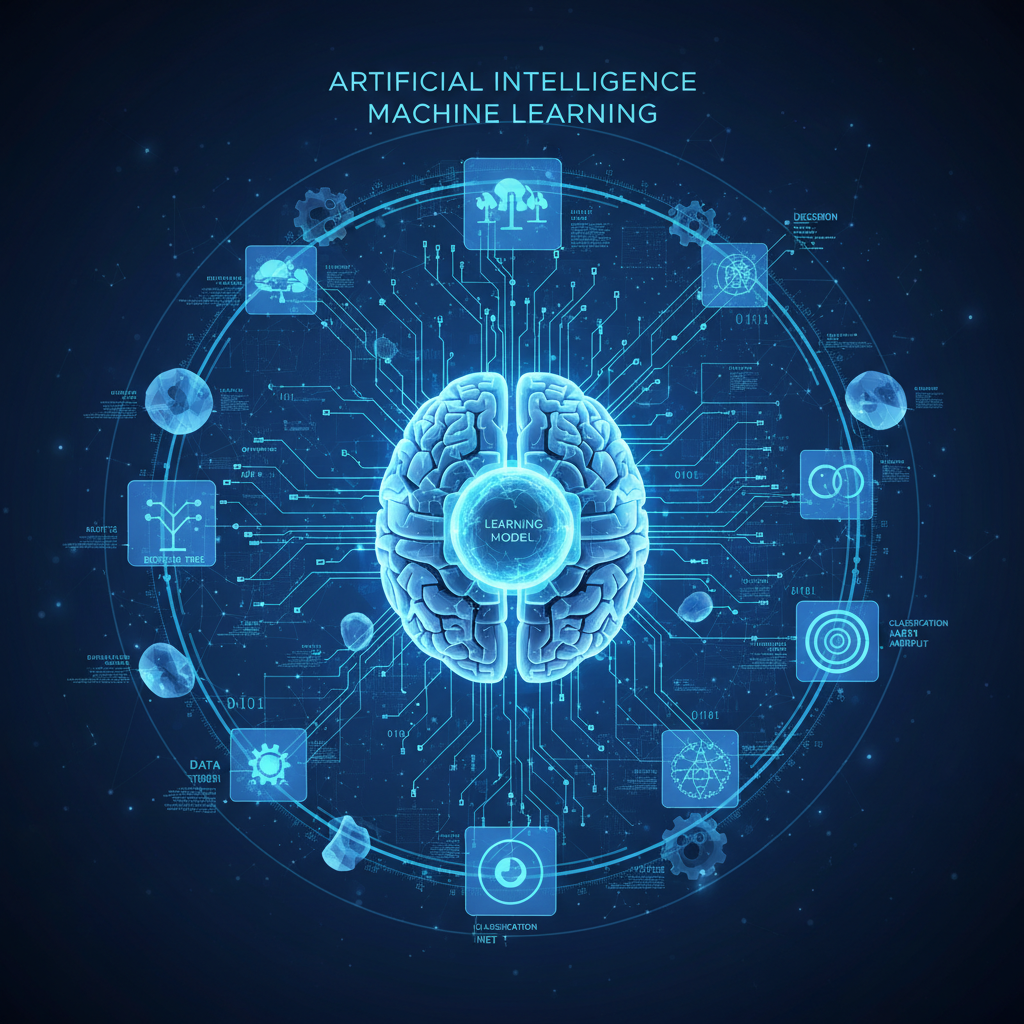 ⚠️ This picture may have spelling mistakes. Trust the words in the lesson.Different Ways Machines Learn: Types of ML
Just like humans learn in different ways, there are several main approaches to Machine Learning:
1. Supervised Learning: Learning with a Teacher
This is the most common type of ML. In Supervised Learning, the model is trained using labeled data. This means each piece of data comes with the correct answer already attached. Think of it like a student learning with flashcards where each card has a question on one side and the correct answer on the back.
- How it works: The model makes a prediction, compares it to the correct label, and then adjusts itself to reduce errors in future predictions.
- Examples: Predicting house prices based on size and location (where past house sales are labeled with actual prices), classifying emails as spam or not spam (where emails are labeled as 'spam' or 'not spam').
Analogy: Teaching a toddler to distinguish between apples and oranges. You show them an apple and say, "This is an apple." Then you show an orange and say, "This is an orange." You provide the correct label every time until they learn.
2. Unsupervised Learning: Learning by Exploring
Unlike supervised learning, Unsupervised Learning deals with unlabeled data. Here, the machine is given data and told to find hidden patterns, structures, or relationships within it, all on its own. There's no 'teacher' telling it the correct answers.
- How it works: The model explores the data to find inherent groupings or patterns without prior knowledge of what those patterns might be.
- Examples: Grouping customers into different segments based on their purchasing behavior (without being told beforehand what those segments should be), identifying common themes in a collection of documents.
Analogy: Giving a child a box of mixed LEGO bricks and asking them to sort them into groups that make sense to them, without any specific instructions on how to sort (e.g., by color, size, or shape). They find their own way to organize.
3. Reinforcement Learning: Learning by Trial and Error
Imagine training a pet: you reward them for good behavior and discourage bad behavior. Reinforcement Learning works similarly. An 'agent' (the ML program) learns to make decisions by performing actions in an environment and receiving 'rewards' for good actions and 'penalties' for bad ones. It learns to maximize its rewards over time.
- How it works: The agent tries different actions, observes the outcome, and learns a strategy to achieve a goal by trial and error.
- Examples: Training an AI to play chess or Go (where winning is a big reward), robots learning to navigate complex environments, developing self-driving car policies.
Analogy: Teaching a dog a new trick. When the dog performs the trick correctly, you give it a treat (reward). If it does something else, it gets no treat (no reward/penalty). Over time, the dog learns which actions lead to treats.
AI & ML All Around Us: Real-World Examples
AI and ML aren't futuristic concepts; they are woven into the fabric of our daily lives. Here are just a few examples:
- Personal Assistants: Siri, Alexa, and Google Assistant use natural language processing (an AI field) and ML to understand your voice commands and respond intelligently.
- Recommendation Systems: Ever notice how Netflix suggests movies you'll love, or Spotify knows your next favorite song? That's ML analyzing your past preferences and comparing them to others.
- Self-Driving Cars: These vehicles use AI and ML to perceive their surroundings (identifying other cars, pedestrians, traffic signs), make decisions, and navigate roads safely.
- Email Spam Filters: ML algorithms analyze incoming emails to identify patterns characteristic of spam and automatically move them to your junk folder.
- Facial Recognition: Unlocking your phone with your face or tagging friends in photos on social media relies on ML to identify and verify individuals.
- Medical Diagnosis: AI-powered tools can analyze medical images (like X-rays or MRIs) to help doctors detect diseases earlier and more accurately.
- Fraud Detection: Banks use ML to monitor transactions for unusual patterns that might indicate fraudulent activity, protecting your money.
- Online Shopping: When you see "customers who bought this also bought...", that's ML working to increase your shopping experience.
The Bright Side and the Big Questions: Benefits & Challenges
Like any powerful technology, AI and ML bring incredible benefits but also come with important considerations.
Benefits:
- Efficiency and Automation: AI can perform repetitive tasks much faster and more accurately than humans, freeing up people for more creative work.
- New Discoveries: ML can analyze vast amounts of data to find patterns that humans might miss, leading to breakthroughs in science, medicine, and research.
- Personalization: From education to entertainment, AI can tailor experiences to individual needs and preferences.
- Solving Complex Problems: AI can tackle grand challenges like climate change, disease outbreaks, and disaster response.
Challenges:
- Ethical Concerns: Questions arise about privacy, surveillance, and how AI decisions impact human lives.
- Bias: If ML models are trained on biased data, they can perpetuate and even amplify existing societal biases, leading to unfair outcomes.
- Job Displacement: As AI automates tasks, some jobs may change or become obsolete, requiring people to adapt and learn new skills.
- Security Risks: AI systems can be vulnerable to attacks, and their misuse could have serious consequences.
- Complexity: Understanding and controlling highly complex AI systems can be challenging.
Conclusion: Shaping Our Future
Artificial Intelligence and Machine Learning are not just buzzwords; they are fundamental technologies that are rapidly transforming our world. From the simple recommendations on your streaming service to the complex decisions made by self-driving cars, AI and ML are everywhere. Understanding their core concepts, how they learn from data, and the different ways they operate gives you a powerful lens through which to view the modern world.
As these technologies continue to evolve, they will undoubtedly bring even more innovations and challenges. By grasping the basics now, you're better equipped to participate in the discussions, understand the impacts, and perhaps even contribute to shaping the ethical and responsible development of AI for a better future!
Keep learning, free
Create a free Syllabax account to unlock practice questions and games for this topic.
Visual Learning Enhanced! 🚀
To help you master this topic, we use Advanced Syllabax AI to generate detailed diagrams and visual models.
Note on Visuals: The AI sometimes makes spelling errors in image labels. Please refer to the lesson text for the correct terminology.