Division as sharing & grouping (Division)
Watch this topic in 60 seconds
Free preview · Lesson 1
Understanding Division as sharing & grouping (Division)
Understanding Division: Sharing and Grouping!
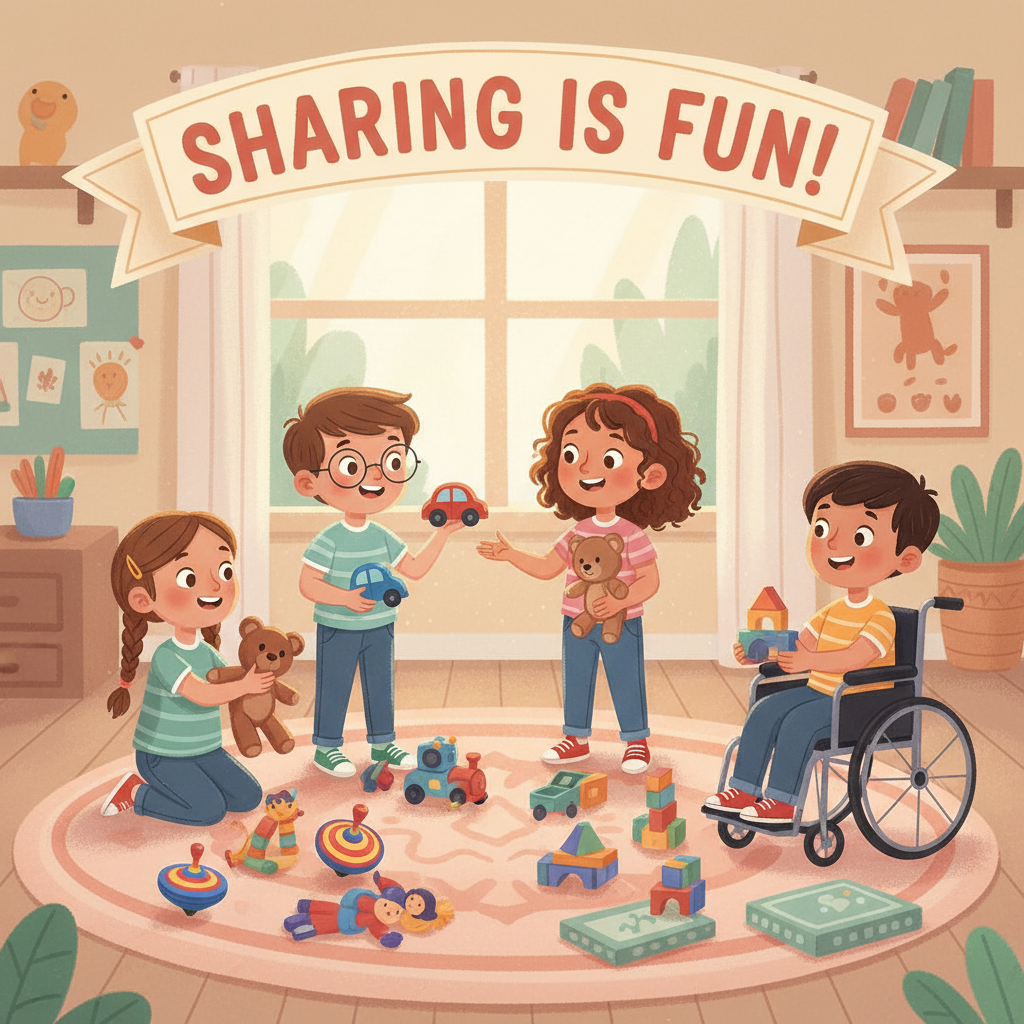
Hello, super learners! Today, we're going on an exciting adventure into the world of math, specifically into something called **Division**. Have you ever had to share your toys with friends, or maybe pack your favorite snacks into small bags for a party? That's exactly what division is all about – sharing and grouping!
What is Division? Sharing is Caring!
Imagine you have 10 yummy cookies, and you want to share them equally among your 5 friends. How many cookies does each friend get? This is a division problem!
Division is like splitting a big group of things into smaller, equal groups, or finding out how many groups of a certain size you can make from a bigger group.
Division as Sharing (Partitive Division)
This is when we know the total number of items and the number of groups, and we want to find out how many items are in each group. Think about our cookie example:
- Total Cookies: 10
- Number of Friends (Groups): 5
- Cookies per Friend (Items in each group): ?
To find the answer, we can give one cookie to each friend, then another, and keep going until all cookies are shared equally.
Analogy: Birthday Party Favors!
Let's say you have 12 party favors (like mini-toys) and you want to give an equal number to each of your 3 best friends. You would give 4 favors to friend 1, 4 favors to friend 2, and 4 favors to friend 3. You shared the total (12) into 3 equal groups, with 4 in each group.
Division as Grouping (Quotative Division)
This is when we know the total number of items and how many items should be in each group, and we want to find out how many groups we can make.
Let's try another example. Imagine you have 12 colorful crayons, and you want to put them into boxes, with 3 crayons in each box. How many boxes will you need?
- Total Crayons: 12
- Crayons per Box (Items in each group): 3
- Number of Boxes (Groups): ?
To solve this, you can count out groups of 3 crayons until all crayons are used. You'll make 4 groups (boxes).
Analogy: Building with Blocks!
Suppose you have 15 building blocks, and each tower you build needs exactly 5 blocks. How many towers can you build? You can make 3 towers because 15 blocks can be split into 3 groups of 5 blocks each.
The Division Symbol and Number Sentences
In math, we use a special symbol for division: ÷.
For our cookie example (10 cookies shared among 5 friends), the number sentence would be:
10 ÷ 5 = 2
This means "10 divided by 5 equals 2." It tells us that when 10 is split into 5 equal groups, there are 2 in each group.
For our crayon example (12 crayons put into boxes of 3), the number sentence would be:
12 ÷ 3 = 4
This means "12 divided by 3 equals 4." It tells us that 12 can be made into 4 groups with 3 in each group.
Vocabulary Time!
- Dividend: The total number you start with. (e.g., the 10 cookies, the 12 crayons)
- Divisor: The number you are dividing by; it can be the number of groups or the number of items in each group. (e.g., the 5 friends, the 3 crayons per box)
- Quotient: The answer to a division problem; it's the number of items in each group or the number of groups. (e.g., the 2 cookies per friend, the 4 boxes)
So, in 10 ÷ 5 = 2:
- 10 is the dividend
- 5 is the divisor
- 2 is the quotient
And in 12 ÷ 3 = 4:
- 12 is the dividend
- 3 is the divisor
- 4 is the quotient
Real-World Fun with Division!
Division is everywhere!
- When you help set the table and make sure each person has the same number of forks.
- When you pack lunches and want to give everyone the same number of carrot sticks.
- When you see how many teams of 4 players you can make from a class of 24 students.
Remember, division is all about making things fair and organized by sharing equally or creating equal groups. Keep practicing, and you'll become a division superstar!
Keep learning, free
Create a free Syllabax account to unlock practice questions and games for this topic.
Visual Learning Enhanced! 🚀
To help you master this topic, we use Advanced Syllabax AI to generate detailed diagrams and visual models.
Note on Visuals: The AI sometimes makes spelling errors in image labels. Please refer to the lesson text for the correct terminology.