Properties: shape, volume, compressibility (CHEMISTRY)
Watch this topic in 60 seconds
Free preview · Lesson 1
Understanding Properties: shape, volume, compressibility (CHEMISTRY)
Exploring the Amazing Properties of Matter: Shape, Volume, and Compressibility!
Welcome, young scientists, to an exciting journey into the world of chemistry! Today, we're going to become super-detectives and investigate some of the fundamental ways we can describe and understand matter. Matter is anything that takes up space and has mass – basically, everything around you! We'll focus on three key properties: shape, volume, and compressibility.
What is Shape?
Imagine you have a Lego brick. It has a specific shape, right? It's a rectangular prism. Now, imagine you have a balloon filled with air. Does the air have a specific shape like the Lego brick? Not really! This is where the idea of shape comes in.
Solids: Masters of Their Own Shape
Solids are like the Lego bricks. They have a definite shape. This means they keep their shape no matter what container you put them in. A rock will always look like a rock, whether it's in your pocket, on a table, or at the bottom of a swimming pool. Its particles are packed very tightly together and can only vibrate in place. Think of them as tiny dancers holding hands very, very tightly on a dance floor – they can wiggle, but they can't easily move away from their neighbors.
Liquids: Shapeshifters!
Liquids are different. They don't have a definite shape. Instead, they take the shape of their container. Think about pouring juice into a glass. The juice spreads out and fills the bottom part of the glass, taking its shape. If you pour it into a bowl, it will spread out and take the shape of the bowl. The particles in a liquid are close together but can slide past each other. Imagine those dancers on the dance floor again, but this time, they've let go of each other's hands. They can still move around, but they stay relatively close, sliding and flowing past one another.
Gases: Free Spirits!
Gases are the ultimate free spirits when it comes to shape. They have no definite shape and will spread out to fill the entire container they are in. When you inflate a balloon, the air inside spreads out to fill the whole balloon. If you open the balloon, the air spreads out to fill the whole room! The particles in a gas are very far apart and move around randomly and quickly. Think of those dancers now having left the dance floor and running all over the entire building, bumping into walls and each other occasionally.
What is Volume?
Now that we've talked about shape, let's talk about volume. Volume is the amount of space that matter takes up. Every object, whether it's a solid, liquid, or gas, has a volume.
Solids and Volume
A solid, like that Lego brick, has a definite shape and also a definite volume. It always takes up the same amount of space. You can't magically make a Lego brick smaller or larger just by putting it in a different box. Its particles are fixed in place and don't change their spacing easily.
Liquids and Volume
Liquids also have a definite volume, even though they don't have a definite shape. If you have 1 liter of water, it will still be 1 liter of water whether it's in a tall, skinny glass or a wide, flat bowl. The amount of space it occupies stays the same. The particles are close, so they don't spread out to take up more space than they already are.
Gases and Volume
Gases are the most interesting when it comes to volume. They have no definite volume. They will expand to fill the entire volume of whatever container they are in. If you have a small balloon and fill it with a certain amount of air, the air takes up the volume of the small balloon. If you then transfer that same amount of air to a much larger balloon, the air will spread out and take up the larger volume of the big balloon. The particles are so far apart and move so freely that they will fill any available space.
What is Compressibility?
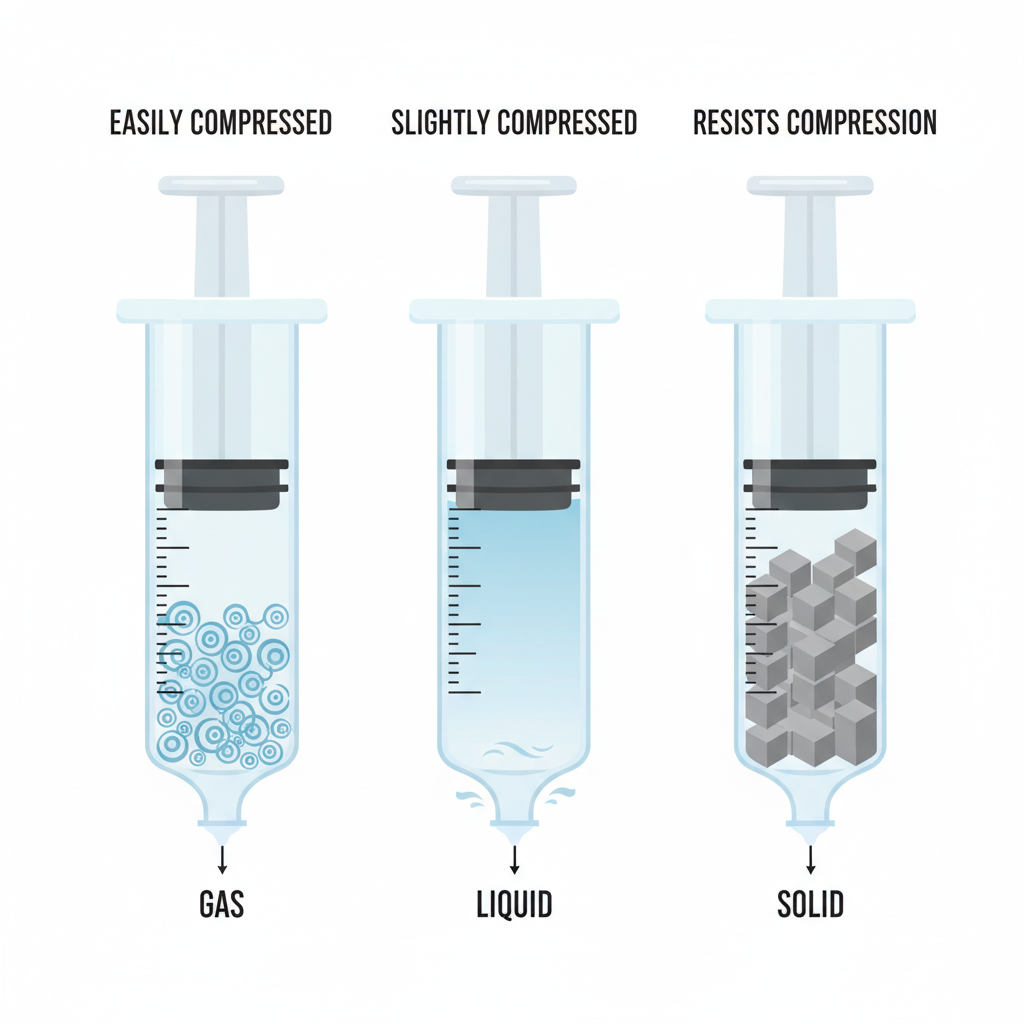
The last property we'll explore is compressibility. Compressibility is how much the volume of a substance can be reduced by applying pressure. Think about squeezing something!
Solids: Hard to Squeeze!
Solids are generally incompressible, meaning it's very, very hard to squeeze them and make them take up less space. Remember how tightly packed the particles are in a solid? They are already as close as they can get. Trying to squeeze a rock makes no noticeable difference because its particles can't be pushed much closer together. It's like trying to squeeze a box of tightly packed marbles – there's not much room for them to move closer.
Liquids: A Little Squeezable, But Not Much
Liquids are also considered nearly incompressible. While it's slightly easier to compress a liquid than a solid, the change in volume is very, very small. The particles in a liquid are close together, but they can slide. Trying to squeeze water in a sealed container is very difficult. You can feel some resistance, but you won't be able to make the water significantly smaller. It's like trying to squeeze a bag filled with water – it bulges out, but the water itself doesn't shrink much.
Gases: Super Compressible!
Gases are the champions of compressibility! They are very compressible. Remember how far apart the particles in a gas are? There's a lot of empty space between them. This means you can easily push those particles closer together and reduce the volume of the gas. Think about a bicycle pump. When you push down on the handle, you are squeezing the air inside the pump into a smaller space. This is because the air particles are far apart and can be easily pushed closer together. It's like having a bag of balloons – you can easily squish them together to take up less space.
Putting It All Together!
Let's recap our properties:
- Shape: Do they keep their own shape (definite shape) or take the shape of their container?
- Volume: Do they take up a fixed amount of space (definite volume) or fill whatever space is available?
- Compressibility: Can their volume be easily reduced by squeezing (compressible)?
Understanding these properties helps us understand the world around us, from why a balloon floats (air inside is spread out!) to why we can't easily squeeze rocks!
Keep learning, free
Create a free Syllabax account to unlock practice questions and games for this topic.
Visual Learning Enhanced! 🚀
To help you master this topic, we use Advanced Syllabax AI to generate detailed diagrams and visual models.
Note on Visuals: The AI sometimes makes spelling errors in image labels. Please refer to the lesson text for the correct terminology.