Counting squares [Area (Conceptual)]
Watch this topic in 60 seconds
Free preview · Lesson 1
Understanding Counting squares [Area (Conceptual)]
Understanding Area: Counting Squares!
Imagine you have a flat chocolate bar, or a beautiful mosaic made of tiny tiles. Have you ever wondered how much space that chocolate bar takes up on your desk, or how many tiles are in your mosaic? That's what we call area! Area is simply the amount of space a flat shape covers.
What is a Square?
Before we talk about area, let's remember what a square is. A square is a special shape with four equal sides and four perfectly square corners (we call these right angles). Think of a perfectly cut slice of cheese, or the screen on your TV.
Counting Squares to Find Area
The easiest way to measure area is by using something called square units. Think of these like little building blocks. We use these blocks to cover the entire shape, and then we count how many blocks it takes!
Imagine you have a small picture frame. You want to cover the empty space inside with tiny, square stickers. If you use stickers that are all the same size and perfectly square, and you cover the whole frame without any gaps or overlaps, the number of stickers you used tells you the area of the frame's opening!
Let's pretend we're decorating a tabletop with square tiles. Each tile is a 'square unit'.
Example 1: A Small Tabletop
Imagine a small, rectangular tabletop. We want to cover it with square tiles, each one being 1 inch by 1 inch. We lay down the tiles:
- First, we put down a row of 3 tiles along one side.
- Then, we put down another row of 3 tiles next to it.
- We do this one more time, so we have 3 rows in total.
How many tiles did we use in total? We have 3 rows, and each row has 3 tiles. That's 3 + 3 + 3, which equals 9 tiles! Or, we can think of it as 3 groups of 3, which is 3 x 3 = 9.
So, the area of our small tabletop is 9 square inches. We write it like this: 9 sq. in. or 9
Analogy Time!
Think of it like filling a box with small, identical cubes. The number of cubes that fit perfectly inside the box tells you the volume (which is similar to area but for 3D shapes!). For area, we're filling a flat shape with flat squares.
Analogy Time Again!
Imagine coloring in a picture with a grid. Each little square in the grid you color in adds to the total colored space. The total number of colored squares is the area you've covered!
Example 2: A Bigger Rug
Let's say we have a rectangular rug. We decide to measure its area by laying down square floor tiles, each tile measuring 1 foot by 1 foot.
- We find that we can fit 4 tiles along the length of the rug.
- And we can fit 3 tiles along the width of the rug.
To find the total number of tiles (the area), we can count them all:
Row 1: 4 tiles
Row 2: 4 tiles
Row 3: 4 tiles
Total tiles = 4 + 4 + 4 = 12 tiles. Or, 3 rows of 4 tiles is 3 x 4 = 12.
The area of the rug is 12 square feet (12 sq. ft. or 12
We can also draw a picture to help us see this:
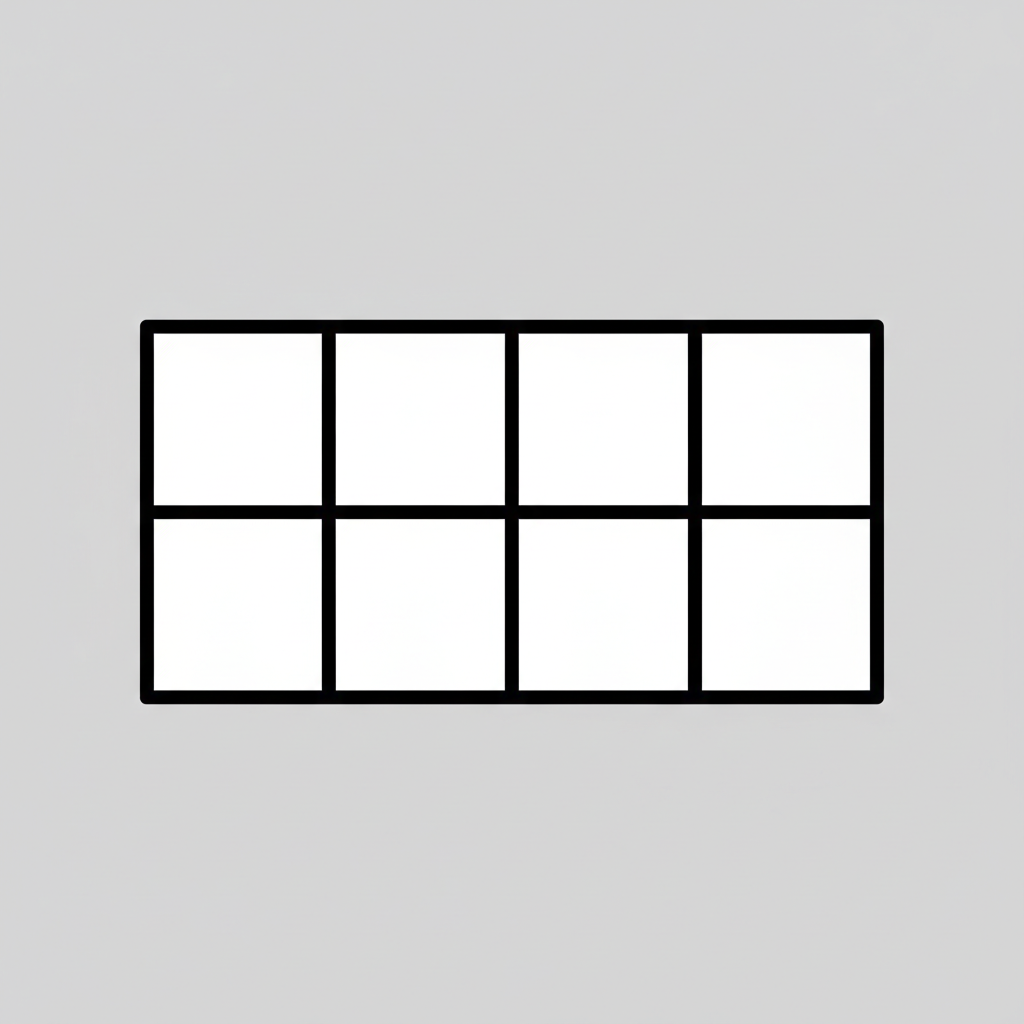
See? Each small square represents one 'square unit' of area. By counting all the squares inside the shape, we find its total area.
Why Square Units?
Using squares to measure area is helpful because:
- Squares fit together perfectly without leaving gaps.
- All squares of the same size are equal. This means our measurements are consistent, like using the same ruler every time.
Think of it like building with LEGO bricks. If all your bricks are the same size and shape, it's easy to count how many you used to build something.
The Importance of Size
It's important to remember that the size of the square unit matters! If we measure the same tabletop with 1-inch squares, we'll get a different number than if we measure it with 1-foot squares. A square foot is much bigger than a square inch, so it takes fewer square feet to cover a space than square inches.
Analogy: Measuring with Different Rulers
Imagine you want to measure how long your desk is. If you use a tiny ruler marked in millimeters, you'll need a lot of millimeters to cover the desk. If you use a long ruler marked in meters, you'll only need a few meters. The object you're measuring is the same, but the number changes depending on the size of your measuring tool (the square unit).
So, when we talk about area, we always need to say what kind of square unit we used, like square inches, square feet, or square centimeters.
Let's Look at Another Example
Imagine a garden patch shaped like a square. We want to cover it with small, square flower pots, each one taking up 1 square yard of space.
- We find we can fit 5 flower pots along one side.
- And because it's a square garden, we can also fit 5 flower pots along the other side.
How many flower pots do we need in total? We have 5 rows, with 5 pots in each row. That's 5 x 5 = 25 flower pots!
The area of the garden patch is 25 square yards (25 sq. yd. or 25
We can simply count the squares inside the shape to find its area. This is the core idea of understanding area!
Remember, area is the amount of flat space a shape covers, and we often measure it by counting how many identical squares fit inside.
Keep learning, free
Create a free Syllabax account to unlock practice questions and games for this topic.
Visual Learning Enhanced! 🚀
To help you master this topic, we use Advanced Syllabax AI to generate detailed diagrams and visual models.
Note on Visuals: The AI sometimes makes spelling errors in image labels. Please refer to the lesson text for the correct terminology.