Properties of isosceles & equilateral triangles (Triangle)
Watch this topic in 60 seconds
Free preview · Lesson 1
Understanding Properties of isosceles & equilateral triangles (Triangle)
Unlocking the Secrets of Special Triangles: Isosceles and Equilateral
Welcome, young mathematicians! Today, we're going on an exciting adventure into the world of triangles. You already know that triangles are three-sided shapes, and they're everywhere – from the pyramids of ancient Egypt to the slices of pizza you love! But just like people, some triangles have special traits that make them stand out. We're going to meet two very special families of triangles: the Isosceles (pronounced Eye-SAW-sell-ees) and the Equilateral (pronounced Ee-kwuh-LAT-uh-rul) triangles.
What Makes a Triangle Special?
Imagine you have a team of three friends. Most teams are just, well, teams. But what if two friends always wore the same hat, or all three friends always wore matching shoes? That would make them special, wouldn't it? Triangles are similar! Their 'features' are their sides and their angles.
The Isosceles Triangle: The 'Twin' Triangle
Let's start with the Isosceles triangle. Think of a perfectly symmetrical roof on a house, or a balanced see-saw with two identical seats. What do these have in common? They have two parts that are exactly the same!
Definition: An Isosceles triangle is a triangle that has at least two sides of equal length. Because it has "at least two," this means an equilateral triangle can also be considered an isosceles triangle (but we'll get to that!).
Parts of an Isosceles Triangle:
- Legs: The two sides that are equal in length are called the 'legs' of the isosceles triangle. Imagine them as the twin legs holding up the triangle!
- Base: The third side, which is usually the one that's different in length, is called the 'base.' Think of it as the ground the triangle stands on.
- Vertex Angle: The angle formed by the two equal sides (the legs) is called the 'vertex angle.' This is often at the very 'top' of the triangle, like the peak of a roof.
- Base Angles: The two angles that are opposite the equal sides (and are adjacent to the base) are called the 'base angles.' These are the angles at the 'bottom' corners of the triangle, next to the base.
The Super Power of Isosceles Triangles: Equal Base Angles!
Here's the most exciting property of an isosceles triangle, a true superpower! If an isosceles triangle has two sides of equal length, then the angles opposite those sides are also equal.
Analogy: Imagine you have two perfectly identical strong magnets (the equal sides). If you place them in a specific way, they will always attract the same amount of force (the equal angles). Or think of it like this: if you have two identical arms (the legs) on a robot, they will naturally make the same angle with the ground (the base). If side A is equal to side B, then the angle opposite side A will be equal to the angle opposite side B.
This means if you know one base angle, you automatically know the other! And since you know that all angles in a triangle add up to 180 degrees, you can easily find the vertex angle too.
The Equilateral Triangle: The 'Perfect' Triangle
Now, let's meet the Equilateral triangle. If the isosceles triangle had two matching parts, the equilateral triangle has ALL matching parts! It's like a perfectly symmetrical snowflake, or a balanced three-legged stool where all legs are the same length.
Definition: An Equilateral triangle is a triangle in which all three sides are equal in length.
The Super Power of Equilateral Triangles: All Sides and All Angles are Equal!
Since all its sides are equal, an equilateral triangle is actually a very special kind of isosceles triangle (because if all three sides are equal, it definitely has at least two equal sides!). And because of this, its superpowers are even stronger:
- All sides are equal: If one side is 5 cm, then all three sides are 5 cm!
- All angles are equal: This is a direct consequence of the sides being equal. Since all angles in a triangle add up to 180 degrees, and all three angles are identical, what must each angle be? That's right! 180 degrees / 3 = 60 degrees. Every angle in an equilateral triangle is exactly 60 degrees.
Analogy: Imagine a perfectly cut slice of a three-way even pizza. Each crust length is the same, and each angle at the pointy tip is the same. It's balanced, uniform, and perfectly symmetrical!
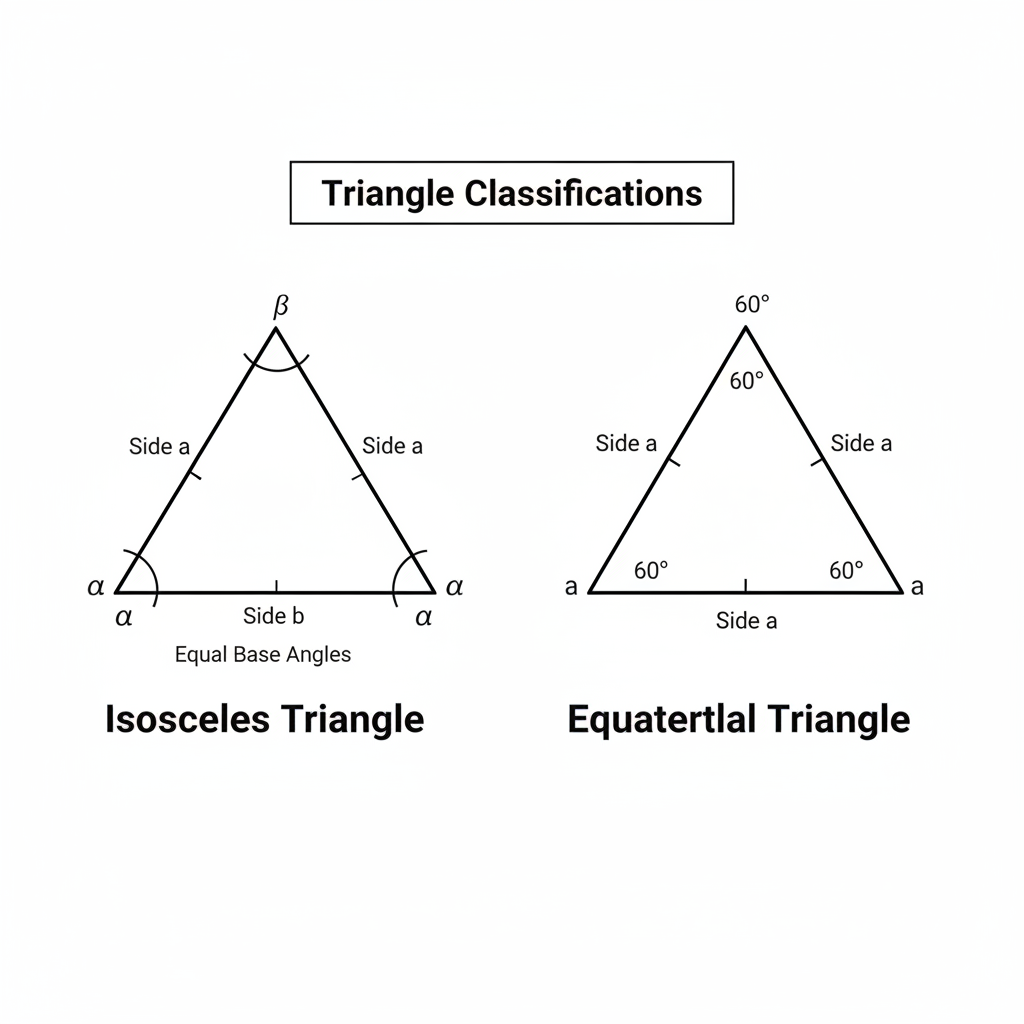 ⚠️ This picture may have spelling mistakes. Trust the words in the lesson.
Connecting the Dots: Is an Equilateral Triangle Always Isosceles?
Yes! This is an important point. Since an isosceles triangle only needs at least two equal sides, an equilateral triangle (which has three equal sides) perfectly fits this description. So, every equilateral triangle is also an isosceles triangle. However, not every isosceles triangle is equilateral (unless its third side also happens to be equal to the other two, making all three equal).
Think of it like this: All squares are rectangles, but not all rectangles are squares. A square is a 'special' rectangle. Similarly, an equilateral triangle is a 'special' isosceles triangle.
Putting It All Together: Why Do These Properties Matter?
Understanding these properties isn't just about memorizing definitions. It's like knowing the secret codes to solve geometry puzzles! If you see a problem with an isosceles triangle, you instantly know that two angles are equal, which can help you find missing angles or side lengths. If you see an equilateral triangle, you immediately know all angles are 60 degrees, which is a huge shortcut!
These foundational ideas are used in everything from designing buildings and bridges to creating art and understanding the natural world. So, keep practicing, and you'll soon master the secrets of these special triangles!
Keep learning, free
Create a free Syllabax account to unlock practice questions and games for this topic.
Visual Learning Enhanced! 🚀
To help you master this topic, we use Advanced Syllabax AI to generate detailed diagrams and visual models.
Note on Visuals: The AI sometimes makes spelling errors in image labels. Please refer to the lesson text for the correct terminology.