Learning Journey
Watch this topic in 60 seconds
Free preview · Lesson 1
Understanding Electric cell, bulb, switch[PHYSICS]
Discovering Electricity: The Simple Circuit
Imagine you have a toy that needs batteries to work, or a flashlight that turns on when you press a button. Have you ever wondered what makes these things light up or move? It's all about electricity! Today, we're going to explore the very basic building blocks of how electricity makes things happen, focusing on three key friends: the electric cell, the bulb, and the switch.
What is an Electric Cell? The Powerhouse!
Think of an electric cell, like a battery, as a tiny, portable power station. It's where the energy for our simple electric devices comes from.
Batteries: The Common Electric Cell
You've seen batteries before, right? Those cylindrical things you put in remote controls, toys, or flashlights. These are common types of electric cells. Each battery has a positive (+) end and a negative (-) end.
Analogy Time! Imagine a battery is like a water tank. The water at the top of the tank has more stored energy because it's higher up. The electric cell works similarly, with different 'levels' of electrical 'push' at its positive and negative ends. This 'push' is called voltage.
The electric cell stores chemical energy. When it's connected in a circuit, this chemical energy can be changed into electrical energy. This electrical energy is what flows to power our devices. It's like a stored-up 'charge' waiting to be released!
What is an Electric Bulb? The Light-Maker!
An electric bulb, like the ones in lamps or flashlights, is designed to use electricity to create light.
How a Bulb Works (Simply!)
Inside a typical bulb, there's a very thin wire called a filament. When electricity flows through this thin wire, the wire gets very hot. When things get hot enough, they glow! That glow is the light we see.
Analogy Time! Imagine you're rubbing your hands together very, very fast. They get warm, right? Now imagine rubbing them so fast that they start to glow red! That's a bit like what happens to the filament in a bulb. The electricity makes it 'rub' so hard (so to speak) that it glows!
A bulb has two metal contacts at its base. These contacts are where the electricity enters and leaves the bulb to make the filament glow.
What is a Switch? The Gatekeeper!
A switch is like a gatekeeper for electricity. It can control whether electricity can flow or not.
On and Off
When a switch is 'on', it's like opening a gate. It allows electricity to flow through it. When a switch is 'off', it's like closing the gate. It stops the electricity from flowing.
Analogy Time! Think of a drawbridge over a river. When the drawbridge is up (closed), boats (electricity) can't pass. When the drawbridge is down (open), boats (electricity) can sail through. The switch is like the lever that controls the drawbridge.
Putting It All Together: The Simple Circuit
Now, let's see how these three parts work together. We need to connect them in a way that allows electricity to flow from the electric cell, through the bulb, and back to the cell. This complete path is called a circuit.
Imagine the electric cell is the start of a journey for tiny electrical messengers. The switch is a checkpoint. The bulb is a special stop where the messengers do their job and create light. For the messengers to make it all the way around and back, the path must be complete and unbroken.
If the switch is 'off' (closed gate), the messengers can't reach the bulb, and it won't light up. If the switch is 'on' (open gate), the messengers can flow, make the bulb glow, and return to the cell, completing their journey.
A simple circuit usually looks like this:
- Electric Cell (Battery): Provides the energy (the 'push').
- Wires: These are like roads that carry the electrical messengers from one place to another.
- Switch: The gatekeeper that can stop or allow the flow.
- Bulb: The destination where the messengers do their work and produce light.
Why is the circuit important?
Electricity needs a complete, unbroken loop to flow. If there's a break anywhere in the circuit (like an 'off' switch or a burnt-out bulb), the electricity stops flowing, and the device stops working.
Analogy Time! Think of a race track. For the cars (electricity) to keep going around and around, the track must be complete. If there's a gap in the track, the cars stop. The circuit is the race track for electricity!
Here's a simple diagram of how these parts connect:
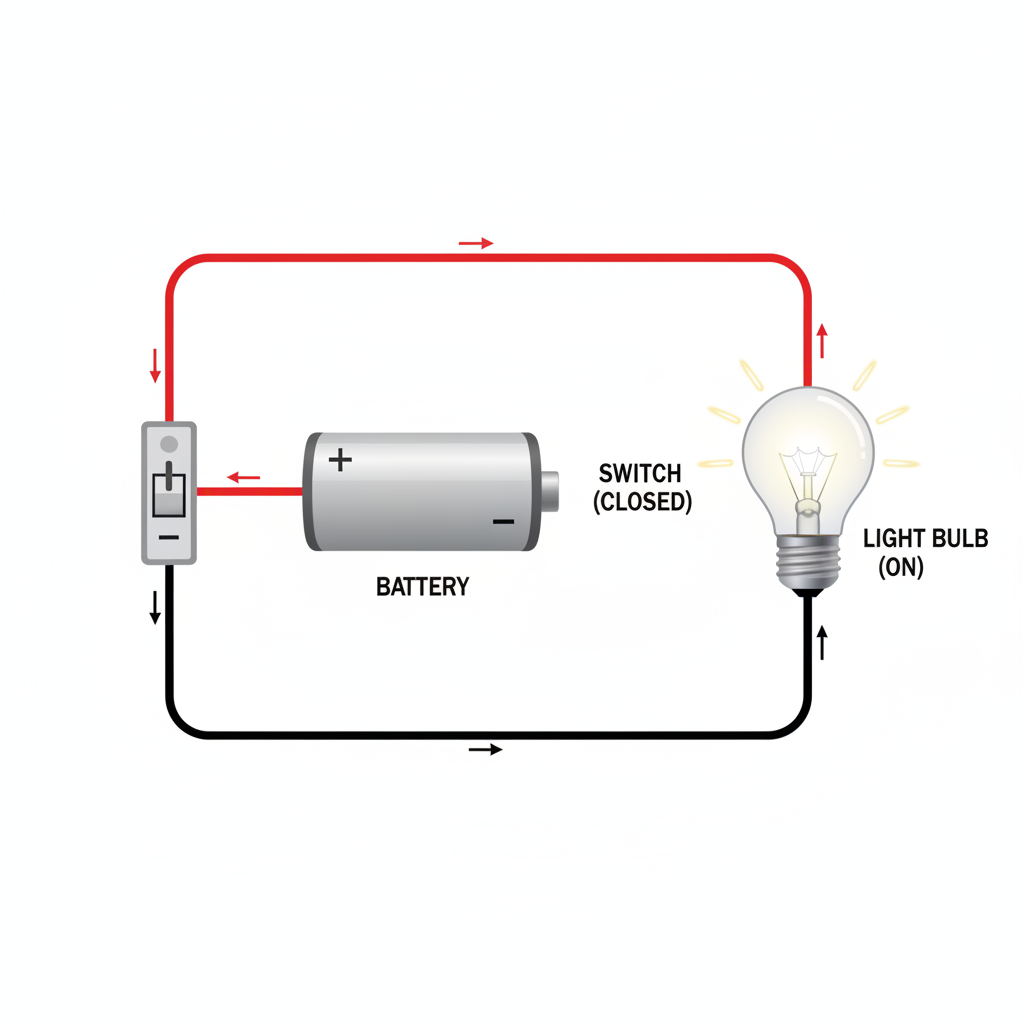
In this diagram, you can see the battery providing power, the wires acting as pathways, the switch controlling the flow, and the bulb lighting up when the circuit is complete and the switch is 'on'.
Key Terms to Remember:
- Electric Cell: A source of electrical energy (like a battery).
- Bulb: A device that uses electricity to produce light.
- Switch: A device that can start or stop the flow of electricity.
- Circuit: A complete path for electricity to flow.
- Filament: The thin wire inside a bulb that glows.
- Voltage: The 'push' or 'pressure' that electricity has, provided by the electric cell.
Understanding these basic parts is the first step to understanding the amazing world of electricity and how it powers so many things around us!
Keep learning, free
Create a free Syllabax account to unlock practice questions and games for this topic.
Visual Learning Enhanced! 🚀
To help you master this topic, we use Advanced Syllabax AI to generate detailed diagrams and visual models.
Note on Visuals: The AI sometimes makes spelling errors in image labels. Please refer to the lesson text for the correct terminology.