Speed calculation[PHYSICS]
Watch this topic in 60 seconds
Free preview · Lesson 1
Understanding Speed calculation[PHYSICS]
Understanding Speed: How Fast Are We Going?
Imagine you're playing a game of tag with your friends. Who's the fastest runner? How do you know? You probably look at how quickly they can cover a certain distance, right? That's exactly what speed is all about in physics!
What is Speed?
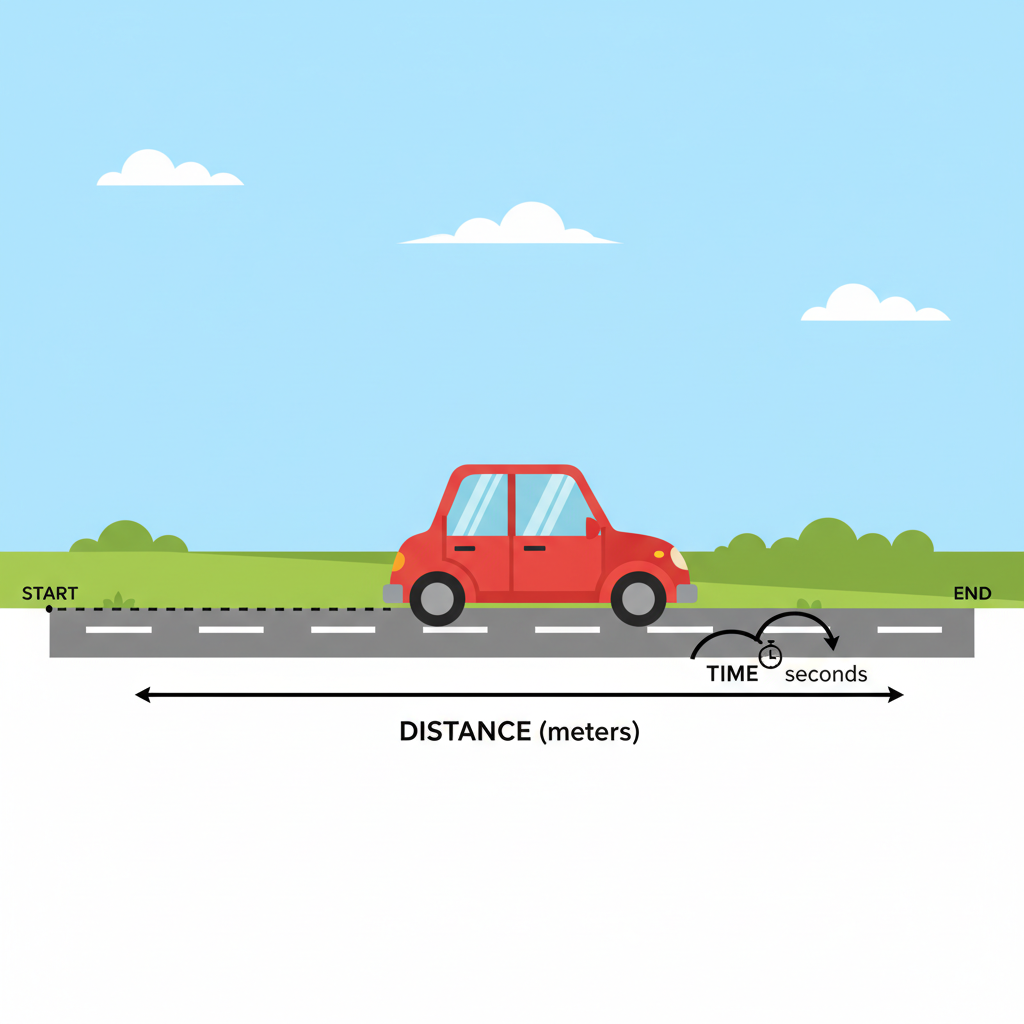
In simple terms, speed tells us how fast an object is moving. It's a measure of how much distance an object covers in a certain amount of time. Think of it like this:
Analogy 1: The Race Car
Imagine two race cars. One car zooms around the track really quickly, finishing laps in just a minute. The other car takes two minutes to complete the same lap. Which car is faster? The first one! It covers the same distance (one lap) in less time. So, it has a higher speed.
Analogy 2: Walking vs. Running
If you walk to school, it takes you a certain amount of time. If you run to school, you'll get there much faster! Running covers the same distance (the distance to school) in less time than walking, so running is a faster speed than walking.
The Formula for Speed
Scientists and engineers use a simple formula to calculate speed. It's like a recipe to figure out just how fast something is going.
The formula is:
Let's break this down:
- Distance: This is how far an object has traveled. It can be measured in meters (m), kilometers (km), miles (mi), or feet (ft).
- Time: This is how long it took for the object to travel that distance. It can be measured in seconds (s), minutes (min), or hours (hr).
So, speed is just the distance divided by the time. The units of speed will be a combination of distance units and time units, like meters per second (m/s) or kilometers per hour (km/h).
Understanding the Units of Speed
The units of speed are very important. They tell us what kind of measurement we're using.
- Meters per second (m/s): This is a common unit in science. It means how many meters an object travels in one second. A fast runner might have a speed of around 8 m/s.
- Kilometers per hour (km/h): You often see this on speed limits signs for cars. It means how many kilometers an object travels in one hour. The speed limit on a highway might be 100 km/h.
- Miles per hour (mph): This is used in countries like the United States. It means how many miles an object travels in one hour. A car on the highway might travel at 65 mph.
Let's Calculate Some Speeds!
Now, let's use our formula and some examples.
Example 1: The Speedy Snail
A snail crawls 0.1 meters in 10 seconds. What is its speed?
Using the formula:
So, the snail's speed is 0.01 meters per second. That's pretty slow!
Example 2: The Fast Cyclist
A cyclist travels 30 kilometers in 2 hours. What is their average speed?
Using the formula:
The cyclist's average speed is 15 kilometers per hour.
Analogy 3: The Marathon Runner
Imagine a marathon runner. They run a very long distance (about 42 kilometers) in a few hours. If you want to know their average speed, you divide the total distance of the marathon by the total time they took to finish. Their speed tells us how much of the marathon they covered each hour, on average.
Constant Speed vs. Average Speed
Sometimes, an object moves at the exact same speed for the entire journey. This is called constant speed.
Analogy 4: A Train on a Straight Track
Imagine a train traveling on a perfectly straight track at exactly 60 km/h for one hour. Its speed is constant throughout that hour.
More often, though, an object's speed changes during its journey. It might speed up, slow down, or stop. In these cases, we usually talk about average speed. Average speed is the total distance traveled divided by the total time taken for the entire journey. It gives us a general idea of how fast the object was moving over that period.
Analogy 5: A Car Trip
When you go on a car trip, you don't drive at the exact same speed the whole time. You might speed up on the highway, slow down in towns, and stop at traffic lights. The total distance of the trip divided by the total time from start to finish gives you the average speed of the car for that trip.
Why is Speed Important?
Understanding speed is super important in many parts of our lives:
- Transportation: It helps us figure out how long it will take to get from one place to another, whether it's by car, train, plane, or even walking!
- Safety: Speed limits are set to keep us safe. Knowing how speed affects stopping distances is crucial for drivers.
- Sports: In many sports, speed is a key factor in performance – from sprinting in athletics to fast bowling in cricket.
- Science and Engineering: Scientists and engineers use speed to understand how things move, from tiny particles to massive planets.
So, the next time you see a car zoom by or watch a runner sprint, you'll know that speed is a fundamental concept that helps us understand how fast the world around us is moving!
Keep learning, free
Create a free Syllabax account to unlock practice questions and games for this topic.
Visual Learning Enhanced! 🚀
To help you master this topic, we use Advanced Syllabax AI to generate detailed diagrams and visual models.
Note on Visuals: The AI sometimes makes spelling errors in image labels. Please refer to the lesson text for the correct terminology.