Learning Journey
Free preview · Lesson 1
Understanding Equivalent rational numbers (Rational Numbers)
Understanding Equivalent Rational Numbers: They're All the Same!
Hello, 7th Graders! Today, we're going on an exciting journey into the world of rational numbers, focusing on something super important: equivalent rational numbers. Don't worry if those words sound big; we'll break them down into simple pieces, just like cutting a pizza!
First Things First: What Are Rational Numbers?
Imagine all the numbers you know. Some are whole numbers like 1, 2, 3, 10, 100. Some are negative numbers like -1, -5, -20. And then there are fractions like 1/2, 3/4, 7/8. You also know decimals like 0.5, 0.75, 2.3. Guess what? All of these can be called rational numbers!
In simple terms, a rational number is any number that can be written as a fraction, where there's a number on top (called the numerator) and a number on the bottom (called the denominator), and the bottom number is NOT zero. We write this as a/b, where 'a' is the numerator, and 'b' is the denominator (and b ≠ 0).
- Fractions: Like 1/2, 3/4, -5/7. These are clearly rational numbers!
- Whole Numbers: Like 5. Can you write 5 as a fraction? Yes! 5/1. So, 5 is a rational number.
- Integers: Like -3. Can you write -3 as a fraction? Yes! -3/1. So, -3 is a rational number.
- Decimals: Like 0.5. Can you write 0.5 as a fraction? Yes! 1/2. Or 0.75 as 3/4. So, many decimals are rational numbers! (Specifically, terminating decimals and repeating decimals).
So, a rational number is basically a number that can be expressed as a simple fraction.
Now, What About "Equivalent" Rational Numbers?
The word "equivalent" means "equal in value" or "the same amount." So, equivalent rational numbers are rational numbers that look different but actually represent the exact same value. They're like different ways of saying the same thing!
Analogy Time! Let's Talk Pizza! 🍕
Imagine you have a delicious pizza. You cut it right down the middle, and you take one slice. You've eaten 1/2 of the pizza.
Now, imagine another identical pizza. Instead of two slices, you cut it into four equal slices. If you take two of those slices, how much pizza have you eaten? You've eaten 2/4 of the pizza.
If you put 1/2 of the first pizza next to 2/4 of the second pizza, you'd see they take up the exact same amount of space! This means 1/2 is equivalent to 2/4. They are equivalent rational numbers!
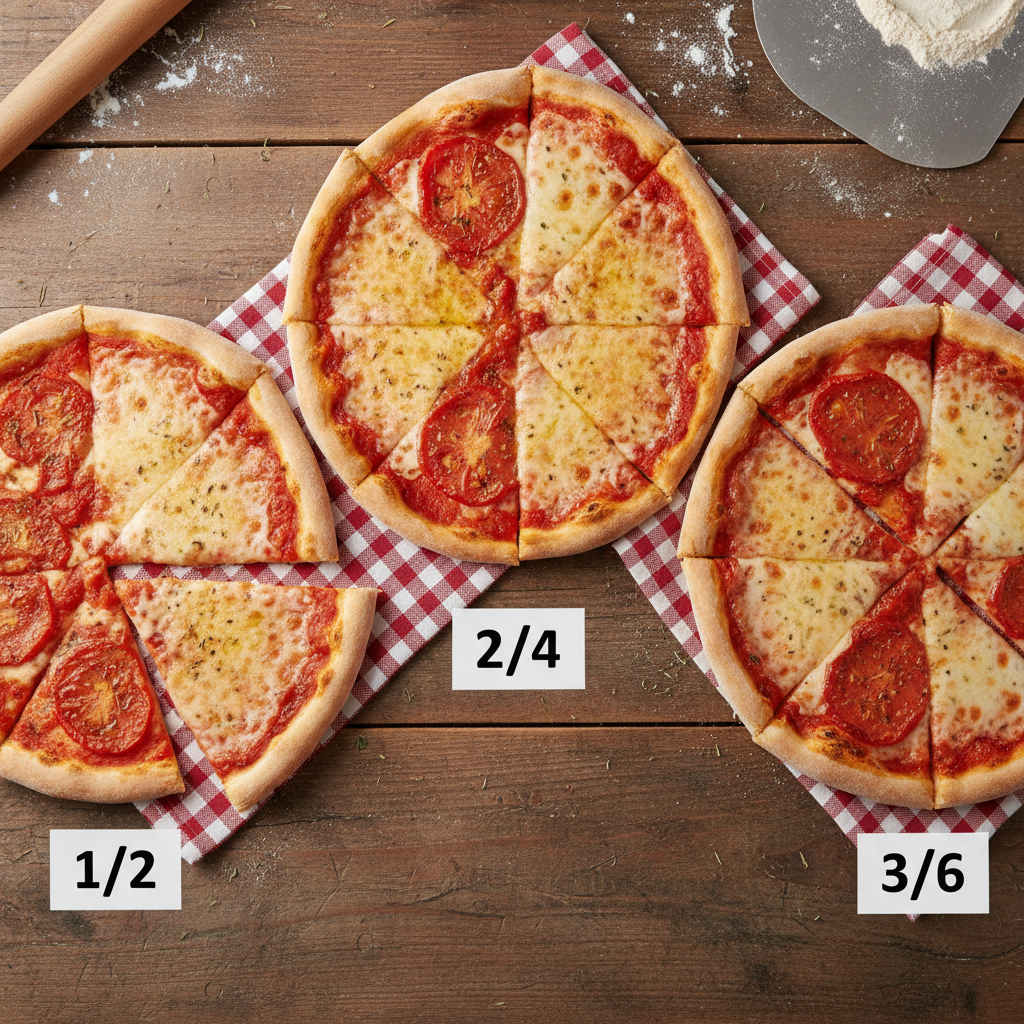
Let's try one more. What if you cut the pizza into eight equal slices? If you take four slices, you've eaten 4/8 of the pizza. Again, 4/8 is the same amount as 1/2 and 2/4! So, 1/2, 2/4, and 4/8 are all equivalent rational numbers.
Another Analogy: Money! 💰
Think about money. How many different ways can you make 50 cents?
- You could have one half-dollar coin (1/2 of a dollar).
- You could have two quarters (2/4 of a dollar).
- You could have five dimes (5/10 of a dollar).
- You could have fifty pennies (50/100 of a dollar).
All of these different combinations represent the same value: 50 cents! So, 1/2, 2/4, 5/10, and 50/100 are all equivalent rational numbers.
How Do We Find Equivalent Rational Numbers?
There are two main ways to find equivalent rational numbers:
1. Multiplying (Making Bigger Pieces Out of Smaller Ones)
You can multiply both the numerator (top number) and the denominator (bottom number) by the same non-zero number. Remember, whatever you do to the top, you MUST do to the bottom to keep the fraction balanced and its value the same!
Example: Let's start with 1/3.
- Multiply top and bottom by 2: (1 × 2) / (3 × 2) = 2/6. So, 1/3 is equivalent to 2/6.
- Multiply top and bottom by 3: (1 × 3) / (3 × 3) = 3/9. So, 1/3 is equivalent to 3/9.
- Multiply top and bottom by 5: (1 × 5) / (3 × 5) = 5/15. So, 1/3 is equivalent to 5/15.
See how 1/3, 2/6, 3/9, and 5/15 all represent the same portion? If you had a candy bar and cut it into 3 pieces and took 1, it's the same amount as cutting it into 6 pieces and taking 2, or 9 pieces and taking 3!
2. Dividing (Simplifying Fractions)
You can divide both the numerator and the denominator by the same non-zero number. This is often called simplifying a fraction or reducing it to its lowest terms. It's like putting your rational number in its simplest, easiest-to-understand form.
Example: Let's start with 6/12.
- Divide top and bottom by 2: (6 ÷ 2) / (12 ÷ 2) = 3/6. So, 6/12 is equivalent to 3/6.
- We can simplify 3/6 even further! Divide top and bottom by 3: (3 ÷ 3) / (6 ÷ 3) = 1/2. So, 6/12 is equivalent to 1/2.
The simplest form of a rational number is when the numerator and denominator have no common factors other than 1. In the example above, 1/2 is the simplest form of 6/12 because 1 and 2 don't share any common factors except 1.
Why Are Equivalent Rational Numbers Important?
Understanding equivalent rational numbers is super important for many reasons:
- Comparing Numbers: It's easier to compare 1/2 and 3/4 if you convert 1/2 to 2/4. Then you can easily see that 3/4 is greater than 2/4.
- Adding and Subtracting Fractions: You need fractions to have the same denominator (a common denominator) before you can add or subtract them. Finding equivalent fractions helps you do this!
- Simplifying Answers: Often, when you solve a problem, you'll need to give your answer in the simplest form.
Putting It All Together: Checking for Equivalence
How can you quickly tell if two rational numbers, say a/b and c/d, are equivalent?
You can use something called cross-multiplication! If a/b = c/d, then (a × d) will be equal to (b × c).
Example: Are 2/3 and 4/6 equivalent?
- Cross-multiply: (2 × 6) = 12
- Cross-multiply the other way: (3 × 4) = 12
Since 12 = 12, yes, 2/3 and 4/6 are equivalent!
Example: Are 1/4 and 2/7 equivalent?
- Cross-multiply: (1 × 7) = 7
- Cross-multiply the other way: (4 × 2) = 8
Since 7 ≠ 8, no, 1/4 and 2/7 are NOT equivalent.
Practice Makes Perfect!
Keep practicing with different fractions, decimals, and even whole numbers. Remember, as long as you multiply or divide the numerator and denominator by the same non-zero number, you're creating an equivalent rational number that represents the exact same value. You've got this!
Keep learning, free
Create a free Syllabax account to unlock practice questions and games for this topic.
Visual Learning Enhanced! 🚀
To help you master this topic, we use Advanced Syllabax AI to generate detailed diagrams and visual models.
Note on Visuals: The AI sometimes makes spelling errors in image labels. Please refer to the lesson text for the correct terminology.