Learning Journey
Watch this topic in 60 seconds
Free preview · Lesson 1
Understanding Calendar & clocks [Logical Reasoning (Olympiad Mandatory Section)]
Understanding Calendars and Clocks: A Journey Through Time
Hello young explorers of time! Today, we're going on an exciting adventure to understand two of the most important tools humans have invented to organize our lives: the calendar and the clock. Think of them as our personal time guides, helping us know when to wake up, when to eat, when to play, and when to learn!
Part 1: The Calendar - Our Yearly Storyteller
Imagine you have a giant storybook, and each page represents a day. The calendar is like that storybook, but for an entire year! It helps us keep track of days, weeks, months, and the whole year.
What is a Calendar?
A calendar is a system that organizes days for social, religious, commercial, or administrative purposes. It's essentially a way to divide time into periods like days, weeks, and months.
The Building Blocks of a Calendar:
- Day: The most basic unit of time we use daily. It’s the time it takes for the Earth to rotate once on its axis. Think of it as one complete cycle of sunlight and darkness.
- Week: A week is a group of 7 days. We have names for each day: Sunday, Monday, Tuesday, Wednesday, Thursday, Friday, and Saturday. It's like a mini-cycle within the month. Imagine a short playlist of 7 songs you listen to every week!
- Month: A month is a longer period, usually made up of about 4 weeks. There are 12 months in a year. Each month has a different number of days. Some have 30, some have 31, and February is special with 28 days (or 29 in a leap year!). Think of months as chapters in our yearly storybook.
- Year: A year is the longest period we usually consider on a calendar. It's the time it takes for the Earth to travel all the way around the Sun. A standard year has 365 days.
Why Do Months Have Different Days?
This is where it gets a little interesting! The number of days in a month is related to how the Moon orbits the Earth. While our calendar is mostly based on the Sun, the idea of months comes from ancient times when people watched the Moon's phases. The Moon seems to go through a full cycle (from new moon to full moon and back) in about 29.5 days. So, months were created to approximate these lunar cycles, leading to the 28, 30, and 31 days we see today. Don't worry too much about the exact reason; just remember that most months have 30 or 31 days, and February is the shortest!
Leap Years: A Special Extra Day!
Have you ever heard of a leap year? The Earth's trip around the Sun doesn't take *exactly* 365 days. It takes a little bit longer – about 365 and a quarter days. To make sure our calendar stays in sync with the Earth's journey, we add an extra day to February every 4 years. This extra day is February 29th, and the year is called a leap year. It's like adding a bonus page to our storybook every four years to catch up!
Calendar Logic Puzzles:
Calendars are great for solving puzzles. For example:
- If today is Wednesday, what day will it be in 7 days? (Answer: Wednesday, because 7 days make a full week!)
- If your birthday is on March 15th, and your friend's birthday is 10 days later, what date is their birthday? (Answer: March 25th)
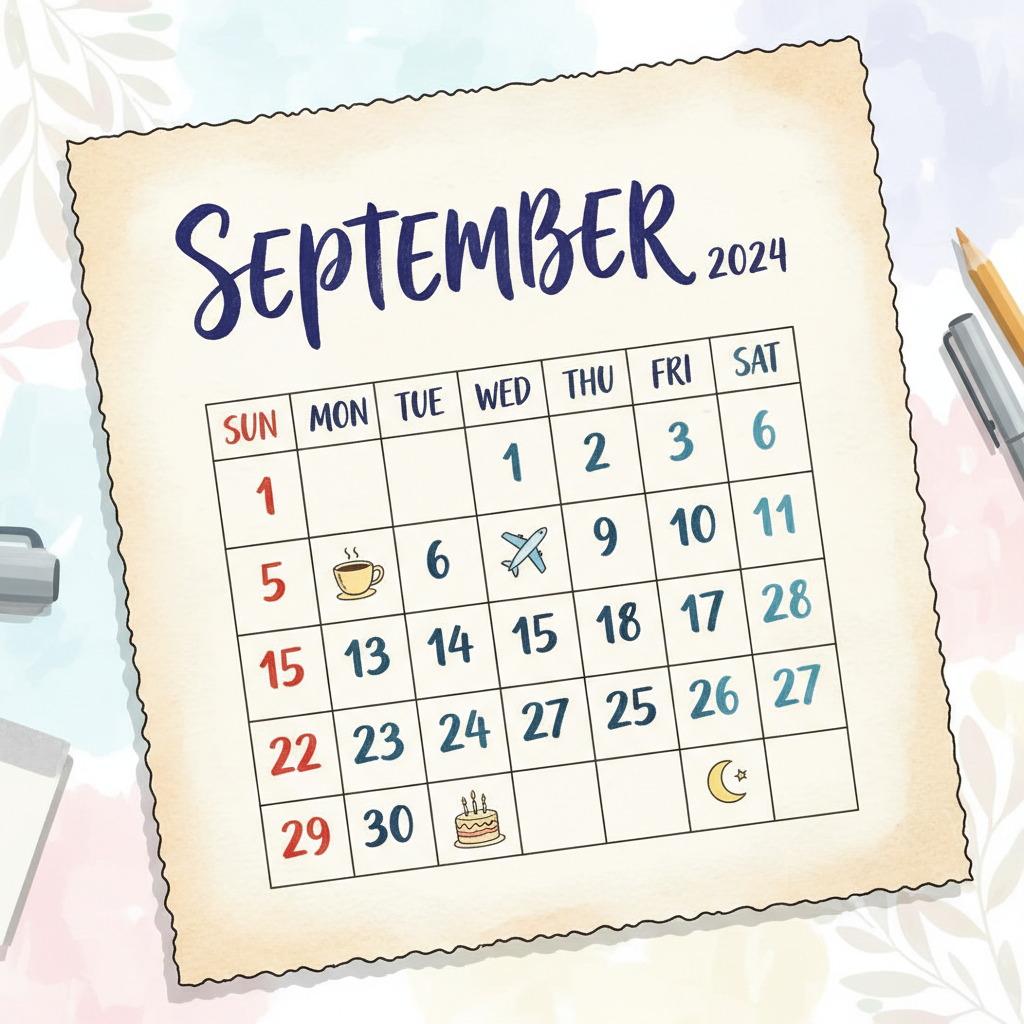 ⚠️ This picture may have spelling mistakes. Trust the words in the lesson.
Part 2: The Clock - Our Daily Timekeeper
While the calendar tells us about the big picture – days, weeks, months, and years – the clock helps us manage our time within a single day. It breaks down the 24 hours of a day into smaller, manageable chunks.
What is a Clock?
A clock is an instrument used to measure, keep, and indicate time. It helps us know what time it is right now!
The Parts of a Clock:
Most clocks have a face with numbers from 1 to 12, and pointers called hands:
- Hour Hand: This is the shortest hand. It moves slowly and points to the hour. It takes 12 hours to go all the way around the clock face once.
- Minute Hand: This hand is longer than the hour hand. It moves faster and points to the minutes. It takes 1 hour (60 minutes) to go all the way around the clock face once.
- Second Hand (Optional): Some clocks have a very thin hand that moves the fastest. It points to the seconds. It takes just 1 minute (60 seconds) to go all the way around.
Understanding Time on a Clock:
A clock face represents 12 hours. To cover the full 24 hours of a day, the hour hand goes around the clock face twice.
- Hours: When the minute hand is pointing straight up at the 12, the hour hand tells you the exact hour. For example, if the hour hand points to the 3 and the minute hand points to the 12, it's 3 o'clock.
- Minutes: Each number on the clock face also represents minutes. Remember, there are 60 minutes in 1 hour. So, if you count the spaces between the numbers, there are 5 minutes between each number (12 to 1 is 5 minutes, 1 to 2 is 5 minutes, and so on). When the minute hand points to the 1, it means 5 minutes past the hour. When it points to the 2, it means 10 minutes past the hour.
AM and PM: Dividing the Day
Since the hour hand goes around twice, we need a way to know if it's morning, afternoon, or night. This is where AM and PM come in:
- AM (Ante Meridiem): This means "before midday." It covers the time from midnight (12:00 AM) to just before noon (12:00 PM). Think of the morning and early afternoon.
- PM (Post Meridiem): This means "after midday." It covers the time from noon (12:00 PM) to just before midnight (12:00 AM). Think of the afternoon, evening, and night.
Analogy: Imagine your day is a race track with two laps. The first lap (AM) is from waking up until lunchtime. The second lap (PM) is from lunchtime until you go to sleep.
Clock Logic Puzzles:
Clocks are also fantastic for puzzles:
- If it is currently 2:00 PM, what time will it be in 3 hours? (Answer: 5:00 PM)
- If the hour hand is pointing at the 7 and the minute hand is pointing at the 12, what time is it? (Answer: 7:00)
- If it is 10:30 AM, and you have a class that lasts for 1 hour, when will your class end? (Answer: 11:30 AM)
Part 3: Putting It All Together - Calendar and Clock Logic
Calendars and clocks work together to help us manage our time effectively. We use the clock for daily schedules and the calendar for longer-term planning.
Key Concepts for Olympiad Questions:
- Time Intervals: How much time passes between two events? (e.g., If a movie starts at 3:00 PM and ends at 5:00 PM, it lasted 2 hours.)
- Future and Past Events: Calculating dates and times in the future or past. (e.g., If today is Tuesday, what day was it 3 days ago? Monday, Sunday, Saturday!)
- Cyclical Patterns: Recognizing that days of the week repeat every 7 days, and the hour hand on a clock repeats every 12 hours.
Remember, practicing with these concepts will make you a time-traveling genius in no time!
Keep learning, free
Create a free Syllabax account to unlock practice questions and games for this topic.
Visual Learning Enhanced! 🚀
To help you master this topic, we use Advanced Syllabax AI to generate detailed diagrams and visual models.
Note on Visuals: The AI sometimes makes spelling errors in image labels. Please refer to the lesson text for the correct terminology.