Methods: handpicking, sieving, filtration, evaporation, sedimentation[CHEMISTRY]
Watch this topic in 60 seconds
Free preview · Lesson 1
Understanding Methods: handpicking, sieving, filtration, evaporation, sedimentation[CHEMISTRY]
Separating Mixtures: Getting Things Apart!
Welcome, young scientists! Have you ever noticed how a salad is made of different ingredients like lettuce, tomatoes, and croutons, but they're all mixed together? Or how sand and water can be mixed? In chemistry, we call these mixtures. Mixtures are things that are put together but are not chemically joined. The exciting part is that we can often separate these mixtures back into their original parts using different methods! Today, we're going to explore some of these super cool methods: handpicking, sieving, filtration, evaporation, and sedimentation.
1. Handpicking: The 'Pick It Out' Method
Imagine you have a bowl of mixed candies, and you really want only the red ones. What do you do? You probably reach in and pick out the red candies one by one, right? That's exactly what handpicking is! It's one of the simplest ways to separate mixtures.
What it is: Handpicking is a method used to separate larger solid particles from a mixture by picking them out with your hands or using simple tools like tweezers.
When we use it: This method works best when the different parts of the mixture are easy to see and are of different sizes or colors, and when there aren't too many things to pick. Think about sorting colorful buttons, picking out stones from rice, or removing seeds from fruit.
Analogy: It's like being a treasure hunter! You carefully look through the sand (the mixture) to find shiny pebbles (the things you want to separate).
2. Sieving: The 'Shake and Sort' Method
Have you ever seen a baker sift flour? Or maybe you've played with a sieve at the beach to get shells? Sieving is another way to separate solids when they are of different sizes.
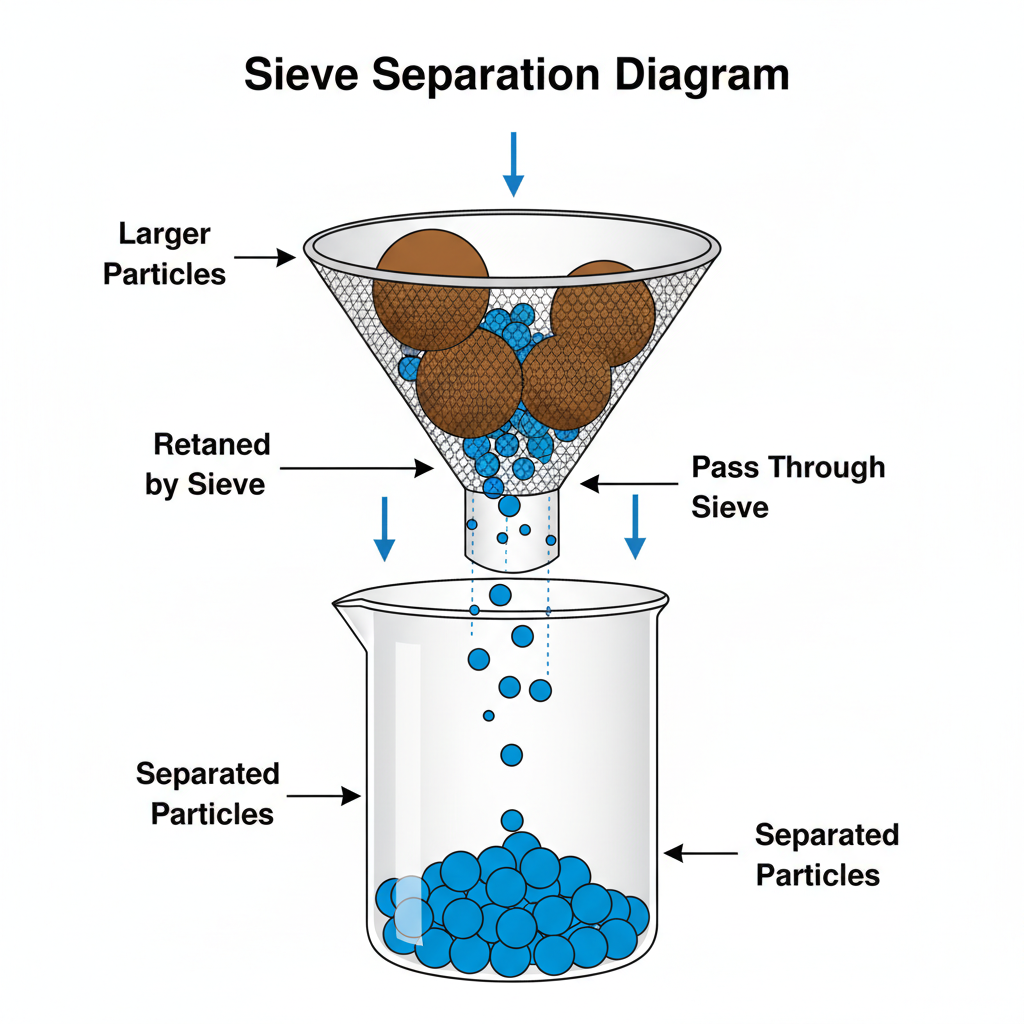
What it is: Sieving uses a sieve, which is like a container with small holes in the bottom. When you shake the mixture over the sieve, the smaller particles fall through the holes, while the larger particles stay behind.
When we use it: This is perfect for separating things like sand from gravel, or separating coarse flour from fine flour. The key is that the items in the mixture have different sizes, and one size can fit through the sieve's holes while the other cannot.
Analogy: Think of a fence with big gaps and small gaps. If you try to roll different-sized balls through it, the small balls will go through the small gaps, but the big balls might only fit through the big gaps or not at all.
 ⚠️ This picture may have spelling mistakes. Trust the words in the lesson.
3. Filtration: The 'Paper Wall' Method
Sometimes, we have mixtures where one part is a solid, and the other is a liquid, and the solid particles are very, very small – too small to pick or sieve.
What it is: Filtration uses a filter, which is like a special paper or cloth with tiny pores (holes). You pour the mixture through the filter. The liquid passes through the filter paper (this is called the filtrate), but the solid particles get trapped on the filter paper (this is called the residue).
When we use it: This is excellent for separating things like sand from water, or even for cleaning coffee! When you make coffee, hot water passes through the coffee grounds (the solid), but the grounds stay behind in the filter, giving you clear coffee.
Analogy: Imagine trying to get tiny bugs out of your swimming pool. You use a pool net (the filter). The water goes through the net, but the bugs get caught in it.
4. Evaporation: The 'Disappearing Act' Method
What happens to a puddle of water after it rains and the sun comes out? It disappears, right? The water turns into a gas called water vapor and floats into the air. This process is called evaporation.
What it is: Evaporation is a method where a liquid turns into a gas (vapor) and escapes into the air, usually when heated. We use this to separate a dissolved solid from a liquid. The liquid disappears, leaving the solid behind.
When we use it: This is how we get salt from saltwater! When we heat saltwater, the water evaporates, leaving behind the salt crystals. Think about drying clothes on a clothesline – the water evaporates from the fabric.
Analogy: It's like when you boil water for tea, and you see steam rising. That steam is water turning into a gas. If you kept boiling until all the water was gone, anything dissolved in the water would be left behind.
5. Sedimentation: The 'Let it Settle' Method
Have you ever stirred up mud in a pond? If you wait for a while, what happens to the mud? It slowly sinks to the bottom, doesn't it? That's sedimentation!
What it is: Sedimentation is the process where heavier solid particles in a liquid mixture settle down to the bottom over time because of gravity. Once the particles have settled, the clear liquid on top can be carefully poured off. This pouring off is called decantation.
When we use it: This is great for separating muddy water or letting tea leaves settle to the bottom of a teapot before pouring. It works when the solid particles are denser than the liquid and will sink.
Analogy: Imagine you're at a party, and there are lots of people (solid particles) dancing in a room (liquid). If the music stops and everyone needs to sit down, the people will find seats (settle at the bottom), and you can then easily see and talk to someone standing up (the clear liquid on top).
Putting It All Together!
These methods are all tools in a scientist's toolbox for separating mixtures. Sometimes, we might even use more than one method to get something pure!
Keep learning, free
Create a free Syllabax account to unlock practice questions and games for this topic.
Visual Learning Enhanced! 🚀
To help you master this topic, we use Advanced Syllabax AI to generate detailed diagrams and visual models.
Note on Visuals: The AI sometimes makes spelling errors in image labels. Please refer to the lesson text for the correct terminology.