Dominant vs recessive[BIOLOGY]
Watch this topic in 60 seconds
Free preview · Lesson 1
Understanding Dominant vs recessive[BIOLOGY]
Understanding Dominant and Recessive: The Building Blocks of Heredity
Have you ever wondered why you have your mother's eyes but your father's hair color? Or why some siblings look so similar while others look quite different, despite having the same parents? The answers lie in the fascinating world of genetics, specifically in how traits are passed down from one generation to the next. At the heart of this process are concepts called dominant and recessive.
What Are Genes and Alleles?
Imagine your body as a magnificent instruction manual. This manual contains all the instructions for building and operating you – everything from your eye color to how tall you'll be. These instructions are stored in tiny units called genes. We inherit these genes from our parents, receiving one copy from our mother and one copy from our father for almost every trait.
Now, think of a specific instruction in the manual, like "eye color." Just as there can be different versions of an instruction (e.g., "blue eyes," "brown eyes," "green eyes"), genes also come in different versions. These different versions of the same gene are called alleles.
Analogy: Think of a vending machine for soda. The "soda flavor" is the gene. But there are different types of soda: cola, lemon-lime, orange. These different types are like the alleles for that "soda flavor" gene.
The Loud and Quiet Voices: Dominant and Recessive Alleles
When you have two alleles for a gene (one from each parent), how does your body decide which trait to show? This is where dominant and recessive come into play.
The Dominant Allele: The Star of the Show!
A dominant allele is like the loudest voice in a room. If it's present, even if there's a quieter voice, it's the one you hear and notice. In genetics, if a dominant allele is present, the trait it carries will be expressed, or "shown," in the organism. It "dominates" or "masks" the presence of any other allele for that same gene.
We often represent dominant alleles with a capital letter (e.g., 'B' for brown eyes).
Analogy: Imagine you have a bright, flashing red light (dominant) and a dim, steady green light (recessive). If both are on, your eye is immediately drawn to the red light. The red light "dominates" your attention.
The Recessive Allele: Waiting for its Turn
A recessive allele is like the quiet voice. It's there, but its trait will only be expressed if there is *no* dominant allele present to overshadow it. If a dominant allele is around, the recessive trait remains "hidden" or "masked."
Recessive alleles are typically represented with a lowercase letter (e.g., 'b' for blue eyes).
Analogy: Using the light analogy again, the dim green light (recessive) only becomes noticeable if the bright red light (dominant) is turned off completely. Only then does the green light get its moment to shine.
Putting it Together: Genotype and Phenotype
To understand how dominant and recessive alleles work, we need two more important terms:
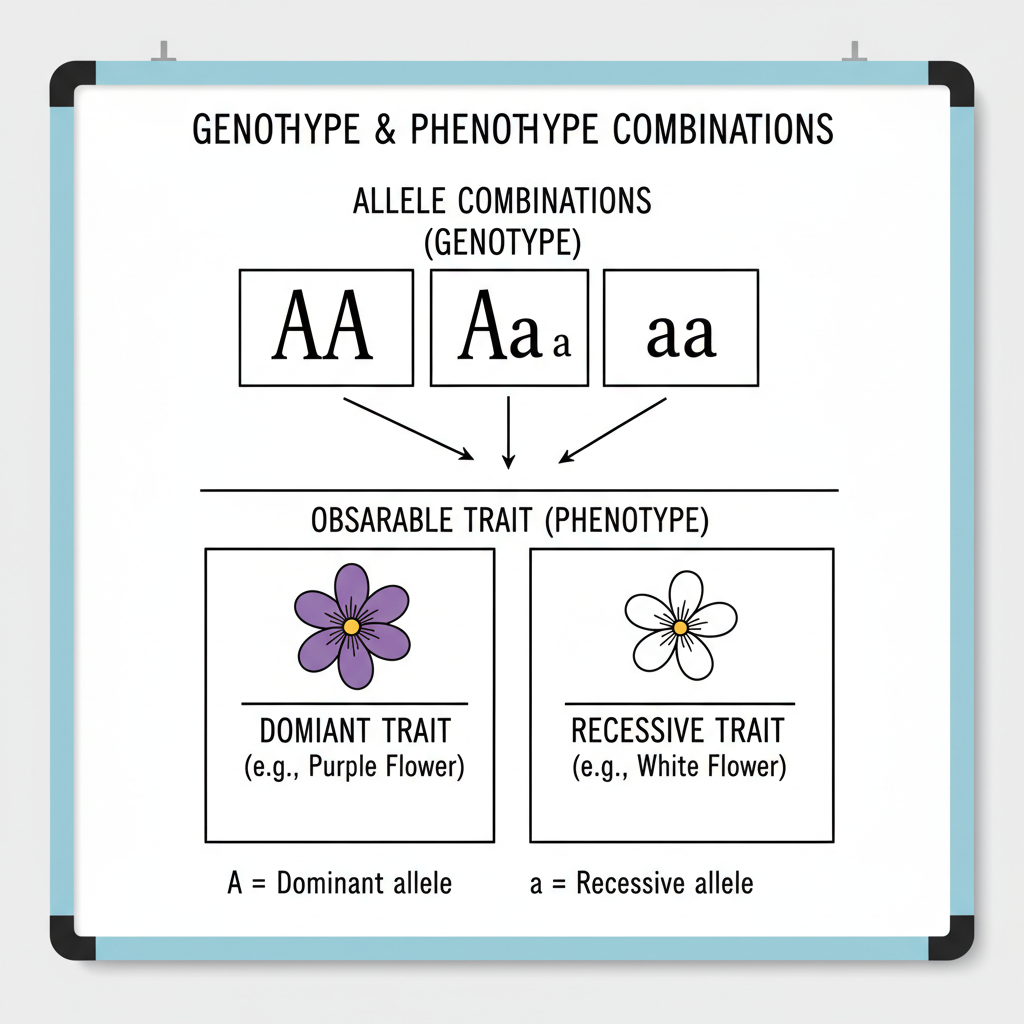
- Genotype: This refers to the specific combination of alleles an individual has for a particular gene. It's like the genetic "recipe" or the actual letters (e.g., BB, Bb, bb).
- Phenotype: This is the observable, physical trait that results from the genotype. It's what you actually "see" (e.g., brown eyes, blue eyes).
Analogy: If a cake recipe says "add chocolate chips and vanilla extract," that's the genotype (the ingredients list). The actual cake you bake, with its taste and appearance, is the phenotype.
The Allele Combinations: Homozygous and Heterozygous
Since we get two alleles for each gene (one from each parent), there are three possible combinations:
-
Homozygous Dominant (e.g., BB): This means an individual has two copies of the dominant allele.
Phenotype: The dominant trait will be expressed.
Analogy: You have two strong, loud dominant singers in a duet. Their song will definitely be loud and clear!
-
Homozygous Recessive (e.g., bb): This means an individual has two copies of the recessive allele.
Phenotype: The recessive trait will be expressed (because there's no dominant allele to mask it).
Analogy: You have two quiet, soft-spoken singers in a duet. Their song will be gentle and soft.
-
Heterozygous (e.g., Bb): This means an individual has one dominant allele and one recessive allele.
Phenotype: The dominant trait will be expressed. The recessive allele is present, but it's "masked" by the dominant one.
Analogy: You have one loud singer and one quiet singer. The loud singer's voice will mostly be heard, overshadowing the quiet one.
 ⚠️ This picture may have spelling mistakes. Trust the words in the lesson.
Real-World Examples in Humans
Many human traits are determined by dominant and recessive alleles. Here are a few simplified examples:
- Attached vs. Unattached Earlobes: Unattached earlobes (where the bottom of the earlobe hangs free) is generally considered a dominant trait (E). Attached earlobes (where the earlobe is directly connected to the side of the head) is a recessive trait (e). So, individuals with EE or Ee genotypes will have unattached earlobes, while only individuals with an ee genotype will have attached earlobes.
- Widow's Peak vs. Straight Hairline: A widow's peak (a V-shaped point in the hairline in the center of the forehead) is a dominant trait (W). A straight hairline is recessive (w). If you have a widow's peak, your genotype is likely WW or Ww. If you have a straight hairline, your genotype must be ww.
- Ability to Taste PTC Paper: The ability to taste a bitter chemical called Phenylthiocarbamide (PTC) is a dominant trait (T). Non-tasting is recessive (t). If you can taste PTC, your genotype is TT or Tt. If you can't taste it, your genotype is tt.
It's important to remember that most traits are much more complex and involve multiple genes and environmental factors, but these simple examples help illustrate the basic principles of dominant and recessive inheritance.
Conclusion
Dominant and recessive alleles are fundamental concepts in understanding how genetic traits are passed down and expressed. The dominant allele always expresses its trait if present, while the recessive allele only expresses its trait if two copies are present (one from each parent). This interplay between alleles determines your unique set of observable characteristics, making you, well, YOU!
Keep learning, free
Create a free Syllabax account to unlock practice questions and games for this topic.
Visual Learning Enhanced! 🚀
To help you master this topic, we use Advanced Syllabax AI to generate detailed diagrams and visual models.
Note on Visuals: The AI sometimes makes spelling errors in image labels. Please refer to the lesson text for the correct terminology.