Learning Journey
Watch this topic in 60 seconds
Free preview · Lesson 1
Understanding Future Tech: AI & VR Basics
Welcome to the Future! AI & VR Basics for 6th Graders
Get ready to explore some of the coolest technologies shaping our world: Artificial Intelligence (AI) and Virtual Reality (VR)! These might sound like something out of a science fiction movie, but they're already all around us and changing how we live, learn, and play. Think of this lesson as your secret decoder ring to understand these amazing inventions.
What is Artificial Intelligence (AI)? Thinking Machines!
Imagine you have a super-smart robot dog. When you first get it, it doesn't know any tricks. But if you show it how to "sit" a few times, give it a treat when it does it right, and repeat the process, eventually, it learns! It starts to understand what "sit" means and does it all by itself. That's a bit like Artificial Intelligence!
In simple terms, Artificial Intelligence (AI) is when we teach computers to "think" and "learn" almost like humans do. Instead of just following exact instructions we give them, AI systems can look at lots of information, find patterns, make decisions, and even solve problems on their own.
AI Analogies:
- The Smart Helper: Think of a really helpful friend who remembers all your favorite snacks, knows the quickest way to school, and can suggest a new book you might love just by knowing what you’ve read before. AI is like that helper for computers!
- The Pattern Detective: Imagine a detective who looks at thousands of clues (data!) and figures out what's going on. AI programs are like these detectives, finding hidden connections in massive amounts of information.
How does AI learn? It mostly learns from data! If you show an AI program thousands of pictures of cats, it starts to figure out what a cat looks like (it has pointy ears, whiskers, a tail, etc.). Then, when you show it a new picture, it can tell you, "Hey, that looks like a cat!" This process is often called Machine Learning, which is a big part of AI.
Where do we see AI today? It's everywhere!
- Smart Assistants: When you ask Siri or Alexa a question, or tell Google Assistant to play your favorite song, you're talking to AI.
- Recommendation Systems: When Netflix suggests a show you might like, or YouTube recommends a new video, AI is at work, trying to guess what you'll enjoy based on what you've watched before.
- Video Games: The bad guys in your favorite video game often use AI to make them seem smart and challenging, reacting to your moves.
- Self-Driving Cars: These cars use AI to see the road, understand traffic signs, and make decisions about steering and braking.
What is Virtual Reality (VR)? Stepping into Another World!
Now, let's talk about something that can literally transport you to another place without leaving your room! Imagine putting on a special pair of goggles, and suddenly, you're not in your living room anymore. Instead, you're flying through space, exploring an ancient castle, or even swimming with dolphins!
This magical experience is called Virtual Reality (VR). VR uses special equipment, usually a headset that covers your eyes, to create a completely made-up, digital world that feels incredibly real. It tricks your brain into believing you are actually inside that computer-generated environment.
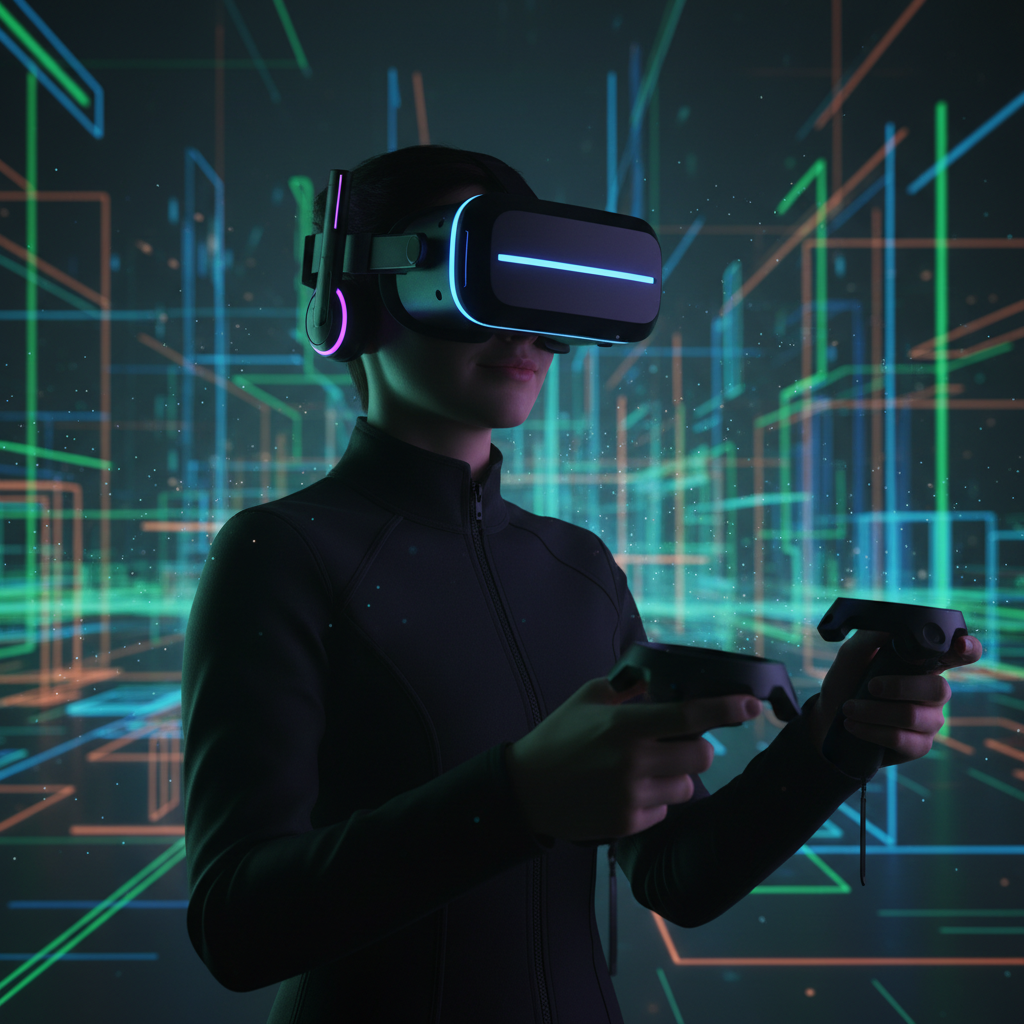 ⚠️ This picture may have spelling mistakes. Trust the words in the lesson.
VR Analogies:
- The Magic Window: Imagine a window that doesn't just show you what's outside, but lets you step through it into a completely different place! That's what a VR headset feels like.
- A Dream You Can Control: You know how dreams feel so real sometimes? VR is like a dream you can step into while you're awake, and you can even interact with the world around you.
How does VR work?
- Two Screens, One World: Inside a VR headset, there are usually two small screens, one for each eye. These screens show slightly different images, which fools your brain into seeing depth, just like in the real world.
- Special Lenses: Lenses magnify the images and make them appear far away, filling your entire field of vision so you can't see anything else.
- Tracking Your Moves: Sensors in the headset track where you're looking and how your head moves. If you turn your head left, the virtual world moves left with you, making it feel like you're truly there. Many VR systems also have hand controllers to let you pick up, move, and interact with things in the virtual world.
Where do we use VR today?
- Gaming: Many exciting games are made for VR, letting you become part of the action like never before.
- Education: Imagine taking a virtual field trip to ancient Rome, dissecting a frog virtually, or practicing a science experiment without any mess!
- Training: Doctors can practice surgeries, pilots can learn to fly, and astronauts can prepare for space missions all in a safe, virtual environment.
- Virtual Tourism: Explore famous landmarks or beautiful places around the world without ever leaving your home.
AI and VR Working Together: Smarter Virtual Worlds!
While AI and VR are incredible on their own, they become even more powerful when they work together! Imagine a VR game where the characters you meet aren't just following simple scripts, but are powered by AI. They could learn your playing style, remember what you say, and react in unique, intelligent ways.
- Smart VR Characters: AI can make the virtual people or creatures in a VR world much more realistic and interactive.
- Personalized VR Experiences: AI could learn what you like in a VR environment and adjust the experience just for you, maybe making a game harder or easier, or showing you more of the things you find interesting.
- Realistic Simulations: In training simulations, AI can make the virtual situations feel even more real and challenging, adapting to the trainee's performance.
The Future is Now (and Even More Later)!
AI and VR are still quite new, and they are getting smarter and more amazing every single day. They are not just for fun; they are tools that can help us learn, solve big problems, and connect with people in new ways.
Being Smart About Tech:
- It's important to remember that these are tools. Like any tool, they can be used for good or bad.
- Always be curious and ask questions about how these technologies work.
- Think about privacy: what information are you sharing with AI systems?
- Balance screen time with other activities: running, reading, playing outside!
You are the generation that will grow up with and shape the future of AI and VR. By understanding the basics now, you're already one step ahead!
Keep learning, free
Create a free Syllabax account to unlock practice questions and games for this topic.
Visual Learning Enhanced! 🚀
To help you master this topic, we use Advanced Syllabax AI to generate detailed diagrams and visual models.
Note on Visuals: The AI sometimes makes spelling errors in image labels. Please refer to the lesson text for the correct terminology.