Probability of Simple Events
Watch this topic in 60 seconds
Free preview · Lesson 1
Understanding Probability of Simple Events
Understanding Probability of Simple Events
Welcome to the exciting world of probability! Probability is all about understanding the chances of something happening. Think of it like this: when you toss a coin, you know there's a chance it will land on heads and a chance it will land on tails. Probability helps us measure exactly how likely those chances are.
What is an Event?
In probability, an event is simply an outcome or a set of outcomes that we are interested in. It's like asking, 'What's the chance of *this specific thing* happening?'
- Example 1: Flipping a Coin
If you flip a coin, the possible events are getting 'Heads' or getting 'Tails'. We are usually interested in the event of getting 'Heads'. - Example 2: Rolling a Die
When you roll a standard six-sided die, the possible outcomes are rolling a 1, 2, 3, 4, 5, or 6. An event could be rolling a '4', or it could be rolling an 'even number' (which means rolling a 2, 4, or 6). - Example 3: Drawing a Card
If you draw a card from a standard deck of 52 playing cards, an event could be drawing the 'Ace of Spades', or it could be drawing 'any red card' (which includes all hearts and diamonds).
What is a Simple Event?
A simple event is the most basic kind of event. It's an event with only one single outcome. It's like looking at the smallest possible piece of what could happen.
- Flipping a Coin: Getting 'Heads' is a simple event. Getting 'Tails' is also a simple event.
- Rolling a Die: Rolling a '3' is a simple event. Rolling a '6' is a simple event.
- Drawing a Card: Drawing the 'King of Hearts' is a simple event.
Contrast this with a compound event, which involves more than one outcome. For example, on a die, 'rolling an even number' is a compound event because it includes three outcomes (2, 4, 6).
Calculating the Probability of a Simple Event
The probability of a simple event is calculated using a very straightforward formula. We want to know, out of all the possible things that *could* happen, how many of them are the specific thing we're interested in?
The formula is:
Probability of an Event = (Number of favorable outcomes) / (Total number of possible outcomes)
Let's break this down:
- Favorable Outcomes: These are the outcomes that match the event you are interested in. If you want to know the probability of rolling a '5' on a die, then rolling a '5' is your favorable outcome. There's only one way to roll a '5'.
- Total Possible Outcomes: This is every single thing that could possibly happen. For a standard six-sided die, there are 6 total possible outcomes (1, 2, 3, 4, 5, 6).
Analogy: Picking a Candy from a Jar
Imagine you have a jar with 3 red candies and 2 blue candies. You want to pick one candy at random.
- What is the probability of picking a red candy?
- Favorable Outcomes: You want to pick a red candy. There are 3 red candies. So, 3 favorable outcomes.
- Total Possible Outcomes: There are 3 red + 2 blue = 5 candies in total. So, 5 total possible outcomes.
- Probability (Red) = 3 / 5
- What is the probability of picking a blue candy?
- Favorable Outcomes: You want to pick a blue candy. There are 2 blue candies. So, 2 favorable outcomes.
- Total Possible Outcomes: Still 5 candies in total.
- Probability (Blue) = 2 / 5
Notice that the probabilities of all possible simple events (picking red, picking blue) add up to 1 (or 100%). This is a key rule in probability!
Analogy: A Spinner Game
Consider a spinner that is divided into 4 equal sections, colored Green, Blue, Red, and Yellow.
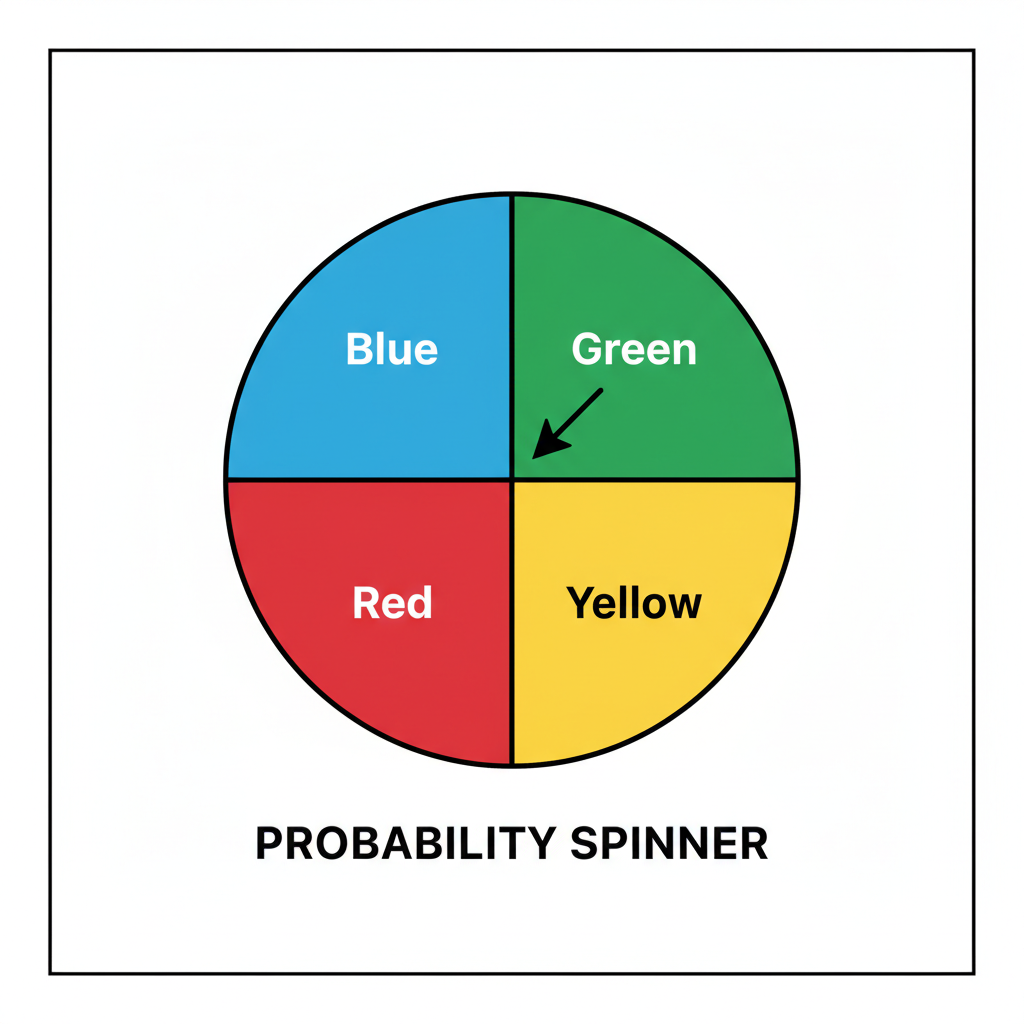
- What is the probability of landing on Green?
- Favorable Outcomes: Landing on Green. There is 1 green section.
- Total Possible Outcomes: There are 4 sections in total (Green, Blue, Red, Yellow).
- Probability (Green) = 1 / 4
- What is the probability of landing on Red?
- Favorable Outcomes: Landing on Red. There is 1 red section.
- Total Possible Outcomes: 4 sections.
- Probability (Red) = 1 / 4
Understanding Probability Values
Probability is always expressed as a number between 0 and 1, inclusive.
- Probability of 0: This means the event is impossible. It can never happen. (e.g., The probability of rolling a 7 on a standard six-sided die is 0).
- Probability of 1: This means the event is certain. It will definitely happen. (e.g., The probability of rolling any number from 1 to 6 on a standard six-sided die is 1).
- Probability between 0 and 1: The closer the probability is to 1, the more likely the event is to happen. The closer it is to 0, the less likely it is.
Key Concepts Recap:
- Experiment: An action or process with uncertain outcomes (e.g., flipping a coin, rolling a die).
- Outcome: A single possible result of an experiment (e.g., 'Heads', rolling a '3').
- Sample Space: The set of all possible outcomes of an experiment (e.g., {1, 2, 3, 4, 5, 6} for a die roll).
- Event: A specific outcome or a set of outcomes we are interested in (e.g., rolling an even number).
- Simple Event: An event with exactly one outcome.
- Probability: A measure of how likely an event is to occur, expressed as a fraction, decimal, or percentage between 0 and 1.
Probability is a fundamental concept that helps us make sense of uncertainty in our daily lives, from predicting weather to understanding game outcomes!
Keep learning, free
Create a free Syllabax account to unlock practice questions and games for this topic.
Visual Learning Enhanced! 🚀
To help you master this topic, we use Advanced Syllabax AI to generate detailed diagrams and visual models.
Note on Visuals: The AI sometimes makes spelling errors in image labels. Please refer to the lesson text for the correct terminology.