Trigonometric ratios of acute angles (Introduction to Trigonometry)
Watch this topic in 60 seconds
Free preview · Lesson 1
Understanding Trigonometric ratios of acute angles (Introduction to Trigonometry)
Unlocking the Secrets of Triangles: An Introduction to Trigonometric Ratios (Grade 10)
Welcome to the exciting world of Trigonometry! Don't let the long word scare you – it simply means 'triangle measurement.' Imagine you want to build a ramp, find the height of a tall tree without climbing it, or even figure out how far away a ship is from the shore. All these real-world problems can be solved using the powerful tools of trigonometry. At its heart, trigonometry is like a special magnifying glass that helps us understand the relationships between the angles and sides of triangles, especially a particular kind of triangle: the right-angled triangle.
What is a Right-Angled Triangle?
Before we dive into ratios, let's quickly review our star player: the right-angled triangle. This is a triangle that has one angle exactly equal to 90 degrees (a 'right angle'). Think of the corner of a square room, or the angle where a wall meets the floor – that's a right angle!
Meeting the Sides of a Right Triangle
Every right-angled triangle has three sides, but in trigonometry, we give them special names that depend on which acute angle we're focusing on. An acute angle is any angle less than 90 degrees. A right-angled triangle always has two acute angles.
Let's imagine you're standing at one of the acute angles of the triangle, looking across it. The names of the sides will depend on your perspective, like how a tree might be 'in front' of you but 'behind' someone else standing on the other side.
-
The Hypotenuse (H): This is the easiest one to spot! It's always the longest side of the right-angled triangle, and it's always directly opposite the 90-degree angle. Think of it as the 'diagonal path' you can take from one corner to another, always the longest route across.
Analogy: If your right-angled triangle is like a slide, the hypotenuse is the slide itself – the longest part you travel down. -
The Opposite Side (O): This is the side that is directly across from the acute angle you are currently focusing on. If you 'point' from your angle, the side you're pointing at is the opposite side.
Analogy: Imagine you're at one corner of a room, and you're looking at the wall directly across from you. That wall is 'opposite' to your position. -
The Adjacent Side (A): This is the side that is 'next to' or 'touching' the acute angle you are focusing on, but it's NOT the hypotenuse. It forms one of the 'arms' of the angle you're interested in.
Analogy: Using the room analogy, if you're looking across at the opposite wall, the wall to your left or right (that meets at your corner) is 'adjacent' to your position.
It's crucial to remember that the 'opposite' and 'adjacent' sides *change* depending on which acute angle you choose to focus on. The hypotenuse, however, always stays the hypotenuse!
The Three Main Trigonometric Ratios: SOH CAH TOA
Now that we know the names of the sides, we can introduce the three fundamental trigonometric ratios. These ratios are simply comparisons (fractions) of the lengths of these sides. For any given acute angle in a right-angled triangle, these ratios will *always* be the same, no matter how big or small the triangle is, as long as the angle is the same! Think of it like a blueprint – all objects built from the same blueprint, regardless of their final size, maintain the same proportions.
There's a super helpful mnemonic (memory aid) to remember these three ratios: SOH CAH TOA.
1. Sine (Pronounced 'sign') - SOH
SOH stands for Sine = Opposite / Hypotenuse.
The sine of an acute angle (often written as sin(angle)) is the ratio of the length of the side opposite that angle to the length of the hypotenuse.
sin(angle) = Opposite / Hypotenuse
Analogy: Imagine a ladder leaning against a wall (this forms a right triangle with the ground and the wall). The sine ratio would tell you how high up the wall the ladder reaches, compared to the total length of the ladder. If the ladder is long, and the angle is steep, it reaches high. If the angle is shallow, it doesn't reach as high relative to its length.
2. Cosine (Pronounced 'koh-sign') - CAH
CAH stands for Cosine = Adjacent / Hypotenuse.
The cosine of an acute angle (often written as cos(angle)) is the ratio of the length of the side adjacent to that angle to the length of the hypotenuse.
cos(angle) = Adjacent / Hypotenuse
Analogy: Using our ladder analogy, the cosine ratio would tell you how far the base of the ladder is from the wall, compared to the total length of the ladder. If the ladder is long and the angle is shallow, its base is far from the wall. If the angle is steep, its base is closer to the wall relative to its length.
3. Tangent (Pronounced 'tan-jent') - TOA
TOA stands for Tangent = Opposite / Adjacent.
The tangent of an acute angle (often written as tan(angle)) is the ratio of the length of the side opposite that angle to the length of the side adjacent to that angle.
tan(angle) = Opposite / Adjacent
Analogy: The tangent ratio is like describing the 'steepness' or 'slope' of a ramp. It compares the vertical 'rise' (opposite side) to the horizontal 'run' (adjacent side). A higher tangent value means a steeper ramp.
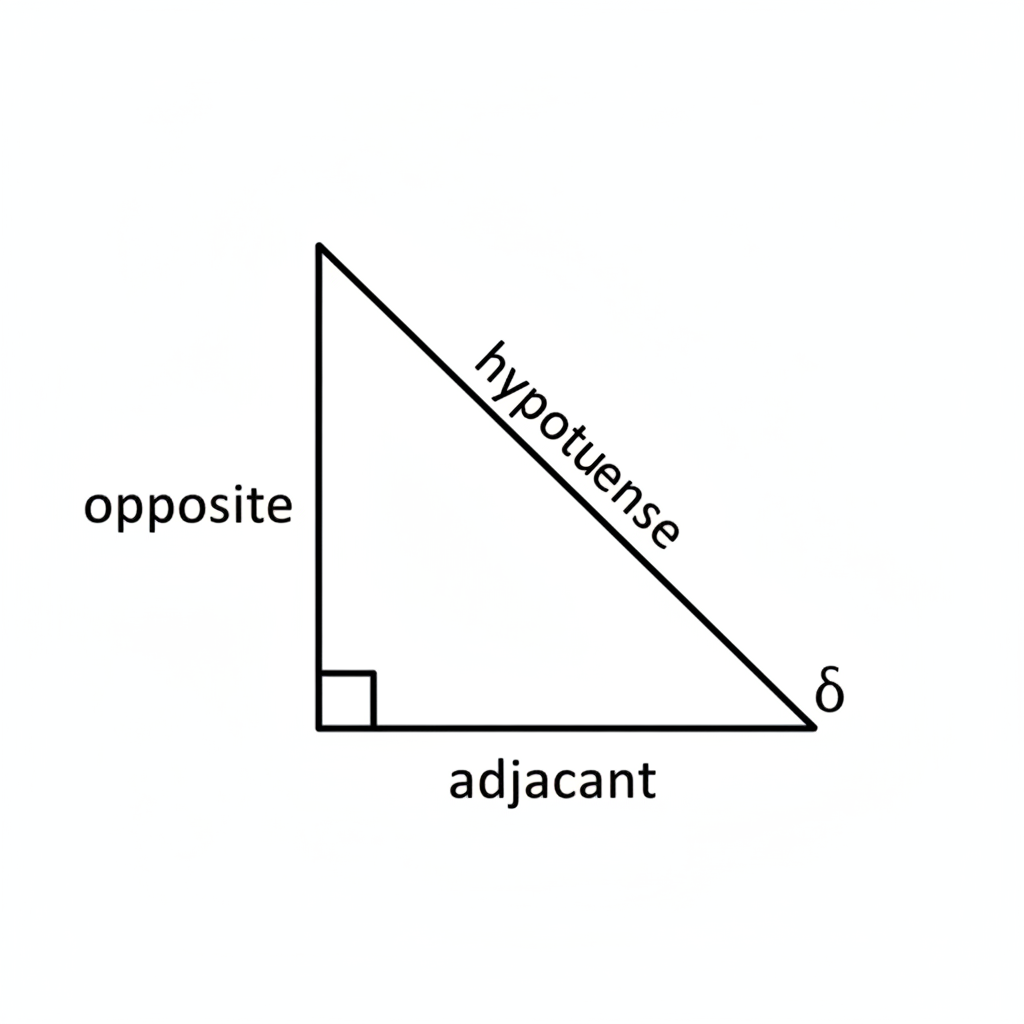 ⚠️ This picture may have spelling mistakes. Trust the words in the lesson.
Putting It All Together: A Step-by-Step Guide
To use these ratios, follow these simple steps:
- Identify the Right Angle: This helps you find the hypotenuse.
- Identify the Acute Angle of Interest: This is the angle you're given or trying to find. Circle it!
- Label the Sides: Based on your chosen acute angle, label the sides as Opposite, Adjacent, and Hypotenuse.
- Choose the Correct Ratio: Use SOH CAH TOA to decide which ratio (sine, cosine, or tangent) relates the sides you know and the side (or angle) you want to find.
- Set up and Solve: Write down the ratio as an equation and solve for the unknown value.
Why are they called 'Ratios'?
They are called ratios because they are literally fractions! They express how many times longer one side is compared to another. For instance, if sin(angle) = 0.5, it means the opposite side is half the length of the hypotenuse. These ratios are incredibly useful because they allow us to find unknown side lengths or angles in right-angled triangles even when we don't have all the measurements, as long as we have enough information.
Trigonometric ratios are the foundational building blocks for much more advanced mathematics and have countless applications in fields like engineering, architecture, physics, astronomy, and even video game development. Mastering these basic concepts will open up a whole new way of understanding the world around you!
Keep learning, free
Create a free Syllabax account to unlock practice questions and games for this topic.
Visual Learning Enhanced! 🚀
To help you master this topic, we use Advanced Syllabax AI to generate detailed diagrams and visual models.
Note on Visuals: The AI sometimes makes spelling errors in image labels. Please refer to the lesson text for the correct terminology.