Cube, cuboid, sphere, cone, cylinder (3D Shapes)
Watch this topic in 60 seconds
Free preview · Lesson 1
Understanding Cube, cuboid, sphere, cone, cylinder (3D Shapes)
Exploring Our World: 3D Shapes!
Hello, young explorers! Today, we're going on an exciting adventure to discover the amazing world of 3D shapes. You see these shapes all around you every single day, even when you're not thinking about them! They are the building blocks of so many things. Let's meet them!
What is a 3D Shape?
Imagine a drawing of a square on a piece of paper. That's a 2D shape – it's flat, like a pancake! Now, imagine a box. A box isn't flat, is it? It has length, width, AND height. It takes up space. That's what makes it a 3D (three-dimensional) shape. 3D shapes have thickness, or depth, and you can hold them, stack them, or roll them!
Meet the Shapes!
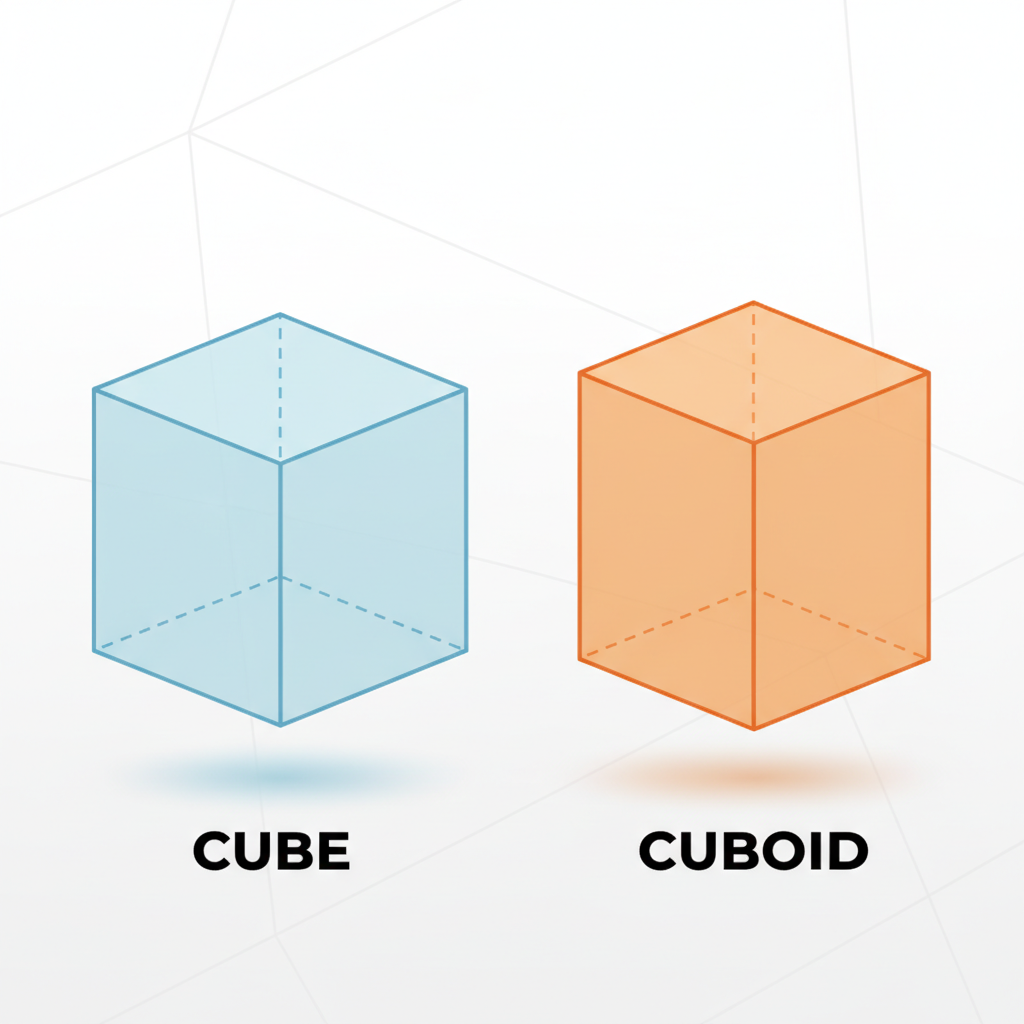
1. The Cube: The Perfect Box!
Our first friend is the Cube. A cube is like a super-perfect box. Think of a dice you use in a board game. What do you notice about it?
- It has 6 sides, and every single side is a perfect square.
- All the corners are sharp and pointy.
- It's like having 6 flat squares all joined together to make a box!
Analogy Time! A cube is like a sugar cube, a perfectly square box of crayons, or even a tiny house with a flat roof and flat walls.
2. The Cuboid: The Stretchy Box!
Next up is the Cuboid. A cuboid is also a box shape, but it's a bit more flexible than a cube. Think about a common brick or a chocolate bar.
- A cuboid also has 6 sides, but they are rectangles (or squares!).
- Not all the sides have to be the same size, but opposite sides are always the same.
- It also has pointy corners.
Analogy Time! A cuboid is like a refrigerator, a school bus, a paperback book, or a loaf of bread. They are all boxy but can be long and thin, or short and wide!
3. The Sphere: The Perfect Ball!
Now, let's roll into the world of the Sphere! A sphere is a perfectly round shape. Think of a ball.
- A sphere has no flat sides. It's completely curved all the way around.
- It has no corners! You can't point to a pointy part on a ball.
- It's like a bubble or a planet.
Analogy Time! A sphere is like a basketball, a bouncy ball, the Sun, or an orange. You can roll it anywhere!
4. The Cone: The Party Hat!
Have you ever worn a party hat? Or seen an ice cream cone?
- That shape is called a Cone.
- A cone has one flat, round bottom (like a circle).
- It has one pointy top, called a vertex.
- It's curved on the side, connecting the flat bottom to the pointy top.
Analogy Time! A cone is like an ice cream cone (without the ice cream!), a traffic cone, a wizard's hat, or a funnel.
5. The Cylinder: The Tall Can!
Our last shape is the Cylinder. Think about things that are round and tall, or round and short, but have flat tops and bottoms.
- A cylinder has two flat, round ends (like circles).
- It has a curved side connecting the two flat ends.
- It doesn't have any pointy corners!
Analogy Time! A cylinder is like a can of soup, a toilet paper roll, a drinking glass, or a battery. You can stack them up!
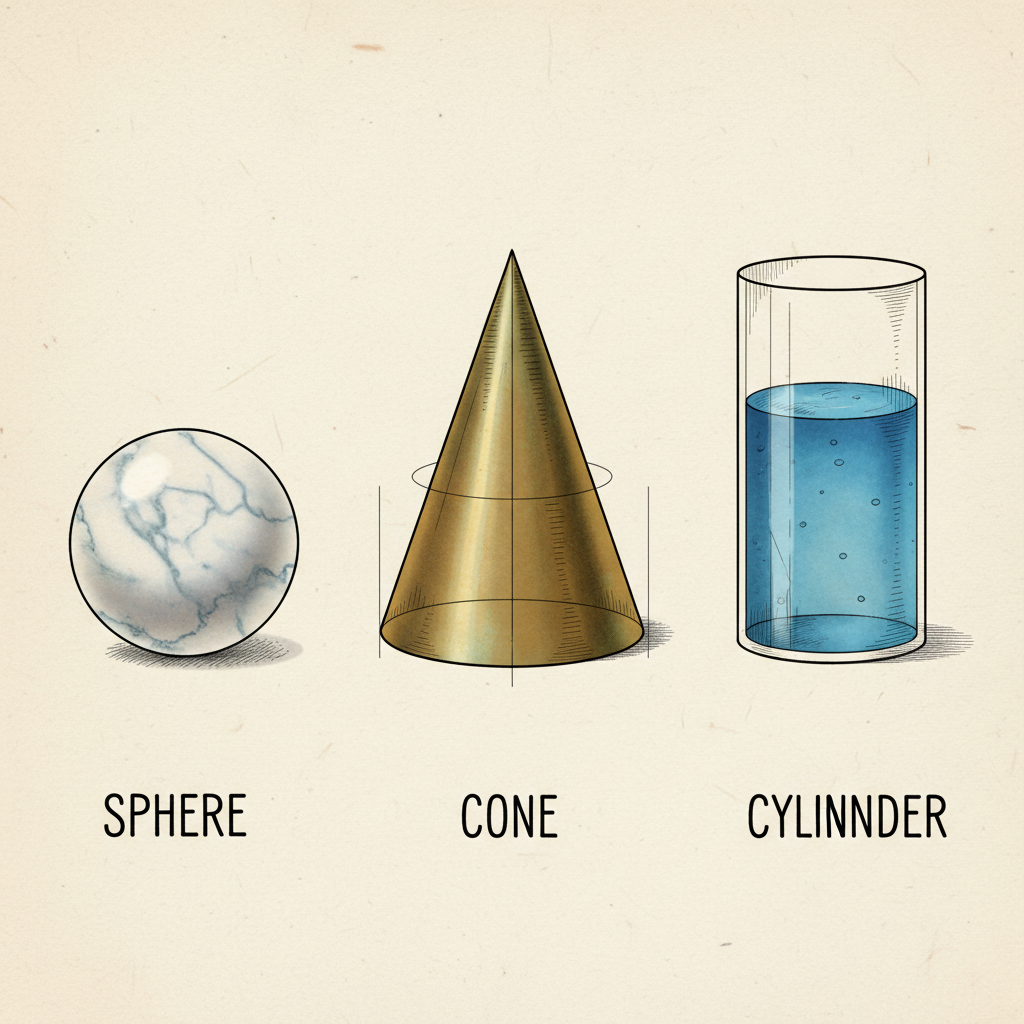 ⚠️ This picture may have spelling mistakes. Trust the words in the lesson.
Let's Review!
We learned about five amazing 3D shapes today:
- Cube: A perfect box with 6 square sides.
- Cuboid: A boxy shape with 6 rectangular sides.
- Sphere: A perfectly round ball with no corners.
- Cone: A shape with a flat circle bottom and a pointy top.
- Cylinder: A shape with two flat circle ends and a curved side.
Look around your house, your classroom, or when you're outside. Can you find examples of these shapes? You'll be surprised how many you can spot!
Keep learning, free
Create a free Syllabax account to unlock practice questions and games for this topic.
Visual Learning Enhanced! 🚀
To help you master this topic, we use Advanced Syllabax AI to generate detailed diagrams and visual models.
Note on Visuals: The AI sometimes makes spelling errors in image labels. Please refer to the lesson text for the correct terminology.