Learning Journey
Watch this topic in 60 seconds
Free preview · Lesson 1
Understanding Air, water, soil[BIOLOGY]
Understanding Earth's Life Support System: Air, Water, and Soil
Welcome, future scientists! Today, we're going on an exciting journey to explore the very foundations of life on Earth: the air we breathe, the water we drink, and the soil beneath our feet. Think of these three as Earth's magnificent life-support system, working together like a perfectly synchronized team to make our planet a vibrant home for all living things.
1. Air: Earth's Invisible Blanket
Imagine wrapping yourself in a cozy blanket. That's a bit like what air does for our planet! Air is the invisible mixture of gases that surrounds the Earth. It's not just empty space; it's a bustling ocean of tiny particles that are absolutely vital for life.
What is Air Made Of?
- Nitrogen (about 78%): This is the most abundant gas, acting like a filler. While we don't use it directly for breathing, it's crucial for plants, which convert it into useful forms for growth.
- Oxygen (about 21%): This is the superstar for animals and humans! We breathe oxygen to get energy from our food. Think of oxygen as the fuel that keeps our internal engines running. Plants also produce oxygen during a process called photosynthesis.
- Carbon Dioxide (about 0.04%): Even though it's a small amount, carbon dioxide is a huge deal for plants. They use it, along with sunlight and water, to make their own food – much like a chef uses ingredients to bake a cake. It's also important for trapping some heat, keeping Earth warm.
- Other Gases (like Argon, Neon, Water Vapor): These are present in tiny amounts but play various roles, from simple fillers to influencing weather patterns.
Why is Air So Important?
- For Breathing: All animals, including us, need oxygen to survive. Without it, our bodies wouldn't have the energy to move, think, or even just be!
- For Plants: Plants need carbon dioxide to make food through photosynthesis. This process also releases oxygen, which is a fantastic cycle!
- Protection: The atmosphere acts like a protective shield, guarding us from harmful rays from the sun and burning up most space rocks (meteors) before they hit the ground.
- Weather and Climate: Air currents (wind) move heat and moisture around the planet, creating our weather patterns.
2. Water: The Elixir of Life
If Earth were a living organism, water would be its blood. It flows everywhere, connecting everything, and is absolutely essential for every single life form we know. From the tiniest bacterium to the largest whale, water is non-negotiable for survival.
Where Do We Find Water?
Water exists in three main forms, just like how ice can melt into liquid water and then boil into steam:
- Liquid: This is what we see in oceans, rivers, lakes, and even the water we drink. It's the most common form on Earth's surface.
- Solid: Ice and snow are solid forms of water, found in glaciers, polar caps, and even frost on a cold morning.
- Gas: Water vapor is an invisible gas in the air, formed when liquid water evaporates. It plays a big role in weather!
Why is Water So Important?
- Universal Solvent: Water is often called the 'universal solvent' because it can dissolve more substances than any other liquid. Think of sugar dissolving in tea – water is doing the dissolving. This is crucial for carrying nutrients in our bodies and in plants.
- Transport System: In living things, water acts like a highway, transporting nutrients, oxygen, and waste products around. Our blood is mostly water! Plants use water to move nutrients from the soil to their leaves.
- Temperature Regulation: Water helps to regulate temperatures. Oceans store and release heat slowly, moderating Earth's climate. Our bodies use sweating (evaporation of water) to cool down.
- Habitat: Oceans, rivers, and lakes are home to countless aquatic organisms, from tiny fish to massive whales.
The Water Cycle: Earth's Never-Ending Journey
Water doesn't just sit still; it's constantly moving in a fantastic loop called the water cycle. Imagine water taking a round trip ticket through the atmosphere, land, and oceans:
- Evaporation: Sunlight warms liquid water, turning it into invisible water vapor that rises into the air. (Like water disappearing from a puddle on a sunny day).
- Condensation: As water vapor rises, it cools and turns back into tiny liquid droplets or ice crystals, forming clouds. (Think of steam from a kettle forming a tiny cloud).
- Precipitation: When clouds get too heavy, the water falls back to Earth as rain, snow, sleet, or hail.
- Collection/Runoff: This water then flows into rivers, lakes, and oceans, or soaks into the ground to become groundwater. And then the cycle begins again!
3. Soil: Earth's Fertile Skin
Now, let's dig a little deeper – literally! Soil is more than just dirt; it's the magical mixture of broken-down rocks, dead plants and animals (organic matter), water, air, and billions of tiny living organisms. Think of soil as Earth's skin, constantly alive and teeming with activity.
What is Soil Made Of?
- Mineral Particles: These come from broken-down rocks (sand, silt, clay) and provide the structure of the soil.
- Organic Matter (Humus): This is decomposed plant and animal remains. It's like a nutrient-rich sponge, holding water and providing food for plants and soil organisms.
- Water: Water fills the tiny spaces between soil particles, making it available for plants to absorb.
- Air: Soil also contains air pockets, which are essential for the roots of plants and many soil organisms to breathe.
- Living Organisms: Billions of bacteria, fungi, worms, insects, and other creatures call the soil home. They are the decomposers and recyclers, breaking down organic matter and enriching the soil.
Why is Soil So Important?
- Anchoring Plants: Soil provides a stable base for plants to grow, holding their roots firmly in place.
- Nutrient Supply: It's like a pantry for plants, storing and supplying essential nutrients that plants need to grow healthy and strong.
- Water Retention: Soil acts like a giant sponge, holding water and slowly releasing it to plants.
- Habitat: It's a bustling city for countless organisms, many of which are crucial for maintaining soil health and fertility.
- Filters Water: As water seeps through soil, the soil particles act as a natural filter, cleaning the water before it reaches groundwater reserves.
The Great Interconnection: Air, Water, and Soil Working Together
The most important thing to remember is that air, water, and soil are not isolated entities. They are constantly interacting and depending on each other, like gears in a complex clock, to keep Earth's life machine running smoothly. Here’s how they dance together:
- Air & Water: Evaporation (water from land/oceans goes into the air), rainfall (water from air returns to land/oceans), wind (air moves water vapor and influences waves).
- Water & Soil: Rainwater soaks into the soil, providing moisture for plants. Water can erode soil, carrying away valuable nutrients. Soil also filters water as it passes through.
- Soil & Air: Soil contains air pockets essential for roots and organisms. Decomposers in the soil release gases (like carbon dioxide) into the air. Wind can also erode dry soil, carrying particles through the air.
- All Three: Plants are a perfect example! They take carbon dioxide from the air, water from the soil (and rain), and nutrients from the soil to grow. When they die, decomposers in the soil break them down, returning nutrients to the soil and gases to the air.
Imagine a giant puzzle where each piece—air, water, and soil—fits perfectly with the others. If one piece is damaged or removed, the whole picture suffers. This interconnectedness means that caring for one aspect of our environment helps to protect all of them. Understanding this relationship is the first step towards being a responsible steward of our amazing planet!
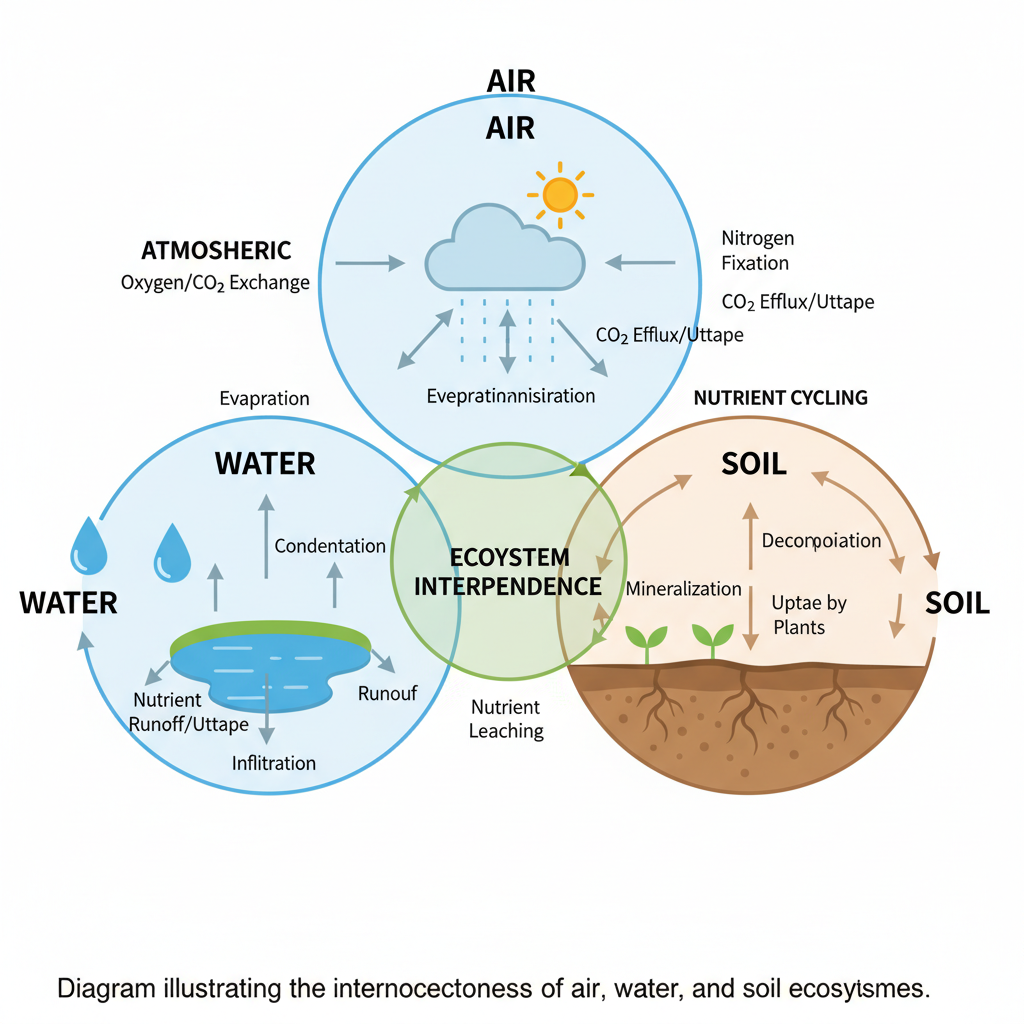 ⚠️ This picture may have spelling mistakes. Trust the words in the lesson.
Keep learning, free
Create a free Syllabax account to unlock practice questions and games for this topic.
Visual Learning Enhanced! 🚀
To help you master this topic, we use Advanced Syllabax AI to generate detailed diagrams and visual models.
Note on Visuals: The AI sometimes makes spelling errors in image labels. Please refer to the lesson text for the correct terminology.