History of Computers & Evolution
Watch this topic in 60 seconds
Free preview · Lesson 1
Understanding History of Computers & Evolution
The Incredible Journey: A History of Computers and Their Evolution
Welcome to the amazing story of computers! Imagine a world without smartphones, video games, or even the internet. It sounds strange, right? But computers, in one form or another, have been around for a lot longer than you might think. Let's embark on a journey to discover how these incredible machines came to be and how they changed over time.
Chapter 1: The Dawn of Calculation - Before Computers!
Long before electricity powered tiny chips, humans needed to count and calculate. Think about early farmers needing to track their crops or merchants needing to tally their goods. They used their fingers, stones, and simple tools.
The Abacus: The Grandfather of Calculators
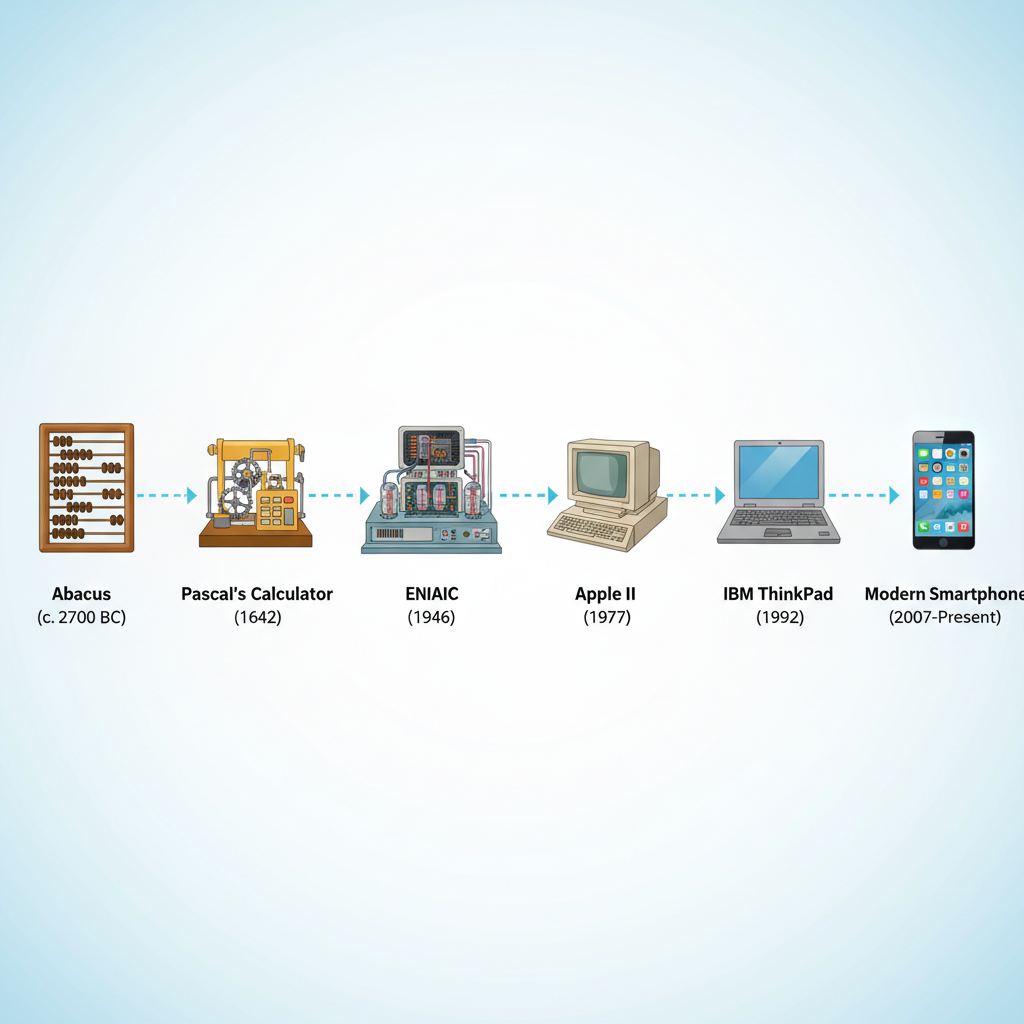
One of the earliest calculating tools was the abacus. Imagine a wooden frame with beads strung on wires. By sliding these beads, people could perform addition, subtraction, and even more complex math. It was like a very basic, physical calculator!
Mechanical Marvels: Gears and Levers
As humans got more inventive, they started building machines that could calculate. In the 17th century, a scientist named Blaise Pascal invented a machine with gears and dials that could add and subtract. Think of it like a very fancy, mechanical cash register. Later, Gottfried Wilhelm Leibniz improved on this idea, creating a machine that could also multiply and divide. These were the first steps towards automated calculation.
Chapter 2: The Birth of the Modern Computer - Dreams of Automation
The idea of a machine that could do more than just simple calculations started to take hold. People dreamed of machines that could follow a set of instructions, almost like a recipe.
Charles Babbage and the Analytical Engine
In the 19th century, a brilliant mathematician named Charles Babbage is often called the "father of the computer." He designed a machine called the Analytical Engine. This machine was incredibly advanced for its time. It had a "mill" (like a processor), a "store" (like memory), input devices (like a keyboard), and output devices (like a printer). It was designed to be programmable, meaning it could follow a list of instructions. While Babbage never fully built it, his ideas were revolutionary. Think of it like designing a car on paper, knowing all the parts it would need, even if you couldn't build it yet.
Ada Lovelace: The First Programmer?
Working with Babbage, Ada Lovelace understood the potential of the Analytical Engine. She wrote notes about it, including what is considered the first algorithm intended to be processed by a machine. She realized that computers could do more than just crunch numbers; they could manipulate symbols and even create music or art if given the right instructions! She was like the first person to write a recipe for the machine, showing it what delicious calculations it could make.
Chapter 3: The Electronic Age - Computers Get Real!
The 20th century brought incredible technological leaps, especially with the invention of electricity and electronics. This allowed for much faster and more powerful calculating machines.
Early Electronic Computers: Big and Powerful
During World War II, the need for faster calculations for things like code-breaking and ballistics became urgent. This led to the development of the first large-scale electronic computers:
- ENIAC (Electronic Numerical Integrator and Computer): Built in the 1940s, ENIAC was massive! It filled a huge room, weighed about 30 tons, and used thousands of vacuum tubes. Vacuum tubes were like light bulbs that could control electrical signals. Imagine a whole room filled with giant, glowing light bulbs that were smarter than normal ones. ENIAC was used for complex calculations, but reprogramming it was a tedious process, like rewiring a whole house every time you wanted to change something.
- The Transistor Revolution: Smaller, Faster, Cooler
Vacuum tubes were bulky, hot, and prone to breaking. The invention of the transistor in the late 1940s was a game-changer. Transistors are tiny semiconductor devices that can amplify or switch electronic signals. They were much smaller, used less power, and were more reliable than vacuum tubes. Think of transistors as tiny, super-efficient switches that replaced those giant, power-hungry light bulbs. This allowed computers to shrink dramatically in size and become much more efficient.
Chapter 4: The Integrated Circuit and Beyond - The Computer on a Chip
The next big leap was the invention of the integrated circuit (IC), also known as a microchip. Instead of connecting individual transistors on a board, engineers figured out how to etch many transistors and other electronic components onto a single, small piece of silicon.
The Microchip: A City of Transistors
Imagine cramming thousands, then millions, and now billions of those tiny transistor switches onto a fingernail-sized piece of silicon. That's what a microchip does! This invention made computers incredibly powerful, compact, and affordable. It's like going from a single tiny house (transistor) to a whole bustling city (microchip) on a tiny plot of land.
The Personal Computer (PC) Revolution
With the advent of microchips, computers became small enough and cheap enough for everyday people and businesses to own. The 1970s and 1980s saw the rise of personal computers like the Apple II and the IBM PC. Suddenly, computers weren't just for scientists and governments; they were on desks in homes and offices. This was like going from only seeing a few giant buses (mainframes) to everyone having their own car (personal computer).
Chapter 5: The Internet and the Future - Connecting the World
Computers continued to evolve at an astonishing pace. The development of the internet allowed these powerful machines to talk to each other, creating a global network of information.
From Arpanet to the World Wide Web
The internet started as a way for researchers to share information. It grew and grew, eventually leading to the World Wide Web, which made information accessible through websites and browsers. Think of the internet as a massive highway system connecting all the computers, and the World Wide Web as the easy-to-navigate streets and buildings on those highways.
Mobile Computing and Beyond
Today, computers are everywhere! They are in our phones, our watches, our cars, and even our refrigerators. This is called mobile computing. The evolution continues with advancements in artificial intelligence (AI), cloud computing, and quantum computing. We are living in an exciting time where computers are becoming even more integrated into our lives and capable of doing things we only dreamed of just a few decades ago.
Conclusion
From simple counting tools to powerful devices that connect the world, the history of computers is a testament to human ingenuity. We've seen how each invention, from the abacus to the microchip, built upon the last, leading to the incredible technology we have today. The journey is far from over, and it will be fascinating to see what the future holds!
Keep learning, free
Create a free Syllabax account to unlock practice questions and games for this topic.
Visual Learning Enhanced! 🚀
To help you master this topic, we use Advanced Syllabax AI to generate detailed diagrams and visual models.
Note on Visuals: The AI sometimes makes spelling errors in image labels. Please refer to the lesson text for the correct terminology.