Learning Journey
Watch this topic in 60 seconds
Free preview · Lesson 1
Understanding Number patterns (Patterns in Numbers)
Discovering Number Patterns!
Hello, young mathematicians! Today, we're going on an exciting adventure to explore something super cool called Number Patterns. Imagine you're a detective, and numbers are giving you clues to solve a mystery. That's exactly what we'll be doing!
What is a Number Pattern?
A number pattern is like a secret code or a special rule that numbers follow. When you see a list of numbers, and they seem to be jumping or skipping in a certain way, you're probably looking at a pattern! It's like a sequence of numbers that repeat or grow in a predictable way.
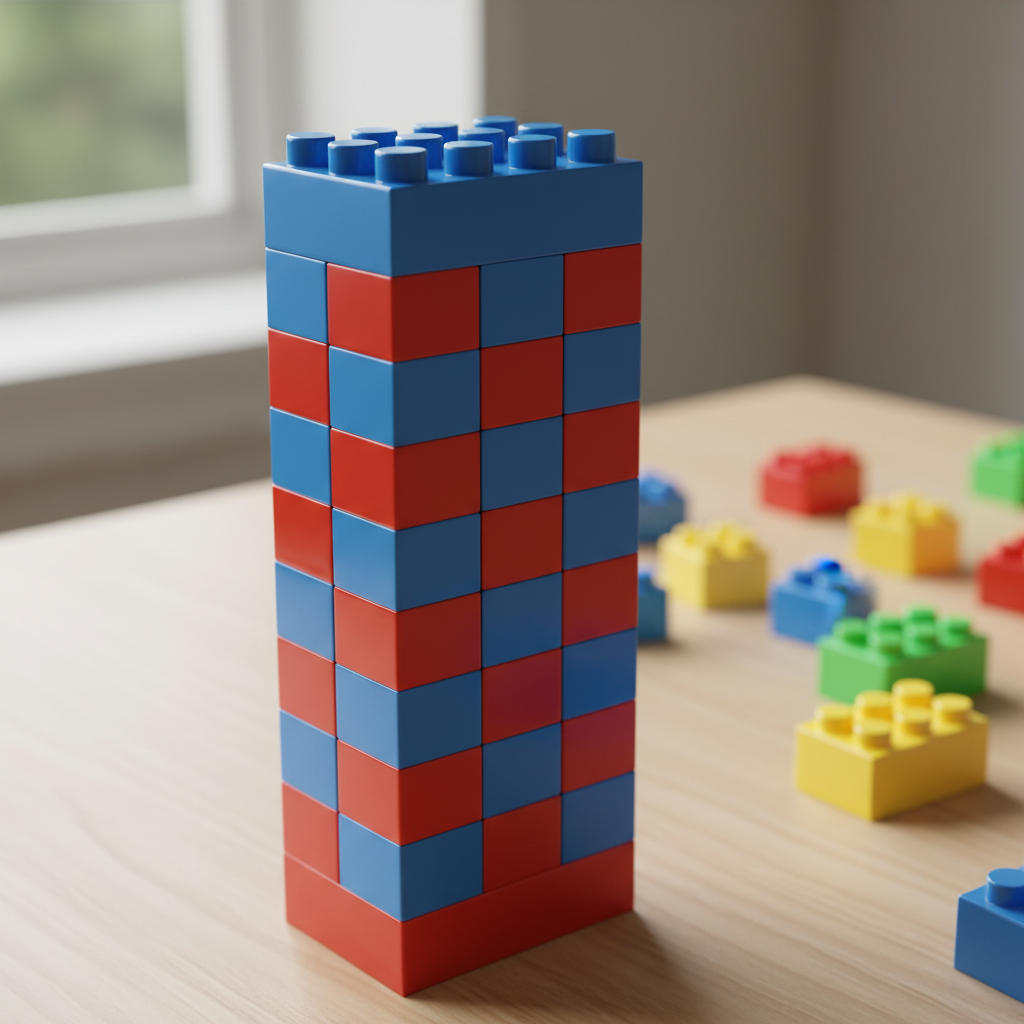
Think about building with LEGOs. If you have a pile of red bricks and then a pile of blue bricks, and you start building a wall by placing one red brick, then one blue brick, then one red, then one blue... What comes next? A red brick, right! That's a pattern: Red, Blue, Red, Blue, Red...
Looking for Clues: The Rule!
Every pattern has a rule. This rule tells us how to get from one number to the next. Sometimes the rule is to add a number, sometimes it's to subtract a number, and sometimes it can be to multiply or divide! Let's look at some examples:
Adding Patterns
This is like getting more candies from your friend. Each time, they give you the same number of candies. Let's say your friend gives you 2 candies every day.
- Day 1: You have 0 candies.
- Day 2: Your friend gives you 2. You have 0 + 2 = 2 candies.
- Day 3: Your friend gives you 2 more. You have 2 + 2 = 4 candies.
- Day 4: Your friend gives you 2 more. You have 4 + 2 = 6 candies.
The pattern of candies is: 0, 2, 4, 6... The rule here is add 2 each time. We can see that each number is 2 more than the number before it.
Subtracting Patterns
This is like eating cookies from a jar. Each time, you eat the same number of cookies. Imagine you have 10 cookies, and you eat 1 cookie every hour.
- Hour 1: You have 10 cookies.
- Hour 2: You eat 1. You have 10 - 1 = 9 cookies.
- Hour 3: You eat 1 more. You have 9 - 1 = 8 cookies.
- Hour 4: You eat 1 more. You have 8 - 1 = 7 cookies.
The pattern of cookies is: 10, 9, 8, 7... The rule here is subtract 1 each time. Each number is 1 less than the number before it.
Growing Patterns (Multiplication)
Sometimes patterns grow much faster! Imagine you have a special plant that doubles its leaves every day.
- Day 1: The plant has 1 leaf.
- Day 2: The leaves double. You have 1 x 2 = 2 leaves.
- Day 3: The leaves double again. You have 2 x 2 = 4 leaves.
- Day 4: The leaves double once more. You have 4 x 2 = 8 leaves.
The pattern of leaves is: 1, 2, 4, 8... The rule here is multiply by 2 each time. This is a growing pattern because the numbers get bigger quickly!
Shrinking Patterns (Division)
This is the opposite of growing. Imagine you have a big pizza, and you cut it into fewer slices each time.
- Start: You have 16 slices.
- Cut 1: You cut the pizza in half. You have 16 ÷ 2 = 8 slices.
- Cut 2: You cut those slices in half. You have 8 ÷ 2 = 4 slices.
- Cut 3: You cut those slices in half. You have 4 ÷ 2 = 2 slices.
The pattern of slices is: 16, 8, 4, 2... The rule here is divide by 2 each time. This is a shrinking pattern because the numbers get smaller.
Why are Patterns Important?
Patterns are everywhere! They help us understand the world around us. When we can spot a pattern, we can predict what might happen next. This is super useful in math and in real life.
Think about the days of the week: Monday, Tuesday, Wednesday, Thursday, Friday, Saturday, Sunday. Then it starts all over again! That's a pattern. Or think about the seasons: Spring, Summer, Fall, Winter. They happen in a pattern too.
Learning to find number patterns is like learning a secret language that numbers speak. Once you understand the language, you can solve lots of fun puzzles!
Let's Practice Being Pattern Detectives!
To find the rule of a pattern, look at the first few numbers and ask yourself:
- How do I get from the first number to the second?
- How do I get from the second number to the third?
- Does the change seem to be the same each time?
- Is the number getting bigger (adding or multiplying) or smaller (subtracting or dividing)?
Example 1: What comes next?
Look at this pattern: 3, 6, 9, 12, ...
How do we get from 3 to 6? We add 3 (3 + 3 = 6).
How do we get from 6 to 9? We add 3 (6 + 3 = 9).
How do we get from 9 to 12? We add 3 (9 + 3 = 12).
The rule is add 3. So, what comes after 12? We add 3: 12 + 3 = 15!
Example 2: What is the rule?
Look at this pattern: 20, 18, 16, 14, ...
How do we get from 20 to 18? We subtract 2 (20 - 2 = 18).
How do we get from 18 to 16? We subtract 2 (18 - 2 = 16).
How do we get from 16 to 14? We subtract 2 (16 - 2 = 14).
The rule is subtract 2. The next number would be 14 - 2 = 12.
Keep practicing, and you'll become a master pattern detective in no time!
Keep learning, free
Create a free Syllabax account to unlock practice questions and games for this topic.
Visual Learning Enhanced! 🚀
To help you master this topic, we use Advanced Syllabax AI to generate detailed diagrams and visual models.
Note on Visuals: The AI sometimes makes spelling errors in image labels. Please refer to the lesson text for the correct terminology.