Infectious vs non-infectious[BIOLOGY]
Watch this topic in 60 seconds
Free preview · Lesson 1
Understanding Infectious vs non-infectious[BIOLOGY]
Understanding Diseases: Infectious vs. Non-Infectious
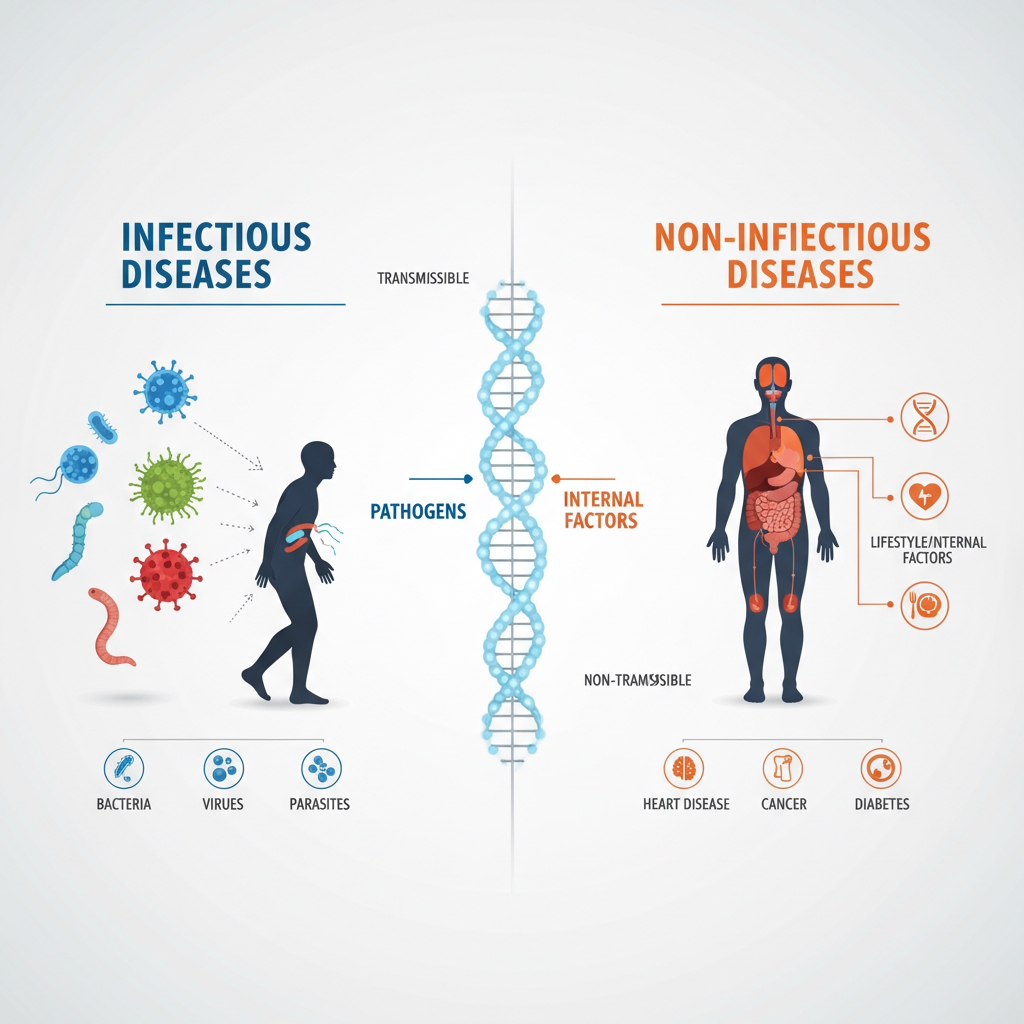
Have you ever felt under the weather? Maybe a runny nose, a cough, or just generally unwell? What makes us sick? In biology, we categorize illnesses into two main groups: Infectious Diseases and Non-Infectious Diseases. Understanding the difference is like knowing if your car trouble is due to a flat tire (something from outside affecting it) or a faulty engine part (something internal going wrong).
Part 1: The Case of the Invaders – Infectious Diseases
Imagine your body as a bustling city. Everything is working smoothly, people (your cells) are going about their business, and the systems (your organs) are running perfectly. Then, suddenly, tiny unwanted visitors, like mischievous little villains, sneak in! These tiny villains are what cause Infectious Diseases.
What are Infectious Diseases?
Infectious diseases are illnesses caused by tiny living things called pathogens. Think of pathogens as microscopic troublemakers. When these pathogens enter your body, they can multiply and disrupt your body's normal functions, making you feel sick. The key thing about infectious diseases is that they can usually be passed from one person to another, or even from animals to people, or through the environment.
Who are These Pathogens? Meet the Gang!
There are different types of pathogens, each with its own way of causing trouble:
- Bacteria: These are single-celled organisms, some of the smallest living things on Earth! While many bacteria are good for us (like the ones in your gut that help digest food), some are harmful. They're like tiny factory workers; some produce helpful products, others produce toxins that damage your body. For example, strep throat is caused by bacteria.
- Viruses: Even smaller than bacteria, viruses are like tiny parasites. They can't live or reproduce on their own. Instead, they act like hijackers, invading your body's cells and forcing those cells to make more viruses. It's like a computer virus taking over your computer's programs! Examples include the common cold, the flu, and chickenpox.
- Fungi: These include yeasts and molds. Fungi are often found in moist, warm environments. They're like unwanted weeds that can grow on your skin (causing things like athlete's foot) or even inside your body. Most fungal infections are not serious, but some can be.
- Parasites: These are organisms that live on or in another organism (called the host) and get their food from or at the expense of their host. Think of them as uninvited house guests who eat all your food and don't pay rent! They can range from microscopic creatures like those that cause malaria, to larger organisms like worms.
How Do They Spread? (The "Contagious" Part)
Infectious diseases are often called "contagious" because they can spread. Imagine trying to stop a secret from spreading; it can go many ways!
- Direct Contact: This is like a high-five or a handshake. Pathogens can spread when an infected person touches someone else, or through contact with body fluids (like blood or saliva). E.g., kissing, touching.
- Indirect Contact: This is like leaving a message on a sticky note. Pathogens can survive for a short time on surfaces like doorknobs, toys, or desks. If you touch an infected surface and then touch your mouth, nose, or eyes, you can pick up the germs. E.g., touching a sneeze-covered doorknob.
- Airborne Transmission: Imagine a tiny cloud of invisible particles! When an infected person coughs, sneezes, or even talks, they can release tiny droplets containing pathogens into the air. If you breathe in these droplets, you can get sick. E.g., the flu, colds.
- Vector-borne: Sometimes, an animal or insect can carry pathogens from one person to another. These carriers are called "vectors." Think of a mosquito carrying malaria; it's like a tiny messenger delivering a harmful package. E.g., mosquitoes spreading malaria.
- Contaminated Food or Water: Eating food or drinking water that contains pathogens can make you sick. This is like eating a spoiled meal; it looks fine, but it has harmful bacteria. E.g., food poisoning.
 ⚠️ This picture may have spelling mistakes. Trust the words in the lesson.
Part 2: The Inside Job – Non-Infectious Diseases
Now, let's go back to our city analogy. Sometimes, problems don't come from invaders. Instead, they come from within the city itself, or from the environment the city is built in. These are Non-Infectious Diseases.
What are Non-Infectious Diseases?
Non-infectious diseases are illnesses that are not caused by pathogens. This means they cannot be spread from person to person like a cold or the flu. Instead, they often result from a combination of genetics, lifestyle choices, environmental factors, or the natural aging process. Think of it as a car's engine failing due to manufacturing defects, poor maintenance, or just old age, rather than someone sabotaging it.
What Causes Them? (The Root of the Problem)
Since there are no pathogens to blame, what causes these diseases?
- Genetics (Your Body's Blueprint): Sometimes, the instructions (genes) you inherit from your parents have a tiny glitch or a predisposition to certain conditions. It's like your body's instruction manual having a slight typo from the beginning. For example, some forms of diabetes or heart disease can have a genetic link.
- Lifestyle Choices (How You Live): The decisions you make every day can greatly impact your health. Things like what you eat, how much you exercise, whether you smoke, or how much sleep you get can contribute to non-infectious diseases. This is like the wear and tear on your car if you don't do regular oil changes or drive recklessly. E.g., Type 2 Diabetes (linked to diet), heart disease (linked to diet and exercise), some cancers (linked to smoking).
- Environmental Factors (Your Surroundings): The world around us can also play a role. Exposure to pollution, toxic chemicals, or certain allergens can trigger or contribute to non-infectious conditions. This is like the air quality or road conditions affecting your car. E.g., asthma (triggered by allergens or pollution), some cancers (linked to chemical exposure).
- Aging (Natural Wear and Tear): As our bodies get older, certain parts naturally start to wear down or function less efficiently. This is a normal part of life and can lead to conditions like arthritis or some forms of heart disease. It's like an old car eventually needing more repairs just because of its age.
Examples of Non-Infectious Diseases:
You probably know many of these:
- Diabetes: A condition where your body can't properly use sugar (glucose) for energy.
- Heart Disease: A broad term for various conditions affecting the heart, often related to blood vessels.
- Cancer: Caused by uncontrolled growth of abnormal cells in the body.
- Asthma: A chronic lung condition that makes breathing difficult.
- Allergies: An immune system reaction to a substance that is usually harmless (like pollen or peanuts).
The Big Picture: Why It Matters
Knowing the difference between infectious and non-infectious diseases is super important! It helps us:
- Prevent Illnesses: For infectious diseases, we know to wash our hands, get vaccinated, and avoid sick people. For non-infectious diseases, we focus on healthy lifestyles, managing stress, and understanding our genetic risks.
- Treat Illnesses: Doctors use different approaches. Antibiotics for bacterial infections, antiviral medicines for some viruses. For non-infectious diseases, treatments might involve lifestyle changes, medications to manage symptoms, or surgery.
So, next time you hear about a disease, you'll have a better idea if it's a battle against tiny invaders or a challenge from within your own amazing body!
Keep learning, free
Create a free Syllabax account to unlock practice questions and games for this topic.
Visual Learning Enhanced! 🚀
To help you master this topic, we use Advanced Syllabax AI to generate detailed diagrams and visual models.
Note on Visuals: The AI sometimes makes spelling errors in image labels. Please refer to the lesson text for the correct terminology.