Importance of sense organs (Human Body)
Watch this topic in 60 seconds
Free preview · Lesson 1
Understanding Importance of sense organs (Human Body)
The Amazing Five Senses: How Our Body Helps Us Explore!
Hello, young explorers! Have you ever wondered how you know when your favorite cookie is baking, or how you hear your friend's laugh, or how you see a beautiful rainbow? It's all thanks to some very special helpers in your body called sense organs! These organs are like super cool tools that help us learn all about the world around us. Let's find out about them!
What are Sense Organs?
Imagine your body is a fantastic spaceship, and your sense organs are the windows and sensors that help you navigate and understand everything outside. We have five main sense organs, and each one has a super important job. They help us see, hear, smell, taste, and touch. These are our five amazing senses!
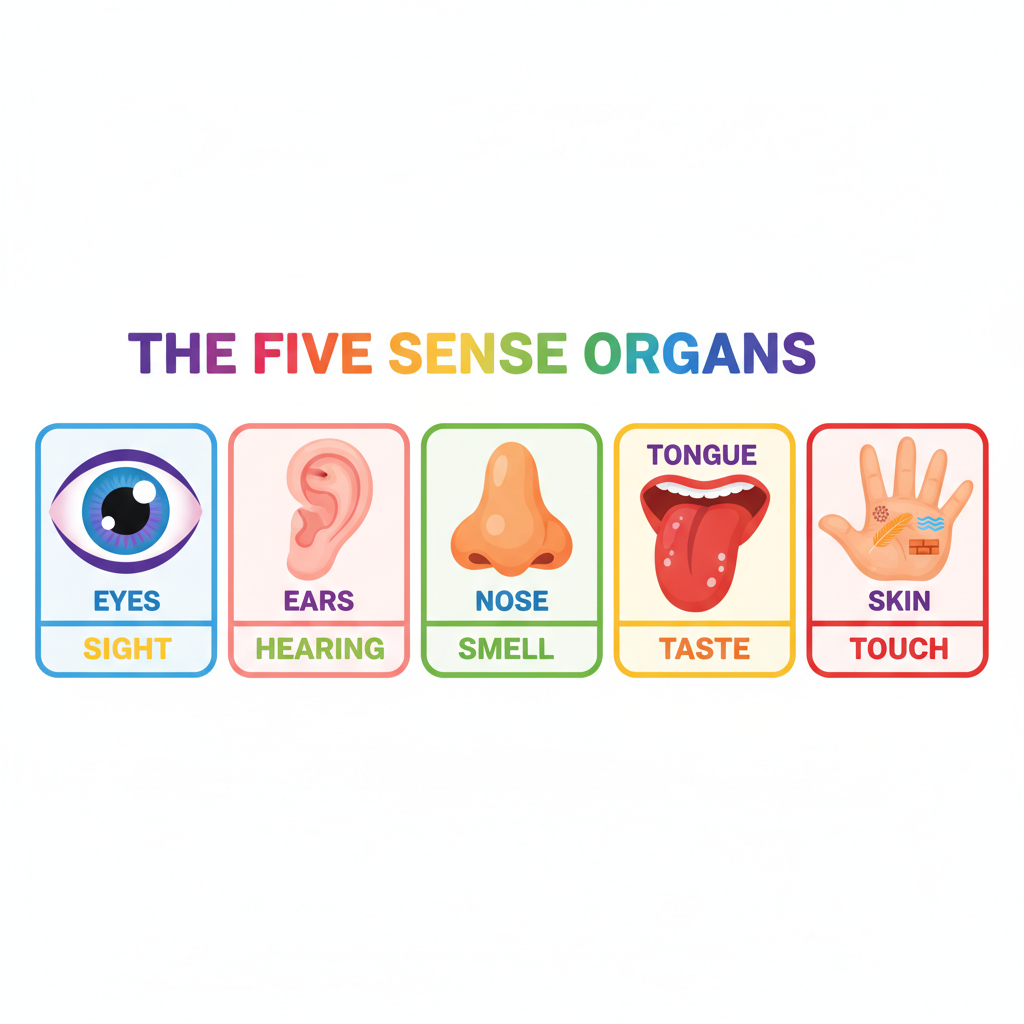
1. Our Wonderful Eyes: The Sense of Sight!
Have you ever played a game of 'I spy with my little eye'? Your eyes are truly wonderful! They are the sense organs for sight. Our eyes are like tiny, super-fast cameras that take pictures of everything around us. They help us see colors, shapes, how big or small things are, and if it's bright or dark.
- What they do: Your eyes help you see the bright yellow sun, the green leaves on a tree, the words in your storybook, and your friend's smiling face.
- Analogy: Think of your eyes as two very special cameras that are always on, taking pictures and sending them to your brain!
- Why they are important: Without our eyes, it would be hard to read books, watch cartoons, ride a bike, or even know who is walking towards us! They help us stay safe by seeing dangers like a car coming or a step we might trip on.
- Taking care of your eyes: Don't look directly at the sun! It's too bright and can hurt your eyes. Make sure to read in good light and rest your eyes when they feel tired.
2. Our Clever Ears: The Sense of Hearing!
What's that sound? Is it a bird singing, a bell ringing, or someone calling your name? Your ears are the sense organs for hearing. They are like very sensitive microphones that pick up all the sounds around you, from a whisper to a loud drum!
- What they do: Your ears help you listen to music, hear your teacher's instructions, enjoy stories your parents tell, and know when someone is talking to you.
- Analogy: Your ears are like two amazing microphones always listening to the world's symphony of sounds!
- Why they are important: Hearing helps us communicate with others, enjoy music, and also keeps us safe by letting us hear warnings, like a fire alarm or a car horn.
- Taking care of your ears: Don't put anything inside your ears, not even your fingers! Listen to music at a soft volume. If sounds are too loud, they can hurt your ears.
3. Our Amazing Nose: The Sense of Smell!
Mmm, what's that delicious smell coming from the kitchen? Is it pizza? Your nose is the sense organ for smell. It has tiny detectors inside that can tell the difference between thousands of different scents!
- What it does: Your nose helps you smell yummy cookies baking, fresh flowers in the garden, and even helps you know if something has gone bad, like spoiled milk.
- Analogy: Your nose is like a super-smart smell detective, always sniffing out clues about what's around you!
- Why it is important: Smell helps us enjoy our food even more. It also helps us stay safe by warning us of danger, like the smell of smoke from a fire or a gas leak.
- Taking care of your nose: Don't put tiny objects up your nose. If your nose feels stuffy, gently blow it into a tissue.
4. Our Tasteful Tongue: The Sense of Taste!
Yum! This ice cream is so sweet! Or maybe you bit into a sour lemon? Your tongue is the sense organ for taste. It has tiny bumps called taste buds that can tell you if something is sweet, sour, salty, or bitter.
- What it does: Your tongue helps you enjoy your favorite foods! It can taste the sweetness of a cake, the saltiness of popcorn, the sourness of a pickle, and sometimes the bitterness of certain vegetables.
- Analogy: Your tongue is like a food critic or a taste testing expert, giving you all the details about what you're eating!
- Why it is important: Tasting helps us enjoy our meals and drinks. It also helps us avoid eating things that might be bad for us, because sometimes bad food tastes bad!
- Taking care of your tongue: Brush your tongue gently when you brush your teeth to keep it clean. Be careful not to eat food that is too hot, as it can burn your tongue.

5. Our Sensitive Skin: The Sense of Touch!
Brrr, it's cold outside! Or, ahh, this blanket is so soft. How do you know? It's your skin! Your skin is the sense organ for touch, and it's the largest organ in your body! It covers you from head to toe and helps you feel everything.
- What it does: Your skin helps you feel if something is hot or cold, soft or hard, smooth or rough, tickly or prickly. It also tells you if something is hurting you, like a tiny prick from a thorn.
- Analogy: Your skin is like a giant, super-sensitive blanket that covers your whole body, feeling everything it touches!
- Why it is important: Touch helps us feel loving hugs, play with toys, and enjoy different textures. It also protects us by warning us of danger, like feeling that something is too hot to touch, or feeling pain if we get hurt so we can be careful next time.
- Taking care of your skin: Keep your skin clean by taking baths or showers. Protect it from the sun by wearing sunscreen or hats. Be gentle with your skin!
Why Are All Five Senses So Important Together?
Imagine trying to play a game without being able to see the ball, hear your friends, or feel the ground under your feet! Our sense organs work together like a team to give us a complete picture of the world. They help us:
- Learn: We learn about new things by seeing them, hearing about them, and touching them.
- Stay Safe: Our senses warn us about dangers like fire (smell smoke, feel heat), traffic (see cars, hear horns), or bad food (smell it, taste it).
- Enjoy Life: They let us enjoy beautiful sights, wonderful music, delicious food, pleasant smells, and comforting touches.
So, the next time you see a butterfly, hear a bird, smell a flower, taste your lunch, or feel a warm hug, remember to thank your amazing sense organs for helping you experience all the wonders of the world!
Keep learning, free
Create a free Syllabax account to unlock practice questions and games for this topic.
Visual Learning Enhanced! 🚀
To help you master this topic, we use Advanced Syllabax AI to generate detailed diagrams and visual models.
Note on Visuals: The AI sometimes makes spelling errors in image labels. Please refer to the lesson text for the correct terminology.